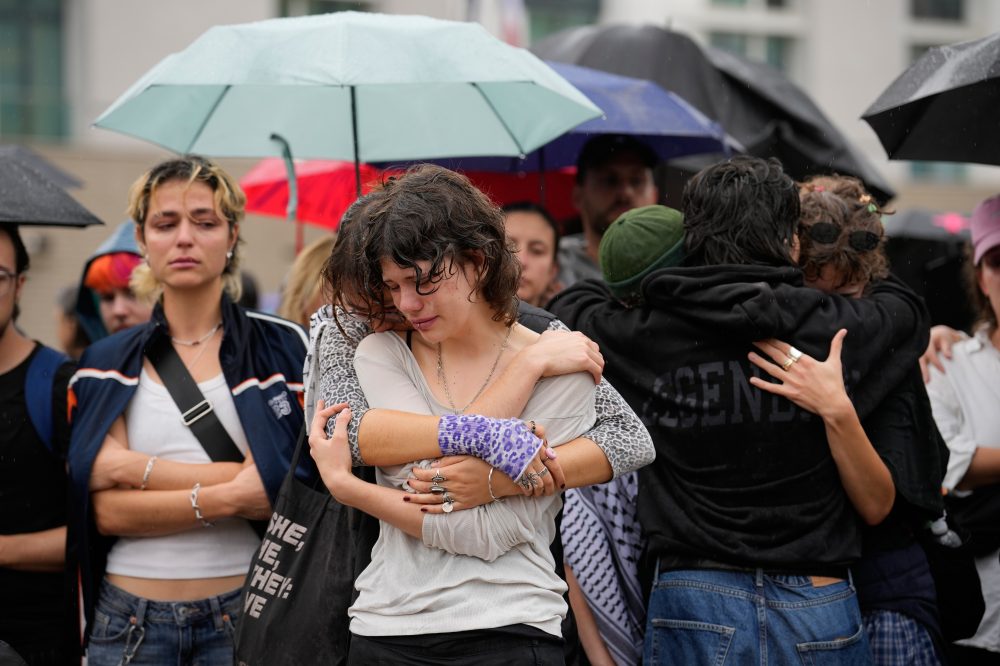

Berliners gathered to grieve Monday following a devastating attack near the city’s Pride festival, as growing concerns emerged over why the suspect had been allowed to walk free despite a prior conviction connected to the Islamic State group.
The suspect, 21-year-old Abdul Ballout, a German citizen, was killed after a manhunt that stretched nearly 24 hours. He was suspected of driving a van into a crowd near the Pride festival on Saturday night before allegedly attacking others with a machete. Authorities are treating the incident as an extremist terror attack.
One woman lost her life in the attack, and 29 others were injured.
On Monday, Chancellor Friedrich Merz called for an explanation of how the attack could have been prevented. Prosecutors confirmed that Ballout had previously attempted to join the Islamic State group.
“We must do everything to protect people in Germany as best possible from such criminals, from dangerous people who for whatever reason can’t be taken into custody,” Merz stated.
Ballout was born in Germany and has Lebanese roots. According to Berlin prosecutors, he traveled to Lebanon in 2025 with the intention of crossing into Syria to join the Islamic State. He made contact with several individuals believed to be members of the group, or at least people he assumed to be members.
He was arrested in Lebanon and convicted by a military court to a three-month prison sentence for charges including incitement to religious and sectarian conflict. After completing that sentence, he returned to Germany, where he was taken into custody at the Berlin airport.
In May, a juvenile court in Berlin found Ballout guilty of preparing a serious act of violence against the state, distributing Islamic State propaganda on Instagram, and additional charges. He was handed a sentence of one year and ten months in youth custody — a ruling that Berlin prosecutors subsequently appealed.
In Germany, individuals between the ages of 18 and 21 can be tried under the juvenile justice system.
Officials stated that Ballout had received a suspended sentence, but Berlin courts clarified that his sentence had not been formally suspended — rather, they had been in the process of evaluating whether it should be.
The court explained that Ballout was released because his pretrial detention — which had been unusually lengthy — was no longer justified, and he did not meet the legal criteria related to flight risk, likelihood of reoffending, or other relevant factors.
Several German officials criticized the court’s decision, pledging to investigate how Ballout ended up free and whether the juvenile sentencing system, which some view as too lenient, requires reform.
Interior Minister Alexander Dobrindt, speaking with public broadcaster ZDF, said it made no sense that Ballout was on the streets given his conviction and history of IS support. “You can assume that it certainly would have made sense to put this person in custody,” he said.
Berlin Mayor Kai Wegner, speaking with regional broadcaster RBB, said he did not want to undermine the independence of the court system, but added that in this case, “words fail me.”
As part of his release conditions, Ballout was ordered to participate in a deradicalization program for high-risk offenders. He had already been evaluated twice by the Berlin-based Violence Prevention Network, an organization that works with individuals at risk of right-wing extremism and Islamism. The group defines deradicalization as successfully stepping away from extremist ideology and rejecting violence.
Ballout was scheduled to meet with the organization’s staff on Monday for his third and final evaluation, according to Cornelia Lotthammer, the group’s public relations director.
Staff members had planned to inform the court that Ballout was not a suitable candidate for their program, because he appeared to be deliberately portraying himself as non-threatening and non-extremist in order to avoid the deradicalization process.
“Normally high-risk people are very convinced of themselves and of their ideology, and they would propagate it within those sessions,” Lotthammer said. “And then it’s easier to work with them. This is not a typical incident.”
Lotthammer said Ballout seemed to be calculating what the staff wanted to hear. “They could see that he is a problem. I mean, everybody knew that he was a high-risk person,” she said. “But still, if he does not work together with our colleagues, then we can’t do anything.”
She also noted: “But nobody would have said, ‘He’s not a threat, just let him go.’”
Lotthammer said there was no indication Ballout was planning an attack, and that if any such signs had been present, the staff would have alerted law enforcement. She said he would have been required to find another program to work with, or potentially returned to prison.
She declined to weigh in on whether the organization believed Ballout should have remained in detention, saying that decision fell within the court’s authority.
Three German states, including Berlin, are holding elections in September. The attack is expected to become a flashpoint in campaign rhetoric, with concerns that anti-immigrant sentiment could give a boost to far-right political forces.
A series of deadly attacks carried out by immigrants was among the factors that shaped Germany’s 2025 national election, in which the far-right Alternative for Germany party, known as AfD, came in second place.
The AfD has been a vocal critic of the government’s immigration policies and has built support around broader public frustrations. In the eastern state of Saxony-Anhalt, the party is hoping to secure its first state governor.
Kristin Brinker, the AfD’s local leader in Berlin, posted on X questioning how an Islamic State supporter was able to move freely throughout Germany after being in custody. “Who bears responsibility for that in the city government?” she wrote.