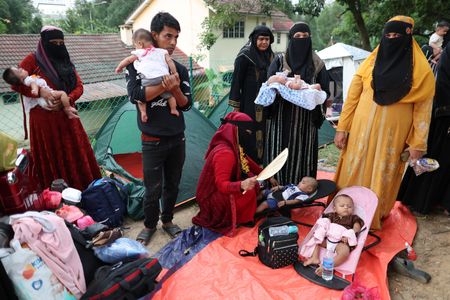

Malaysian authorities arrested more than 100 Rohingya Muslim asylum seekers Monday evening after the group assembled outside the United Nations refugee agency headquarters in Kuala Lumpur hoping to find protection.
Witnesses at the scene reported that all of the refugees present outside the UNHCR building were loaded into four police trucks along with their belongings at approximately 8:30 p.m. local time. An unidentified police official told reporters the group was being transported to police headquarters in the capital for further processing.
The refugees — among them women and children — said they had been forced out of their homes by local residents in Penang, a state in northern Malaysia, on Sunday. They boarded overnight buses to reach Kuala Lumpur, where they hoped to get help from the UNHCR regarding resettlement options.
The forced departures from their homes took place against a backdrop of increasing online hate speech and false information targeting the Rohingya community since May. That environment has contributed to growing harassment of the group, including widespread closures of schools serving Rohingya children.
Malaysian Prime Minister Anwar Ibrahim addressed the situation Monday, saying the congregation outside the UNHCR building had stirred public concern. He cautioned that anyone found without proper documentation would face detention by immigration officials.
“No one has the right to take over any part of the city,” he stated in a video he shared on social media.
According to figures from the UNHCR’s website, roughly 126,000 Rohingya Muslims were registered with the agency in Malaysia as of the end of February. However, human rights organizations say a significant number of additional Rohingya remain unregistered.
One refugee, Syed Kasim, said he had arrived at the UNHCR building in the early morning hours Monday along with his wife and children. He said the group had not received any help from any authority throughout the ordeal.
“Nobody helped (with) our problem, nobody understands,” he said, noting that he had been living in Malaysia for 20 years.
The UNHCR’s Kuala Lumpur office did not respond immediately to a request for comment. However, the agency told Reuters on Friday that it was troubled by the surge in online hate speech, false narratives, and dehumanizing content aimed at Rohingya and other refugees, warning such content could encourage real-world harassment and discrimination.
Although Malaysia has not signed the United Nations refugee convention and treats asylum seekers as undocumented migrants, the Muslim-majority nation has historically been considered a refuge for Rohingya fleeing violence and persecution in largely Buddhist Myanmar.
That perception began to shift during the COVID-19 pandemic, when Rohingya refugees faced accusations of spreading the virus, violating cultural norms, and taking jobs from Malaysian citizens.