
The United States and Iran are exchanging airstrikes on a daily basis in a struggle for dominance over the Strait of Hormuz, and neither side appears willing to stand down — exposing the limits of President Donald Trump’s strategy of escalating military pressure to force Iran into submission.
Although the Trump administration has expressed willingness to negotiate, Iran has refused to relinquish its hold on the vital oil shipping lane in the Persian Gulf. That standoff is raising serious questions about where the conflict goes from here. The escalating violence has already shattered an interim ceasefire agreement, resulted in additional American military deaths, and pushed gasoline prices higher across the country — all of which spell trouble for Republican lawmakers looking ahead to the midterm elections.
Even as faint hopes for diplomacy persist, Trump issued a stark warning: “Every time Iran kills an American Soldier” going forward, “they will pay for that killing many times over.”
The military announced it is investigating the death of Sgt. Michael Emmanuel Swinton, 30, of Fayetteville, North Carolina, who died Sunday during a controlled detonation of an Iranian drone at an air base in Irbil. The Army said Swinton will posthumously receive a Bronze Star, Purple Heart, and Combat Action Badge, and will be promoted to the rank of staff sergeant. He had enlisted in the Army in 2017 and was assigned to the 55th Air Defense Artillery Regiment, 108th Air Defense Artillery Brigade, based out of Fort Bragg.
Two additional U.S. Army soldiers were killed in Jordan on Friday while defending against Iranian ballistic missile and drone attacks — the first American troop fatalities from direct Iranian fire since the earliest days of the war.
On the diplomatic front, Lebanon’s leader Joseph Aoun is scheduled to meet with Trump at the White House at 11 a.m. The visit comes as Lebanon and Israel are engaged in rare direct talks brokered by Washington, aimed at achieving lasting stability in Lebanon following months of fighting between Israel and Hezbollah, the Iran-backed militant organization. Lebanon is hoping the negotiations will result in Israeli forces pulling back from large portions of southern Lebanon and in support for the Lebanese military to take full control of areas previously dominated by Hezbollah fighters. The two countries announced a “framework agreement” on June 26 that laid out a plan for Israeli withdrawal and the disarmament of Hezbollah.
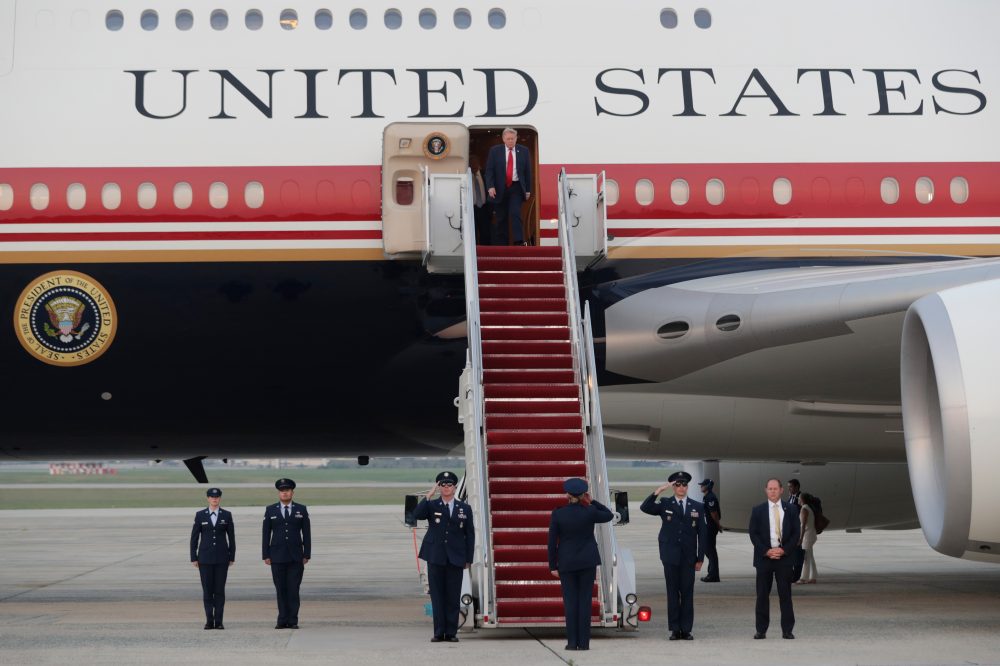
In a separate legal matter, the Justice Department has expanded its subpoenas for phone records connected to New York Times journalists, now targeting the mother of one reporter and the spouses of two others. Prosecutors are attempting to identify confidential sources behind stories about a Qatari-gifted Air Force One jet given to Trump. The Times’ legal team has moved to block the subpoenas, pointing out that the mother is a mental health professional with confidential client relationships and that one spouse serves as general counsel at a law firm. The Justice Department maintains that the reporters themselves are not targets and says it followed proper protocols. U.S. District Judge Arun Subramanian is set to hear arguments Thursday.
In another legal development, an appellate panel ruled 2-1 late Monday that there is “substantial” public interest in releasing audio recordings that former President Joe Biden has sought to keep private, though the majority said redactions could help protect his privacy. The court suspended its ruling until August 3 to give Biden time to consider a further appeal. The recordings were made by Mark Zwonitzer, who collaborated with Biden on two memoirs and interviewed him at his home in 2016 and 2017, before his presidency. Biden’s attorneys argue the conversations were candid, personal, and meant to stay private. The recordings were originally obtained by special counsel Robert Hur during his investigation into Biden’s handling of classified documents from his time as a senator from Delaware and as vice president. Republicans pushed for the release of the material after Hur chose not to bring charges against Biden.
On the battlefield, both the U.S. and Iran have been striking civilian infrastructure used by millions of people. Kuwait’s Electricity, Water and Renewable Energy Ministry reported that Iran hit desalination and power plants for a fourth consecutive day on Monday night, sparking fires and causing significant damage. Since approximately 90% of Kuwait’s drinking water comes from desalination, the attacks represent a direct threat to the survival of the small nation’s population. U.S. strikes have also hit electrical infrastructure inside Iran, and Iranian officials have accused American forces of targeting water facilities as well.
The U.S. military’s Central Command said Tuesday that its forces struck “Iranian military command centers, maritime capabilities, missile and drone launch sites and air defense systems,” releasing new footage of the bombings. “American forces remain postured and prepared to hold Iran accountable for unwarranted aggression toward civilian mariners seeking to freely and openly transit the strait,” the command stated. Iranian state media reported that explosions were heard across six different provinces.
Shipping through the strait has ground nearly to a halt. Lloyd’s List Intelligence reported that only three vessels passed through the waterway on Sunday. The British military’s United Kingdom Maritime Trade Operations center said a tanker was attacked early Tuesday in the strait off Oman, forcing the crew to abandon ship. Iran’s paramilitary Revolutionary Guard claimed responsibility for that attack as well as two others on ships in the waterway on Monday. The alternate route around Oman — which the U.S. military has been recommending to ships seeking to avoid Iranian control — was also the scene of a previously unreported attack, according to a separate UKMTO notice issued Tuesday.
Diplomatic activity continued Tuesday as an Iranian official traveled to Pakistan to meet with mediators in an effort to revive the collapsed interim agreement, even as fighting entered its tenth consecutive day. Iran’s Interior Minister Eskandar Momeni met with Pakistan’s army chief Field Marshal Asim Munir, according to two officials speaking anonymously about the closed-door talks, and later sat down with Prime Minister Shehbaz Sharif. Pakistan’s leadership has been intensifying efforts in recent days to bring both sides back to the negotiating table, though what a new deal might look like remains unclear.