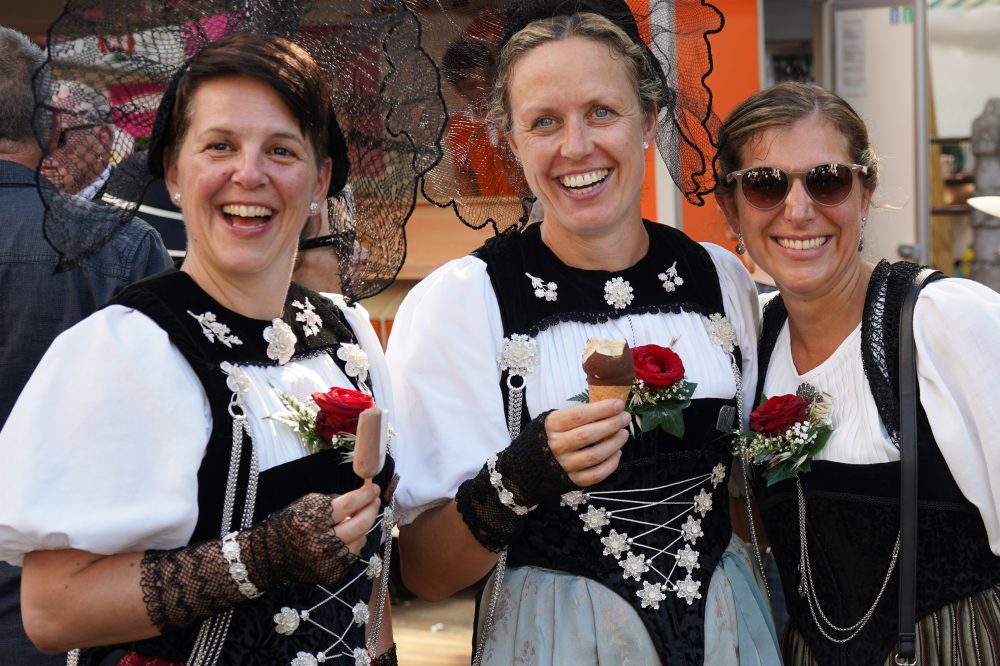

BASEL, Switzerland — When a brutal European heat wave sent temperatures soaring to around 39 degrees Celsius (102 degrees Fahrenheit) this past weekend, performers at Switzerland’s national yodeling festival found a creative way to stay cool — they took their rehearsals straight to the city’s fountains.
At one Basel fountain on Saturday, a folk band waded in and dangled their feet in the water while onlookers clapped along and dipped their hands into the flowing stream to escape the heat.
Throughout the three-day event, which ran from Friday through Sunday, singers and alphorn players spilled into the streets, and spontaneous yodeling broke out inside restaurants — catching diners off guard at first before they warmed up and joined in.
In the central Basel square of Petersplatz, seamstresses stood ready the entire festival to mend the traditional Alpine folk costumes worn by competitors whenever something tore or came undone.
But it was the fountain rehearsals that ended up defining this year’s gathering, as the city struggled through record-high temperatures.
The Eidgenössisches Jodlerfest — Switzerland’s national yodeling festival — drew roughly 12,000 performers and close to 200,000 visitors to Basel. It marked the first time the northwestern Swiss city had hosted the event since 1924.
The festival also carried added historical weight: Swiss yodeling was added to UNESCO’s Representative List of the Intangible Cultural Heritage of Humanity in December 2025, making this the first national gathering since the tradition received that international honor — something many Swiss people hold with considerable pride.
Swiss yodeling differs from the style most people associate with Austria and the Tyrol region. Rather than bright and melodic, the Swiss version is slower and more emotionally complex, rooted in the unique dialects of different regions.
One performer, Freddie Conquer, a member of Jodlerclub Echo Basel — one of the clubs organizing the festival — shared how the tradition has followed him across the globe. “I’ve always loved music, and I left here as a child. When I moved back to New Zealand, I wanted to stay connected to Swiss culture, so I joined a New Zealand-Swiss-Kiwi yodeling club,” he said.
Competitors took part in three categories during the festival: yodeling, alphorn playing, and flag-throwing.
The alphorn is a lengthy wooden instrument with deep roots in Alpine herding culture. Stretching more than 3 meters — or about 10 feet — in length, it was traditionally used to send sound echoing across mountain valleys. During the festival, those sounds rang through Basel’s streets instead. The instrument relies entirely on natural harmonics, with no valves or keys to assist the player.
Pierre-André Karlen, who was practicing on a school lawn, explained the challenge of playing it: “Everything is down to the mouthpiece, hearing the note in your head, and then using your lips to shape the pitch. The higher the note, the harder you have to blow.”
On Sunday morning, competitors gathered in front of the town hall, anxiously waiting to hear the competition results. Members of Jodlerklub Balfrin, from the town of Visp in the canton of Valais, nervously scanned the posted scores — then erupted in celebration after earning a perfect score of one, joining several other top-scoring groups.
The festival wrapped up with a closing parade through Basel’s historic old town, where members of Jodlerklub Muttenz rode by on a tractor to cheers from the crowd. Alphorn players marched behind them, their heavy instruments and thick traditional costumes no match for the heat — though the smiles on their faces never faded.