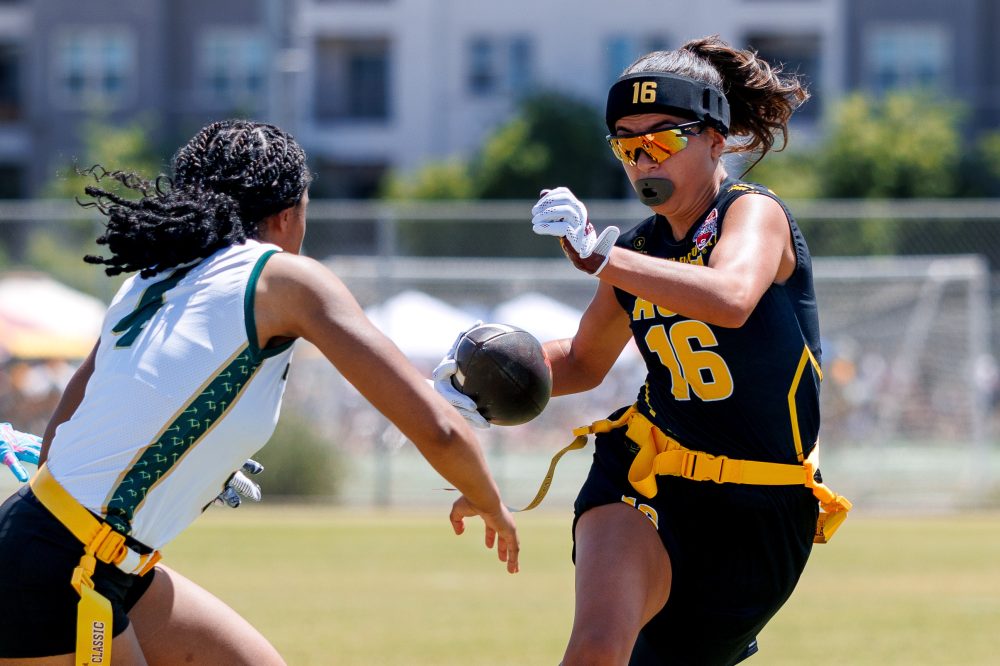

TEMPE, Ariz. — Arizona State receiver Rylen Bourguet raced along the sideline before executing a perfect fake curl route that left her defender behind. She caught the perfectly timed pass for a game-winning touchdown that capped off last week’s first-ever Fiesta Bowl Flag Football Classic.
The dramatic finish exemplified the excitement surrounding the inaugural tournament held on Arizona State’s campus, showcasing the rapid expansion of women’s flag football in NCAA Division I athletics.
Bourguet believes such thrilling moments will become increasingly frequent as the sport gains momentum nationwide. With flag football making its Olympic debut at the 2028 Los Angeles Games, featuring both men’s and women’s divisions, Bourguet has her sights set on representing Team USA.
“It was so awesome — it blew everything I’ve ever experienced out of the water,” Bourguet said of the Fiesta Bowl tournament. “It’s great to see how much it’s taking off at the youth level, the high school level and now the collegiate level. Seeing what it’s become is so surreal — very excited for the generations to come that are going to play the sport.”
The championship event demonstrated why flag football ranks among America’s fastest-expanding sports. Eight universities participated: Arizona State, Alabama State, Georgia, UCF, Florida, Grand Canyon, Charlotte and USC.
UCF claimed the tournament crown with a 19-7 victory over Florida in the championship game, which aired on ESPNU. According to Fiesta Bowl’s Scott Leightman, approximately 1,500 complimentary tickets were distributed to fans during the two-day competition.
Erik Moses, the Fiesta Bowl’s executive director, expressed such enthusiasm about the tournament’s success that he anticipates expanding to 12 or 16 participating teams in future years. He noted that corporate sponsors like Oakley were eager to support the event.
“It is easy to say that women’s sport is having a moment,” Moses said. “But we’re more interested in making sure that this is a movement and not just a moment.”
Bourguet praised the tournament’s professional atmosphere, describing it as the most impressive women’s flag football competition she had witnessed. The event featured dedicated media sessions, athlete gift packages, food truck vendors, and a DJ providing entertainment across two playing fields.
Among the eight participating universities, Alabama State stands alone in providing scholarships, while the remaining seven operate as club sports. This landscape may shift rapidly: flag football has joined the NCAA’s Emerging Sports for Women initiative, and Nebraska recently declared its intention to elevate women’s flag football to varsity status.
Georgia coach Caroline Caplinger anticipates this transformation will accelerate. Her primary role involves working with RCX Sports, which operates NFL FLAG and coordinates clinics and showcases nationwide, including a recent event in Pittsburgh during the NFL draft.
Caplinger reports nearly 100 NCAA Division I club teams currently exist across the country, representing a dramatic increase from roughly 10 teams in 2019. NFL FLAG research indicates 4.1 million girls aged 6-17 participated in flag football last season, up from 2.9 million in 2022.
High school participation reached 68,800 girls in 2024, according to the National Federation of State High School Associations’ most recent survey — a 60% jump from 2023 numbers.
“I definitely foresee by 2028 that one, or a couple, Power 4 conferences deciding to make this a varsity sport,” Caplinger said. “I know it’s on track to become a championship status. It’s really grabbing the attention of colleges, at the Division I, II, III and NAIA level. It’s a rapid-fire transition and spreading across the country.”
“I definitely see this sport, that within the next five years, this sport having a true NCAA championship.”
Multiple factors drive flag football’s growth, particularly among women. The sport requires minimal equipment investment while showcasing football’s athletic demands without the physical punishment of tackle football.
Caplinger observes that much of women’s flag football expansion occurs within Southeastern Conference territory, a region with deep football traditions. Florida pioneered widespread high school flag football programs.
Several tournament participants recently transitioned from volleyball, basketball and soccer backgrounds. However, as more high schools adopt the sport annually, many current players have extensive flag football experience.
“It’s one of the first times that football is really accessible to women — that they get to be on the field and really experience a version of the game,” Caplinger said. “The young women on my team love watching the (men’s) Georgia Bulldogs go play, they’re out there every Saturday and sometimes even travel for the away games.”
“They love football, they understand it and this gives them a chance to play football, grow their knowledge of the sport and be even more invested in a sport they love watching. It really only takes one passionate girl to come to a school and get everyone else on board.”