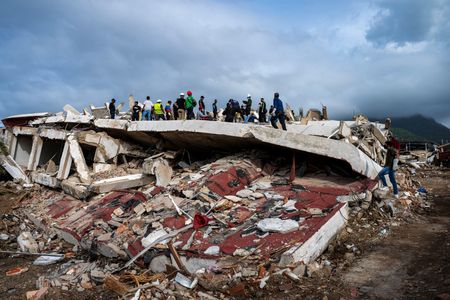

LA GUAIRA, Venezuela — On a normal day, Alexander Delgado stands in front of a classroom teaching physical education at a school in the central Venezuelan state of Aragua. But for the past week, he has been leading a makeshift rescue crew — neighbors and out-of-state volunteers alike — digging through the wreckage of a public housing complex in search of survivors and victims of two powerful earthquakes that struck a coastal state and parts of Venezuela’s capital.
Citizens like Delgado, often armed with nothing more than shovels, ropes and their bare hands, have been trying to fill the gaps left by what they describe as a sluggish and insufficient government response to the country’s most powerful earthquakes in a century.
Adding to the difficulty, volunteers say, is interference from some Venezuelan military and police personnel who have allegedly blocked aid deliveries, seized donated supplies and looted items from destroyed buildings.
Venezuela’s Ministry of Communications, which handles media inquiries on behalf of the military and police, did not respond to requests for comment. Senior government officials have dismissed growing civilian anger and reports of military involvement in looting as misinformation, urging the public to disregard what they called “manipulation strategies on social networks” and trust only official information.
Delgado has no formal rescue training, though he learned basic first aid through his job. He traveled to La Guaira — the hardest-hit state — one day after the earthquakes struck to help however he could. In his view, ordinary citizens and international rescue teams have shouldered the bulk of the effort. “You see the firefighters, (Mexican rescue team) Los Topos, but you don’t see the state per se,” he said.
For five days, his crew worked under the scorching Caribbean sun, moving debris and straining to hear any sign of life beneath the wreckage. Local volunteers kept them going, bringing water, face masks, ice and detailed knowledge of the eight-tower Hugo Chavez housing development, six of whose towers have been reduced to rubble.
By the sixth day — Tuesday — two international rescue teams and some local firefighters were on site, along with one truck from Venezuela’s forensic service. Heavy equipment, however, remained absent. That afternoon, the crew discovered the body of a woman lying between a floor slab and other debris. Work stopped while they waited for the forensic service to remove her.
‘MAKING DO’
The criticism of the government’s disaster response comes as acting President Delcy Rodriguez works to consolidate her authority following the removal of her predecessor Nicolas Maduro in January.
“Delcy and company have been in charge for 26 years and they only have one script,” said Jimmy Story, who served as U.S. ambassador to Venezuela until 2023. “They take credit for anything positive, push blame for anything negative and try to control the narrative.”
President Donald Trump has praised the U.S. relationship with Rodriguez, and American companies have shown interest in opportunities ranging from oil to gold. The U.S. Embassy’s Charge d’Affaires John Barrett also expressed support for Rodriguez’s handling of the crisis, telling Univision on Monday that he had “a great deal of confidence” in local authorities.
Volunteers on the ground see things differently. Mijaed Diaz, a veterinarian who joined other volunteers from a university, clambered over the ruins of two collapsed towers looking for body bags for four people just pulled from the wreckage. “I would like more presence of public entities, who really are those responsible for this. But in the end we’re used to making do with almost nothing,” he said.
After initially welcoming civilian volunteers, the government reversed course on Friday and restricted public access to La Guaira, infuriating people who were trying to help locate survivors.
A government employee stationed at a checkpoint in La Guaira told Reuters on Sunday that they personally witnessed police officers and military personnel seize aid from three supply trucks, with those involved boasting about what they had managed to “score.” The employee, who asked not to be named out of fear of retaliation, also said the officers filmed themselves with shovels as if participating in rescue efforts before abruptly walking away.
FRUSTRATION VENTED OVER SOCIAL MEDIA
Some Venezuelans have taken to social media to express their outrage, posting videos that appear to show security forces picking through debris and taking clothing, appliances and cash. Reuters has not independently confirmed the authenticity of those videos. However, the Interior Ministry confirmed in a statement late Tuesday that four crime scene police officials had been detained and removed from their positions and would be investigated for “appropriating financial assets acquired amid the ruins.” The ministry added that police have generally been acting with transparency.
Other videos show armed Venezuelan military members standing by and watching as civilian volunteers and foreign rescue teams race to find survivors. Still, residents say some military and police personnel are genuinely contributing to the relief effort. One resident told Reuters she saw soldiers remove belongings from buildings at the request of residents, and Reuters witnesses reported that police and firefighters in Chacao, a well-off neighborhood in Caracas, have been working around the clock to respond to humanitarian needs.
Some Venezuelan nonprofits, whose operations had been severely curtailed by government restrictions on civil society enacted in 2024, have publicly stepped back into action to help survivors.
‘KNOCKING, AND NOTHING’
“We are operating and trying to show, once again, that our work is about supporting communities and not something for which we should be persecuted,” said Roberto Patino, founder of the NGO Alimenta La Solidaridad, which runs community kitchens. Since the disaster, the group has focused on getting food, medicine, equipment and Starlink internet antennas to the communities hit hardest.
The United Nations Development Programme estimates the earthquakes have caused approximately $6.7 billion in damage. The United States has pledged $350 million in aid, dispatched rescue teams and sent military personnel to help repair the airport. However, some observers have raised questions about billions of dollars from oil sales sitting in a U.S.-controlled account.
“While the response has been robust, it also calls into question the transparency over the oil fund,” said Story. “Will these funds be released for the disaster response?”
Miguel Poleo, a member of Delgado’s civilian rescue crew, arrived at Los Cocos immediately after the earthquakes, desperately searching for his stepdaughter, her husband and their son. His message about the government’s response was blunt: “We told them two days ago that there are survivors, that they are knocking, and nothing. They don’t help anyone.”