
Underwater explorers have located the wreckage of a Pan Am aircraft that sank off the coast of Puerto Rico 74 years ago — a crash so significant that it helped give birth to the passenger safety briefings that airline travelers hear before every flight today.
The pre-flight instructions that flight attendants deliver on topics like how to inflate a life vest or locate emergency exits became standard practice following the deaths of 52 people aboard Pan Am’s Clipper Endeavor, who perished because they were unable to escape the aircraft before it went under. Last month, a team using an autonomous sonar drone discovered the plane’s fuselage and tail resting under 2,000 feet of water.
The 12 passengers and five crew members who made it out alive after the Good Friday 1952 crash told investigators that the plane’s hard water landing was survivable — everyone on board came through it. But panic quickly took hold. Many passengers were reluctant to enter the open water, life vests were difficult to locate, and crew members struggled to deploy the rafts. The aircraft sank in a matter of minutes.
Aviation safety expert John Cox explained the lasting impact of that tragedy. “This one became a catalyst, and it helped drive safety steps forward of better flotation equipment and the preflight briefings,” he said. “So this is one steppingstone along the path to what we today enjoy as aviation safety. It was a rallying cry at the time.”
Beyond its historical importance, the discovery is generating optimism that similar technology and methods could one day help locate other planes lost at sea, including Malaysia Airlines Flight 370, which vanished 12 years ago carrying 269 people.
The search effort traces back to 2019, when Russ Matthews came across a brief mention of a luggage tag from the Clipper Endeavor washing up on a Florida beach. Intrigued by the flight’s place in aviation history, he began digging deeper. That curiosity turned into years of combing through Pan Am Airlines and Coast Guard archives, as well as records from the Civil Aeronautics Board — the agency that preceded the Federal Aviation Administration.
The critical breakthrough came from records held in Puerto Rico from a hearing about the crash, including a map drawn by Air Force pilots who had witnessed the accident while conducting a training flight nearby and had estimated where the plane went down.
A prior attempt to locate the wreck in 2024 — documented by the Discovery Channel’s “Expedition Unknown” — was derailed by bad weather. That effort used a towed sonar array. Matthews and the volunteers of his Air/Sea Heritage Foundation were determined to try again before the crash’s 75th anniversary next year, this time using newer drone technology originally developed for military purposes such as detecting underwater mines.
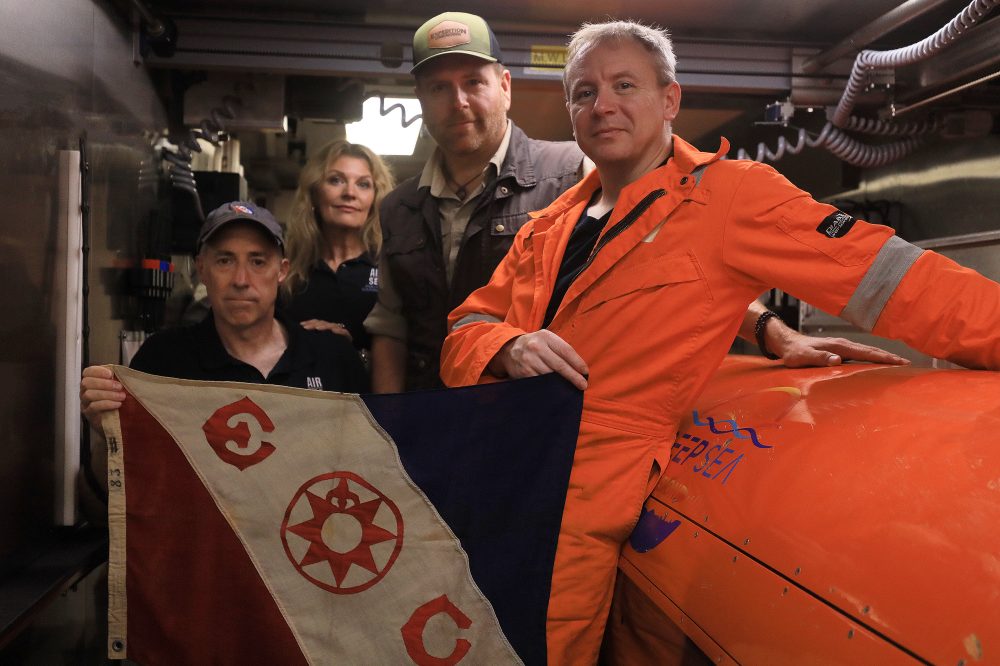
Tony Romeo, CEO of the undersea exploration company Deep Sea Vision, had been in discussions with Matthews about potentially joining the search if one of his vessels ever passed through the region. In April, that opportunity arrived — one of his ships was transiting near Puerto Rico between assignments, carrying an advanced underwater drone equipped with the sensors needed for the job.
“There we were, and everything kind of came together at the moment: good weather, the right team, and the right equipment and ship. So we took a shot at it,” Romeo said.
Deep Sea Vision had previously spent six months in an unsuccessful attempt to find Amelia Earhart’s plane. Romeo had a personal stake in this particular search — his father worked as both a mechanic and pilot for Pan Am. Fittingly, the drone used in the search already had a Pan Am sticker affixed to its side.
Matthews’ team combined all of their archival research with weather data from the time of the crash to map out the most probable location, defining a search zone of 10 square nautical miles. The drone found the wreckage on its very first pass through that area, though the team didn’t know it until the drone surfaced and its images were downloaded.
The Discovery Channel’s Josh Gates and his production crew were present for the search and captured the reaction in the control room as the images appeared on screen. Shouts of “Oh God!” and “That’s a plane!” broke out as the image loaded. A special episode featuring the discovery is set to air this fall, with some highlights already released.
“To have a front-row seat to an expedition like this as it’s unfolding is tremendous, and so I feel really lucky that we were able to be a part of it,” Gates said.