
Venezuelan merchant Grian Serrano has lived through not one, but two of his country’s most devastating natural disasters — both striking the same coastal region of La Guaira.
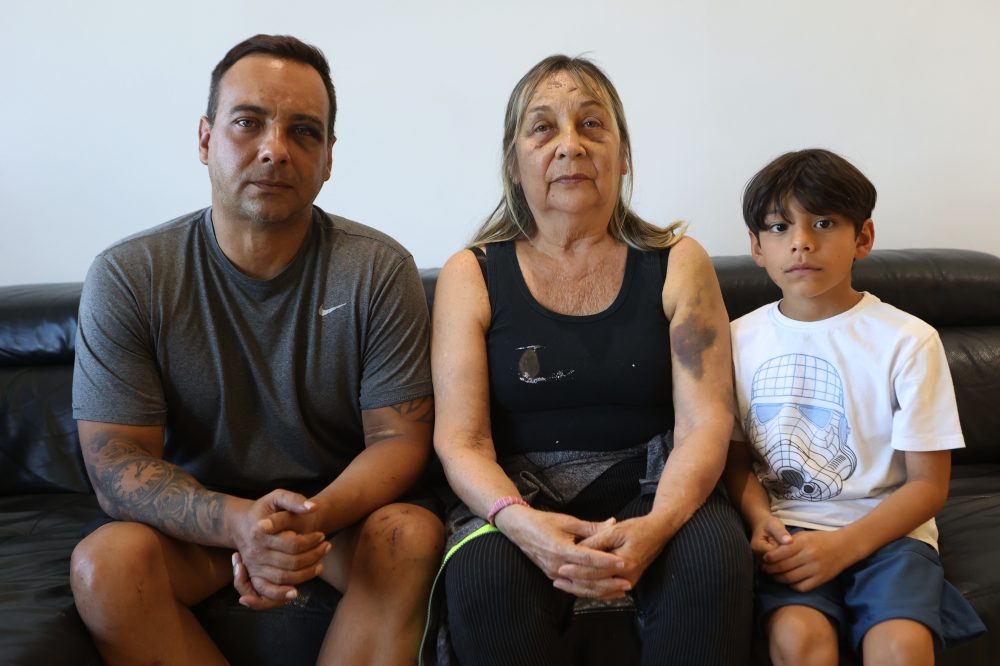
The first was the catastrophic 1999 mudslides that tore through the area. The second came 26 years later, when two powerful earthquakes rocked the same region, burying Serrano, his 8-year-old son, and his 69-year-old mother beneath the rubble of their collapsed eight-story apartment building in the city of Caraballeda.
Now 46 years old and visibly bruised around his left eye and across much of his body, Serrano is recovering at his brother’s home in Caracas after the harrowing ordeal.
“It is a miracle from God,” he said, describing how he dug through wreckage in complete darkness using only his bare hands until two strangers came to help him pull his son and mother to safety.
The twin earthquakes, measuring magnitude 7.2 and 7.5, have claimed more than 1,700 lives and left more than 5,000 people injured, according to government figures. Hundreds of structures collapsed or sustained serious damage, with La Guaira bearing the brunt of the destruction. Notable damage was also reported in the capital city of Caracas and in the states of Carabobo, Miranda, Aragua, and Yaracuy.
La Guaira — formerly known as Vargas until 2019 — is Venezuela’s second-smallest state, yet one of its most vital. Situated roughly 30 kilometers, or about 19 miles, north of Caracas, it houses the nation’s primary international airport and its second-largest seaport. Its approximately 440,000 residents are mostly low-income and rely on tourism, trade, and employment connected to those transportation hubs.
As Serrano reflected on last week’s disaster, his mind drifted back to December 15, 1999, when he was jolted awake by a household employee’s screams after a nearby river overflowed following days of relentless rain. He watched from his window as the swollen river swept away trees, enormous boulders, and vehicles with people trapped inside, desperately banging on windows and crying out for help.
Acting on instinct, he grabbed his mother, sister, and nanny and climbed to the roof of his four-story apartment building. From that vantage point, they watched floodwaters swallow the lower floors as massive trees crashed into the building’s support columns, fearing it would crumble just as neighboring structures had. The danger finally passed at daybreak when the rain stopped and the water began to recede. Unable to wait any longer for rescuers to arrive, the family made their way on foot through mud, rocks, and fallen trees to his grandparents’ home in a nearby neighborhood.
That 1999 disaster, known as the “Vargas Tragedy,” killed 782 people, left another 2,000 missing, and affected roughly 250,000 residents, according to Ángel Rangel, who directed Venezuela’s Civil Protection agency and led rescue operations at the time.
Today, Serrano believes the region — wedged between the Caribbean Sea and the Ávila mountain range — is somehow cursed.
“It isn’t normal for such horrible things to happen in the same place,” he said.
Rangel, now working as a disaster specialist, offers a more technical explanation. The engineer pointed out that many of the buildings that fell in La Guaira were constructed on ground formed over centuries by sediment washing down from the surrounding mountains.
“That type of terrain is particularly risky for construction,” Rangel said, noting that building in such zones demands “strict adherence to seismic-resistant engineering standards” that were put in place following a major earthquake that hit Caracas in 1967.
A large number of the collapsed buildings in La Guaira date back to the 1970s, and it remains unknown whether they were built to meet those safety requirements.
Having lost his home and everything he owned, Serrano says he has no clear plan for what comes next — but his decision about where he will not live is firm.
“That’s twice now,” he said. “Sometimes I think if there’s a third time, it’s going to win the battle.”