
MIAMI — During batting practice before Tuesday night’s World Baseball Classic championship match between the United States and Venezuela, Pablo Cuerta experienced a moment of clarity.
No matter the outcome, he would emerge victorious.
Thousands of Venezuelan supporters packed the Miami stadium that evening, joined by thousands of American fans. Some attendees, like Cuerta who holds dual citizenship, found themselves supporting both nations. He wore Venezuela’s team jersey and cap while proudly displaying the American flag across his shoulders.
“I was born in Venezuela, and this country gave me the opportunity to come, to be a citizen,” explained Cuerta, who made the drive from his Orlando-area home to attend the tournament’s final days in Miami. “I appreciate both countries, you know. One, I was born in Venezuela. And two, this one gave me everything I’ve got. So, I’m proud to have both countries.”
The South American nation claimed a historic 3-2 victory, securing the WBC championship for the first time in the tournament’s history. Following the final out, loanDepot Park erupted in thunderous celebration. Despite technically being the visiting team, Venezuela’s players felt completely at home thanks to Miami’s heavily Latino crowd.
“This is a celebration for all of the Venezuelan country,” declared designated hitter Eugenio Suárez, whose ninth-inning double provided the winning run.
Venezuelan supporters maintained their strong presence throughout the competition, with all seven of their team’s WBC games taking place at the Miami Marlins’ home stadium. Despite ongoing political turmoil in their homeland — including the recent capture and imprisonment of former leader Nicolás Maduro on drug trafficking charges following a U.S. military operation — Venezuelan fans remained focused on celebrating their team’s achievements on American soil.
The pregame ceremony featuring both nations’ flags generated ear-splitting cheers that seemed to vibrate throughout the entire facility.
“Super emotional with Venezuela and being here for the championship game. This is beyond sport. It is well deserved,” stated Argenis Masiaf, a Miami local who decorated his face with Venezuelan flag colors. “We have lived through many difficult things inside our country. This is the moment for Venezuela to accomplish something so special and memorable.”
Throughout the tournament, Venezuela’s players and coaching staff deliberately steered clear of political discussions. They consistently emphasized their singular focus on baseball competition, with manager Omar López reinforcing this message before the championship game.
López did acknowledge the tournament’s profound significance for Venezuela, a baseball-obsessed South American nation with approximately 32 million residents.
“Together we are going to have better generations for our country, united with no color, political colors or ideology,” López stated. “We have people with double citizenship. … Baseball is one of the best tools or ways to educate a country. Discipline, dedication, determination.
“If you don’t believe in that, you should start believing. You have to believe in that. Thirty human beings today are going to unite Venezuela through a baseball game.”
His prediction proved accurate.
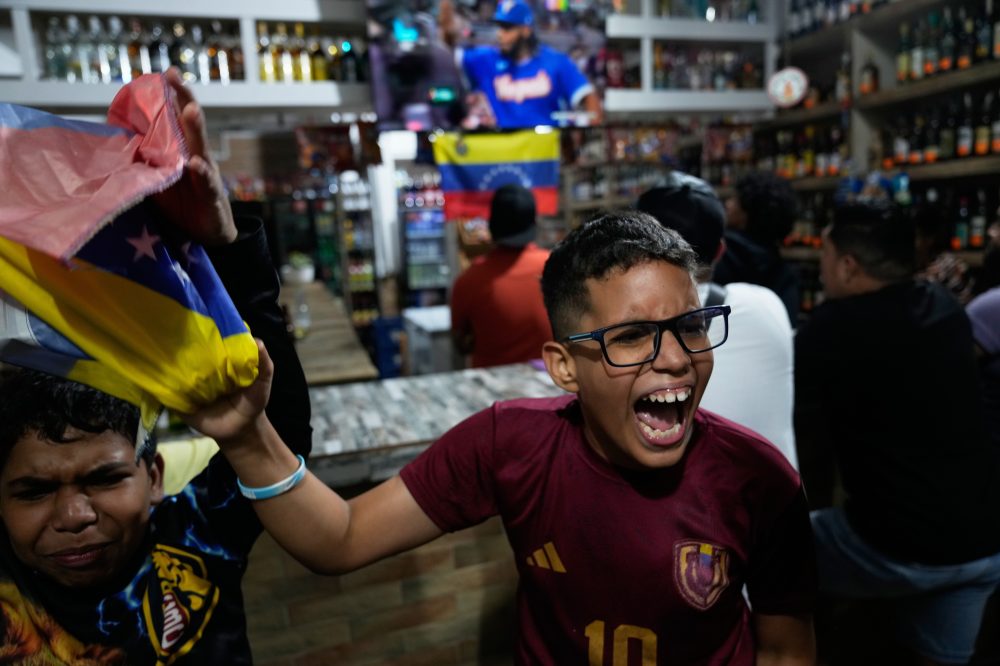
In Caracas, Venezuela’s capital and most populous city, the streets stood virtually deserted Tuesday evening as citizens remained glued to their televisions. Thousands gathered at a public square to watch collectively, many dancing and waving national flags while children joined the festivities.
“Long live Venezuela! Truly, I am very happy,” acting President Delcy Rodriguez declared following the victory. “I want, on behalf of our people and the government of Venezuela, to thank and embrace each one of our players.”
Celebrations continued long after the game concluded, with live music, flag-waving, and emotional fans — both in Caracas and Miami — marking the historic achievement.
“The USA is (the) best country in the world,” shouted Enrique Cabrera, a retired educator, over the massive celebration that transformed loanDepot Park’s right-field concourse into a human sea of revelers. “But Venezuela is the best at baseball.”
In a nation deeply fractured by political divisions, baseball serves as one of the rare activities capable of uniting citizens across generational and ideological lines.
Consider 75-year-old Miguel Blanco, who traveled approximately 43 miles to join fellow fans at Caracas’ public viewing area. After enduring a 12-hour power outage Monday, he refused to risk missing the game due to another blackout — a common occurrence in his region.
Meanwhile, 26-year-old Ashley Peña, a youth organizer in Caracas, described the game as providing essential relief for her fellow citizens.
“This is a moment for every Venezuelan to regain faith,” she observed. “Wherever we are in any country, we are all supporting the national team.”
Josh Rojas, a Utah student, arrived at the stadium three hours before the opening pitch to absorb the electric atmosphere. He sported “V” face paint on both cheeks while carrying a Venezuelan flag.
“Me and my family knew Venezuela would make a good run, so we came,” Rojas explained. “Man, it’s meant everything. I’m a Latino American, and it’s just making me more proud of my Latin heritage. It’s just awesome to see a whole country, a whole community come together to support this country through baseball.”
Jaci Douglas, a Pennsylvania medical student who admits she “hates” baseball, viewed Tuesday’s contest as something far more significant than sports.
“My mother is Venezuelan. I have in-laws who are Venezuelans,” Douglas said. “They’re all here tonight and they told me that if I miss this, I’d regret it. … It’s an event.”
Cuerta departed Venezuela eight years ago but understood the profound meaning of this WBC journey for his birth country even before Tuesday’s championship.
“When we’re born, that’s the first thing your parents do. Before they send you to school, they send you to the field,” Cuerta reflected. “That’s what they mean when they say it’s in our blood.”