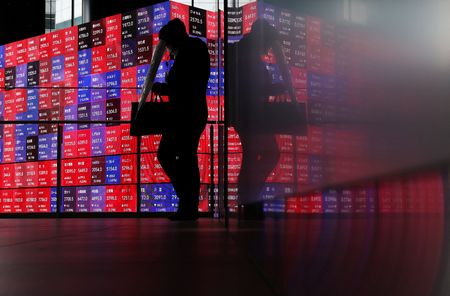

Asian stock markets climbed Thursday following announcements by major U.S. technology companies of enormous capital spending plans that are expected to benefit chipmakers across the region. Meanwhile, the intensifying conflict in the Middle East drove oil prices to their highest levels in six weeks.
The surge in oil prices has reignited fears about inflation, pushing short-term U.S. Treasury yields to 17-week highs as traders increasingly bet that the Federal Reserve may need to raise interest rates sooner than expected.
Brent crude futures jumped 2% to $96 per barrel in early trading after the United States launched a new wave of strikes on Iran and Yemen’s Houthi forces targeted oil tankers in the Red Sea — broadening a conflict that has rattled global markets.
Thierry Wizman, global FX and rates strategist at Macquarie Group, said the climbing oil prices have brought renewed anxiety about the effect on worldwide economic growth. Nearly five months of ongoing war have drained global oil reserves and fueled inflation around the world. Analysts have warned that if both the Strait of Hormuz and the Bab el-Mandeb waterway in the Red Sea were shut down, shipping routes for more than a quarter of the world’s oil and gas supply would be severely disrupted.
“The worries about global growth are well-placed, we think,” Wizman said.
On the technology front, earnings reports from Alphabet and Tesla showed no signs of slowing investment in artificial intelligence infrastructure. Alphabet raised its capital spending plans for the year, now projecting expenditures between $195 billion and $205 billion.
Much of that spending is anticipated to flow toward Asian chipmakers. South Korea’s KOSPI index surged more than 3%, led by gains in SK Hynix and Samsung Electronics, while Japan’s Nikkei rose 1%. The MSCI index tracking Asia-Pacific shares outside Japan gained roughly 1% in early trading and was on pace for a 3% gain for the week, breaking a two-week losing streak.
Gary Tan, portfolio manager at Allspring Global Investments, said the key positive signal for Asia’s chipmakers was that stronger cloud computing growth was confirming higher AI spending, suggesting the investment cycle still has momentum.
“The bigger takeaway is that AI is rapidly moving from infrastructure to disruption, with hyperscalers increasingly using AI to challenge incumbent platforms across search and e-commerce, reinforcing the AI disruption trade,” Tan said.
A central question this earnings season remains whether the enormous sums being poured into AI are actually generating significant profit growth — and whether the sky-high valuations of some technology companies can be justified.
“We will still see a bit of a wary trading session ahead as the good news from earnings competes with the escalating conflict in the Middle East,” said Nick Twidale, chief market strategist at ATFX Global in Sydney.
In currency markets, the Japanese yen remained under pressure, trading at 163.1 per dollar. The currency gave back gains from the prior session after Bloomberg News reported that Bank of Japan officials were open to raising interest rates at a quicker pace. The yen had slipped to 163.23 on Tuesday — its weakest level since December 1986 — with traders closely watching for signs of intervention from Tokyo. Japan’s finance minister has repeatedly issued verbal warnings, though those statements have done little to stabilize the currency.
Strategists at OCBC noted that while the risk of foreign exchange intervention or stronger domestic asset demand could help slow the yen’s decline, neither factor is likely to fundamentally change its role as a funding currency. They said a more lasting shift would likely require the Bank of Japan to speed up the pace of rate increases.
The U.S. dollar remained strong, buoyed by safe-haven demand and rising expectations for Federal Reserve rate hikes. Traders are currently pricing in 42 basis points of increases this year, with a full hike expected by September.