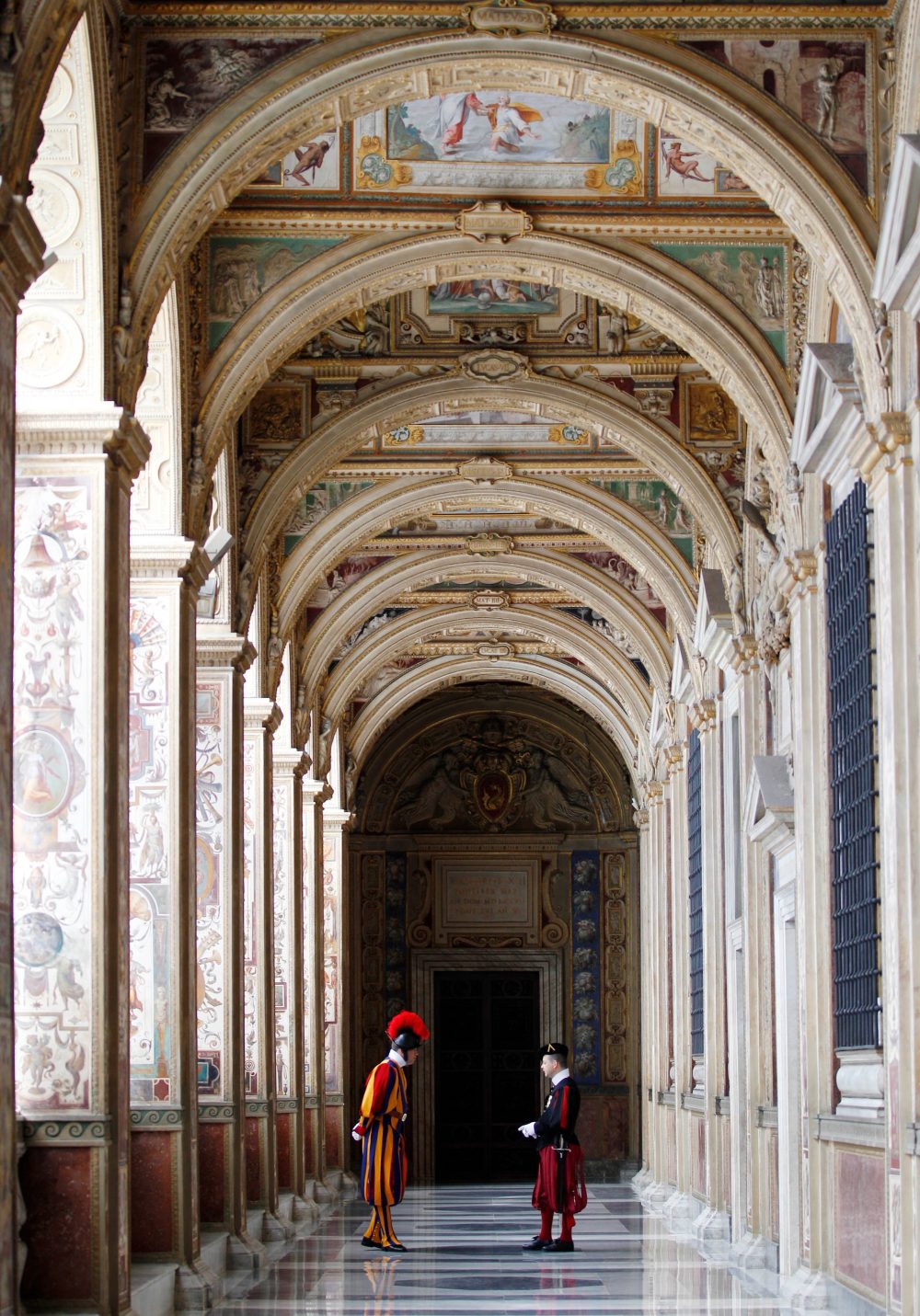

VATICAN CITY (AP) — A breathtaking Renaissance corridor inside the Vatican’s Apostolic Palace — a passageway that popes and world leaders have walked for centuries — is about to receive its first significant restoration in more than 500 years.
The Vatican Museums officially announced Wednesday the launch of a five-year, $5.5 million effort to clean and restore the Raphael Loggia, a corridor stretching 65 meters long and 4 meters wide that stands as one of the finest examples of Renaissance figurative art in existence.
The windowed second-floor passageway overlooks the palace’s San Damaso courtyard and is not accessible to the general public. However, select visitors granted audiences with the pope or the Secretariat of State pass through it and are treated to a stunning display of biblical scenes from both the Old and New Testaments, along with botanical designs rendered in paint and stucco.
Pope Leo XIV, who returned to live in the Apostolic Palace after his predecessor famously chose not to reside there, has his private quarters on the floor above and regularly walks through the corridor on his way to audiences.
The loggia’s decoration was conceived by Renaissance master Raphael between 1517 and 1519, serving as one of his final commissions for Pope Leo X. It stands alongside his more widely known works — including the recently restored Raphael Rooms and his tapestries — which are centerpieces of any visit to the Vatican Museums.
Tucked deep within the heart of the Holy See, the corridor’s 13 arched bays have long been celebrated as a masterpiece of figurative painting. Their fame inspired numerous copies, including a full-scale replica housed at the Hermitage Museum in St. Petersburg, Russia.
Paolo Violini, who oversees painting restoration at the Vatican Museums, explained that the loggia was exposed to the open air until 1813, leaving it vulnerable to rain and weather damage. Even after windows were added, the enclosed space trapped heat and humidity, pushing the artwork into an especially fragile condition that demands careful handling.
To address this, restorers will employ handheld lasers to clean and treat both the stucco and painted surfaces. Violini noted that a “dry” cleaning approach is essential because the paints are water soluble and could be further damaged by traditional cleaning methods or chemical solvents.
The restoration is being carried out in collaboration with the World Monuments Fund and is financed by the Stephen A. Schwarzman Foundation, a philanthropy based in New York. At Wednesday’s press conference, Schwarzman revealed that the foundation’s total contribution to the broader project exceeds $14 million — with $5.5 million directed toward the restoration itself, and the remainder funding efforts to digitize images of the loggia for public access, produce a documentary about the renovation, and establish a training program for art restorers at a Swiss university.
In addition to the restoration work, the Vatican also plans to replace the corridor’s arched windows with specially designed glass capable of filtering out the sun’s harmful ultraviolet rays.