
SALT LAKE CITY — Deeply red Utah has become an unexpected battleground for the ongoing tug-of-war inside the Democratic Party between its progressive and moderate wings, with a key primary election taking place Tuesday.
A court-mandated redrawing of Utah’s U.S. House districts has produced a new, strongly Democratic-leaning seat in the Salt Lake City area — and the competition to claim it has been fierce.
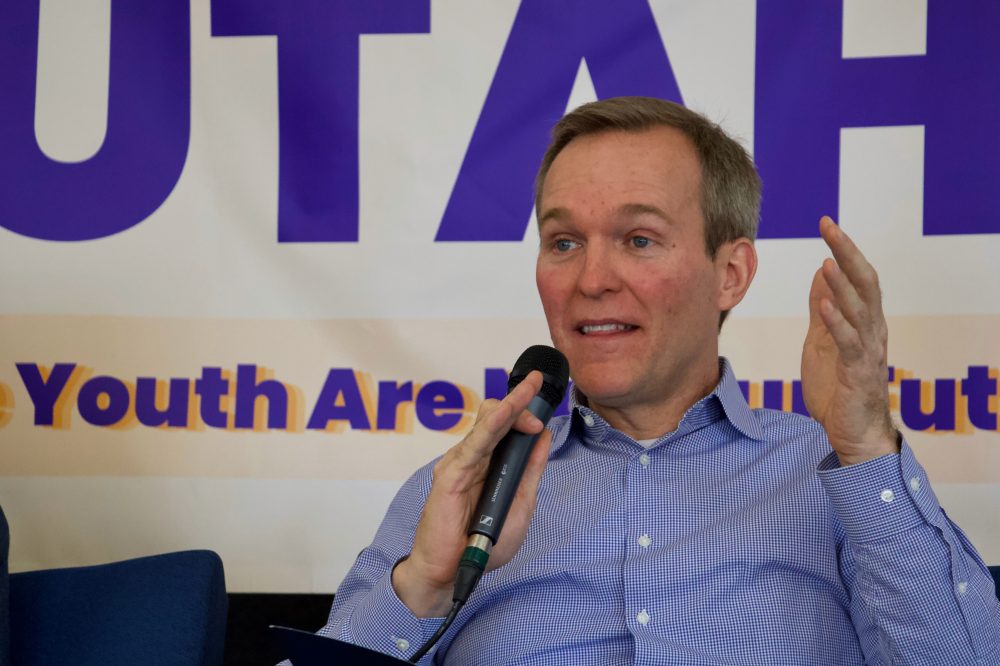
Former U.S. Rep. Ben McAdams, who by one political analysis was ranked the most conservative House Democrat during his single term in office, is facing three opponents who all position themselves further to the left. McAdams has been working to distance himself from his moderate label, while his rivals have been pressuring one another to step aside and unite behind a single progressive candidate.
The remaining three of Utah’s four congressional seats are expected to stay firmly in Republican hands, including the 3rd District, where Tuesday’s GOP primary pits a conservative challenger against a sitting Republican congresswoman.
Utah is an unusual case among Republican-dominated states — it’s one where the GOP is projected to actually lose a U.S. House seat following a prolonged legal dispute over the previous district boundaries.
That newly drawn 1st District seat, along with several in California, represents one of the few places where Democrats are expected to flip a seat — part of the fallout from a nationwide redistricting effort that President Donald Trump launched last year in an attempt to preserve the Republican majority in the House. Democrats need only a small net gain in November to take control of the chamber.
Contenders in the new Salt Lake City-area district have been competing to prove who is the most progressive — a sharp contrast to the traditional Democratic approach of appealing to Utah’s largely conservative voter base.
Given how the 1st District lines were drawn, whoever wins the Democratic primary will be a heavy favorite in November against Republican Riley Owen, a Navy Reserve intelligence officer who secured the GOP nomination at the state party’s spring convention.
Utah Democrats are running an open primary, which means any registered voter in the district — regardless of party — can participate. That format may work in McAdams’ favor, given his wider appeal across party lines.
When McAdams ran in 2018 — successfully ousting a Republican incumbent during the first midterm elections of Trump’s first term — he described himself as pro-life and campaigned as a moderate. Now, running in a far more Democratic district, he has pledged support for abortion rights and says he is only “moderate in tone.”
One of his main challengers is state Sen. Nate Blouin, a progressive voice in Utah’s Republican-controlled state legislature who is trying to recover from a social media controversy. In April, Blouin apologized for posts he made on internet forums between 2009 and 2015 that disparaged women and members of The Church of Jesus Christ of Latter-day Saints, the Utah-based faith commonly known as the Mormon church.
Blouin has been working to energize voters he says have grown too comfortable with candidates who will “play nice” with Republicans. He has earned endorsements from some of the nation’s most prominent progressive figures, including independent Sen. Bernie Sanders and Democratic U.S. Reps. Pramila Jayapal, Greg Casar, and Maxwell Frost.
Two political newcomers are also in the race: Liban Mohamed and Michael Farrell. Mohamed, a former employee of Meta and TikTok, made a splash at the state Democratic convention earlier this year, winning the party’s official endorsement after five rounds of ranked-choice voting — beating out McAdams in the process. His opponents still qualified for the primary ballot by collecting voter signatures. Mohamed has the backing of U.S. Reps. Ilhan Omar and Ayanna Pressley.
On the Republican side, the newly redrawn map has also created a challenge for U.S. Rep. Celeste Maloy, who is facing a primary threat from someone positioned even further to the right.
Maloy, who carries Trump’s endorsement, is being challenged in the redrawn 3rd District — which covers most of southern and eastern Utah — by former state lawmaker Phil Lyman. Lyman has promoted false claims of fraud from the 2020 presidential election and has long been a favorite among the state’s most conservative voters.
Lyman is perhaps best known for organizing an illegal ATV ride in 2014 to protest a federal decision to close a canyon in southeastern Utah to motorized vehicles. That closure was put in place to protect Native American cliff dwellings, artifacts, and burial sites. Lyman argued the move was federal government overreach.
A jury found him guilty of misdemeanor illegal ATV use and conspiracy, and a judge sentenced him in 2015 to 10 days in jail and three years of probation. Trump pardoned him in December 2020.
Maloy was first elected to Congress through a special election in 2023 and won a full term in 2024. She previously worked as a soil conservationist and an attorney specializing in public lands and water policy.
The winner of Tuesday’s Republican primary will face Democratic nominee Kent Udell, an engineer, in the November general election. The Republican candidate is heavily favored to win in the reliably conservative 3rd District.