
Leaders from the United States and China are expected to discuss prolonging an agreement regarding Chinese restrictions on rare earth mineral exports during their upcoming summit meeting this week. Despite these diplomatic talks, new data from Chinese customs officials reveals that Beijing continues to limit shipments of these essential materials that are crucial for defense systems and manufacturing operations.
The ongoing supply constraints and elevated costs globally highlight how restrictions implemented as a response to President Donald Trump’s Liberation Day tariffs have remained a significant consequence of that policy, even after most of those duties were reduced.
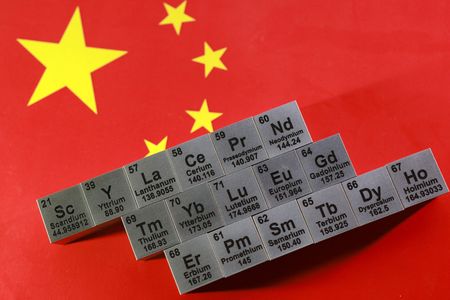
China maintains the strictest controls over several specialized rare earth elements that are produced at large scale only within Chinese borders. These materials are essential for aerospace applications, defense systems, semiconductor production, and powerful magnets used in electronics and manufactured products, including electric vehicles.
Shipments of the heavy rare earth elements yttrium, dysprosium and terbium remain approximately 50% below previous levels since restrictions began in April 2025 compared to the preceding 12-month period, according to Chinese customs records.
The quantities involved are typically measured in tens of tons, and their reduction has been masked by an almost complete recovery in overall rare earth export numbers during the past year.
Ilya Epikhin, senior principal at consultancy Arthur D. Little, explained that “Headline export volumes can be misleading.”
Epikhin added, “China appears to be selectively licensing exports while preserving leverage over supply chains considered strategically sensitive, particularly where defense or advanced technology applications are involved.”
These supply shortages seem to contradict what the White House reports China committed to during a summit in South Korea last October, which was to “effectively eliminate China’s current and proposed controls on rare earth elements.”
Following that summit, China removed a broader range of restrictions but maintained its April 2025 controls. Beijing has consistently justified these measures and states it approves qualifying applications. China’s Ministry of Commerce did not provide responses to Reuters’ inquiries.
The difference between these positions and a potential extension of the October agreement will be discussed when the leaders convene again this week, along with possible Chinese purchases of Boeing aircraft and U.S. agricultural and energy products.
A senior U.S. official informed reporters on Sunday that discussions with Beijing regarding rare earths are ongoing, and both nations seek stability, though it remains uncertain whether the agreement will be extended during or following Trump’s visit.
Additionally, a second U.S. official speaking anonymously told Reuters that supply shortages remain problematic.
The White House recently had to intervene with Beijing to obtain approvals for a major U.S. company with defense and civilian divisions that was losing hundreds of millions in monthly revenue because it could not secure an export license, according to a third U.S. official who declined identification due to lack of authorization to speak publicly.
Reuters previously reported in February that certain U.S. aerospace companies had temporarily halted production due to shortages of yttrium, which is used to shield turbine blades from extreme heat.
A White House official responded to Reuters’ questions by stating, “The President’s team is engaging continuously with China to ensure the flow of rare earths while building out trusted and resilient supply chains.”
While the controls were established in response to Trump’s tariffs, their effects are impacting U.S. allies just as severely as Washington.
Costs outside China since April 2025 have increased between four and five times for dysprosium and terbium and approximately 140 times for yttrium, with prices continuing to rise, according to consultancy Argus data.
This demonstrates how major consumers of Chinese rare earths including Japan and Germany are also experiencing supply cuts that are, in some instances, more severe than those affecting the U.S., Chinese customs data revealed.
Dysprosium is frequently added to magnets to enhance their strength, and since April 2025, Japan, the largest rare earth magnet producer outside China, has received only 4% of the dysprosium it imported during the previous 12 months. Germany has received zero shipments.
Manufacturers are currently paying between 1.5 and 3 times more for magnets than before the controls were implemented, according to Neha Mukherjee, rare earth research manager at Benchmark Mineral Intelligence.
Germany, Japan, the U.S., and other nations are funding projects to reduce dependence on China, including a recent G7 initiative focused on alternative supply chains.
Nevertheless, completely replacing China remains years away, according to David Merriman, research director at consultancy Project Blue.
Merriman stated, “The situation looks set to get worse before getting any better.”