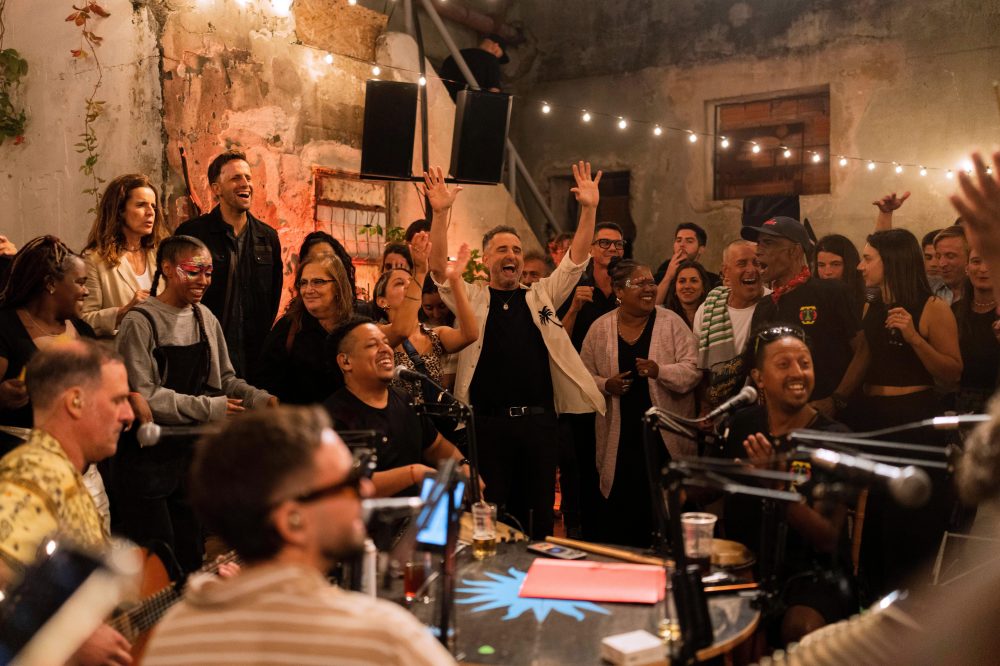

MONTEVIDEO, Uruguay — Each Monday evening in Uruguay’s capital city, crowds of people circle around musicians in a public plaza, captivated by the rhythmic beats of drums, guitars and vocals that echo a musical tradition spanning centuries.
What began as friends getting together to play music has transformed La Rueda de Candombe into one of Uruguay’s most celebrated musical phenomena, taking the group from neighborhood street performances all the way to France’s prestigious Cannes Film Festival.
“What started as something among friends became visible without us intending it,” explained Uruguayan producer Caleb Amado, who helped establish La Rueda de Candombe.
This past Sunday marked the season finale for Rueda de Candombe at Montevideo’s Plaza de España, where six musicians came together to celebrate candombe — an energetic musical style that defines this South American nation’s cultural identity and has earned recognition from UNESCO as an Intangible Cultural Heritage of Humanity.
During autumn 2024, Amado and his companion Rolo Fernández journeyed to Rio de Janeiro, exchanging Montevideo’s cooler weather for balmy evenings at some of Brazil’s most famous nightspots. During their visit, they experienced “rodas” — spontaneous musical gatherings where artists form circles around tables to perform while audiences stand and watch.
Drawing inspiration from these Brazilian sessions, the duo returned to Uruguay and created La Rueda de Candombe alongside four additional musicians.
Similar to their Brazilian counterparts, the ensemble performs seated around a table. However, their musical style remains uniquely Uruguayan: percussion, guitar and accordion create the distinctive rhythms of candombe, a genre with roots in African customs introduced to the area during the 1700s that now forms the core of Uruguay’s cultural identity. UNESCO has designated candombe as an Intangible Cultural Heritage of Humanity.
Initially, close to one hundred people crowded into Santa Catalina, a compact bar located on a peaceful Montevideo street corner, to listen to their performances. Over several months, expanding audiences forced the shows to move to the adjacent Plaza España. As their fame spread, tourist buses started appearing regularly.
Even though Montevideo offers numerous public venues, including a 14-mile waterfront walkway, street performances occur much less frequently than in metropolitan areas such as Buenos Aires or Rio de Janeiro.
Online platforms helped spread their reputation, attracting well-known performers. The ensemble has shared the stage with Uruguayan musician Jorge Drexler at Montevideo’s famous Centenario Stadium and produced a recording. In 2025, they received an invitation to showcase Uruguay at the Cannes Film Festival, which features cultural presentations alongside its cinema programming.
From the 1700s onward, candombe has served as a cornerstone of Uruguayan culture. The genre originated at Plaza España — the historical port where enslaved Africans used drumbeats to preserve their spiritual practices.
The musical form centers on three drum varieties — chico, repique and piano — and achieves its most spectacular expression during February’s carnival season, when numerous musical groups known as comparsas march through city streets.
During the mid-1900s, candombe transformed by incorporating elements of jazz and contemporary music in a fusion called “candombe canción.” It became standard at social events — similar to current Rueda gatherings — while also functioning as a vehicle for cultural and political commentary throughout the 1960s and 1970s.
With winter approaching, Amado and Fernández intend to remain in Montevideo. The Rueda continues to grow, they report, while developing new initiatives, including performances at additional public plazas throughout the city.