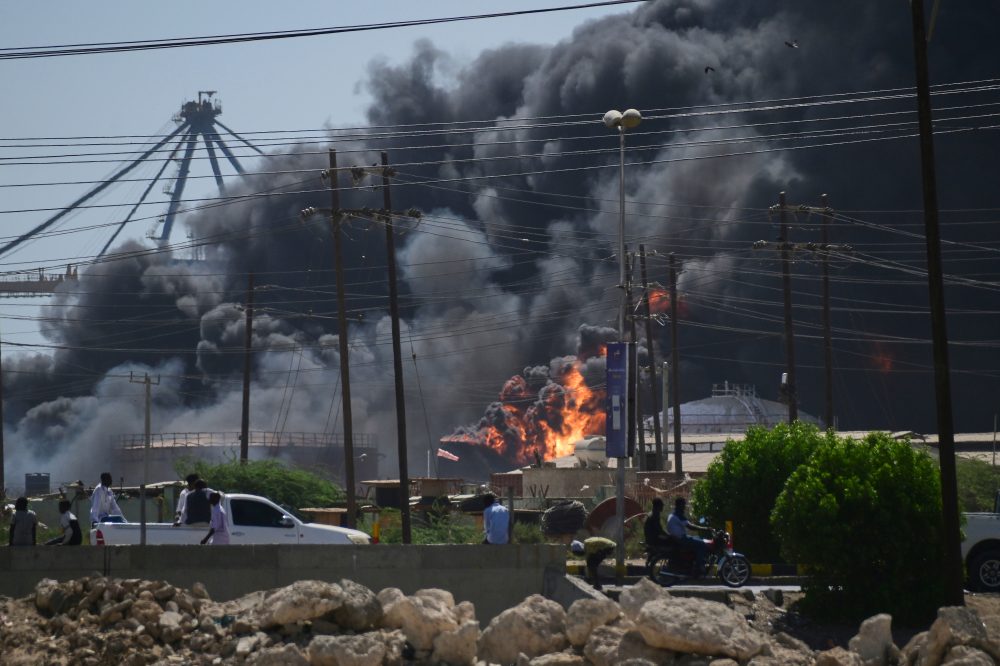

CAIRO (AP) — Unmanned aircraft warfare has emerged as the most lethal danger facing civilians caught in Sudan’s ongoing conflict, with both government forces and the opposing paramilitary Rapid Support Forces receiving equipment from multiple nations across the Middle East and other regions, according to security analysts.
“Armed drones have now become by far and away the leading cause of civilian deaths,” accounting for more than 80% of conflict-related fatalities, United Nations human rights chief Volker Türk stated this week, urging action to halt their shipment to Sudan. These unmanned aircraft killed no fewer than 880 civilians from January through April.
Sudan’s conflict commenced in April 2023 and has resulted in no fewer than 59,000 deaths, forced approximately 13 million people from their homes and created famine conditions in portions of the nation.
During recent weeks, the RSF has conducted unmanned aircraft strikes against Khartoum International Airport and additional locations surrounding the capital, territory that government forces captured last year.
Security experts indicate that internationally-provided sophisticated drone capabilities allow the fighting factions to expand attacks on heavily populated regions, making peace negotiations more difficult and increasing concerns about a wider proxy war.
“On the battlefield, drones have emerged as a force multiplier, enabling ground offensives and weakening enemy defenses,” stated Jalale Getachew Birru, East Africa senior analyst at the U.S.-based Armed Conflict Location & Event Data project.
Government forces and RSF both deploy unmanned aircraft to control disputed areas, interrupt mobilization activities and create instability in territories held by opponents, he explained.
No fewer than 2,670 individuals, including fighters and civilians, died in 2025, representing a 600% rise in drone-caused fatalities and an 81% jump in unmanned aircraft attacks from the prior year, ACLED determined.
Unmanned aircraft strikes conducted by the fighting groups have hit civilian facilities including medical centers, dams, educational institutions, marketplaces and refugee camps.
The majority of civilian fatalities from drone strikes have taken place in the Kordofan region of central Sudan, Türk reported.
On May 8, unmanned aircraft attacks in South Kordofan and close to the city of el-Obeid in North Kordofan allegedly resulted in 26 civilian deaths. Over 70 individuals died in drone strikes on crowded areas in Kordofan during the early months of this year, the Sudan Doctors Network reported.
On Tuesday, a Sudanese advocacy organization, the Emergency Lawyers, reported that nine unmanned aircraft attacks on civilian vehicles had resulted in no fewer than 36 deaths during the previous 10 days throughout seven provinces.
The organization held both government forces and RSF responsible and noted that some drones employ visual surveillance technology able to identify specific targets, creating worries that the strikes may not have been random.
The paramilitary RFS started using drones extensively only last year, according to Gabriella Tejeda, research associate at The Soufan Center.
Government forces and RSF are working to acquire new drone variants, especially from China, but the RSF is adapting drones and “increasingly competing to acquire newer, more sophisticated models, with the UAE likely supplying them,” Tejeda explained. The United Arab Emirates has rejected claims of providing drones to the RSF.
Nathaniel Raymond, executive director of the Humanitarian Research Lab at the Yale School of Public Health, indicated the RSF receives support from foreign technology, especially from the UAE, with satellite pictures revealing its deployment of Chinese-manufactured CH-95 and FH-95 drones that are approximately the size of small aircraft.
In locations like el-Fasher city in North Darfur, where no fewer than 6,000 individuals died during three days last year, RSF drones disable communications of civilians “crying for help” and attack them when a signal is identified, Raymond explained.
The RSF would not have been able to capture the city without these technologies, he noted.
“The sophistication of how they use drones in el-Fasher is unique because it’s the first time you’ve seen this layered, hunter-killer concept of operations to kill people, basically in a kill box or trapped inside a wall, in this case to prevent them from crying for help,” Raymond stated regarding the city, where U.N. specialists said the violence showed “hallmarks of genocide.”
Government forces’ drone technology has been blamed for attacking civilian facilities like Al Daein Teaching Hospital in East Darfur, where no fewer than 64 individuals died. The military officially rejected responsibility. Two military officials at that time, however, indicated the planned target was a nearby police station.
Raymond reported there has been an “alarming increase” in government drone attacks on protected facilities like schools and markets during the previous four to six months. Government forces have insisted they do not attack civilian infrastructure.
Last month, ACLED indicated the military’s drone technology comes from Turkey, Russia, Iran and Egypt, while the RSF receives supplies through networks connected to the UAE via regional transfer locations including Ethiopia, Chad and Libya.
Earlier this month, the Sudanese government blamed neighboring Ethiopia for recent drone strikes on locations including the Khartoum airport. It accused the UAE of providing the drones. Both nations rejected the accusations.
“Ethiopia is a central partner to the UAE, so the allegations are not unfounded and reflects an attempt by the UAE to try to influence the outcome of the war,” Tejeda stated.
International drone operations may have contributed to increasing civilian casualties, but Birru and Raymond indicated that is challenging to verify.
“Both the warring parties’ battle tempo only increasing, and their backers actively still investing in the war, makes it clear that neither side is interested in a resolution,” Tejeda concluded.