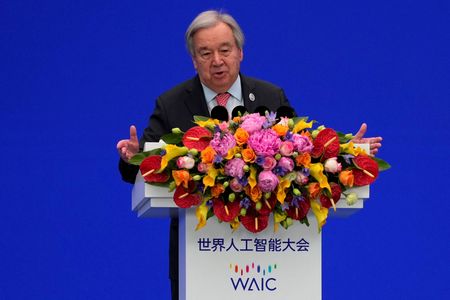

United Nations Secretary-General Antonio Guterres is scheduled to arrive in Syria on Saturday, becoming the first sitting UN chief to set foot in the country since the outbreak of a nearly 14-year war that claimed hundreds of thousands of lives and forced millions of Syrians from their homes.
The trip marks yet another significant moment for Syria following the ousting of former leader Bashar al-Assad by rebel forces in late 2024. That development brought the war — which began in 2011 — to a close and placed an Islamist-led transitional leadership in charge of the country. At the time, Guterres called the fall of Assad’s rule “the end of the Syrian dictatorship” and characterized it as a hopeful sign for the broader region.
During the visit, Guterres is expected to sit down with President Ahmed al-Sharaa, who previously led al Qaeda’s affiliate in Syria and remained under terrorism-related sanctions from the UN Security Council until November 2025. The UN chief will also hold meetings with Syrian Foreign Minister Asaad al-Shaibani, other government officials, and members of Syrian civil society, according to UN spokesperson Stephane Dujarric, who made the announcement on Tuesday.
Dujarric said Guterres will emphasize that Syria now has an opportunity “not only to recover from conflict, but also to lay the foundations for a future for Syria that will be more stable, more inclusive, and more prosperous for all Syrians.”
Guterres is expected to remain in Damascus for several days, though a full itinerary has not been made public by his office.
The visit comes just weeks after two bombs detonated near a Damascus hotel where French President Emmanuel Macron was staying during what was the first trip to Syria by a European Union head of state since Assad was removed from power.
Syria’s new government, led by al-Sharaa, has been working to rebuild the country’s international relationships and revive its economy after more than a decade of war and many years of isolation during the Assad family’s long rule.
However, the transition has been troubled by two serious episodes of sectarian violence that have challenged al-Sharaa’s repeated promises to safeguard Syria’s religious minorities. Nearly 1,500 members of the Alawite sect — the same religious group that Assad belonged to — were killed in Syria’s coastal region last year by factions aligned with the government. Months later, hundreds of Syrians from the Druze minority were killed in the country’s south. Guterres has expressed deep concern over both outbreaks of violence and has called for those responsible to be held accountable.
Al-Sharaa, who severed ties with al Qaeda in 2016, commanded an alliance of Islamist rebel groups that swept Assad from power in a swift offensive in December 2024. Since assuming leadership, his government has worked to broaden Syria’s diplomatic relationships beyond Assad’s long-standing allies, Russia and Iran.
Last year, al-Sharaa became the first Syrian president since 1967 to participate in the UN General Assembly in New York. The United States has since lifted most of its broad sanctions against Syria, and U.S. President Donald Trump recently informed al-Sharaa that he plans to remove Syria from Washington’s list of state sponsors of terrorism.
In addition to his government meetings, Guterres is expected to address Syria’s new parliament on Monday and visit a UN peacekeeping force that has maintained a buffer zone between Israeli and Syrian military forces for decades, Dujarric said.
Israeli troops have moved into new areas of southern Syria following Assad’s removal from power. Syria’s government has demanded that Israel withdraw and return to the terms of a 1974 disengagement agreement.