
NEW DELHI (AP) — India’s young protesters have found an unconventional weapon in their fight against the government: humor. And it appears to be working.
As thousands of demonstrators fill the streets of the Indian capital, they are simultaneously waging a battle online, saturating social media with memes, parody videos, and self-deprecating jokes that are capturing widespread attention.
In doing so, they are turning the tables on Prime Minister Narendra Modi — a powerful leader who is keenly aware of his public image — by using his own preferred battlefield against him.
Modi rose to political prominence in large part through his mastery of social media. Now, protesters are weaponizing those same platforms to ridicule his administration, lampoon pro-government television news coverage, turn police confrontations into viral moments, and wrestle control of the online conversation away from the government.
This digital offensive has carried the protests — which center on demands for accountability and education reform — far beyond the physical demonstrations, widening their reach and piling pressure on a government that is nervous about appearing to cave to a fast-growing youth movement.
Much of the “Cockroach” movement’s online campaign has run on humor as its fuel.
Clashes between protesters and police have morphed into viral content. In one example, videos showed demonstrators joking about keeping their Strava streaks alive — a nod to the fitness tracking app popular among runners — as they fled from police baton charges. In another, protesters edited footage of themselves slipping past police barricades to mimic the well-known endless runner mobile game Subway Surfers.
Some female demonstrators have drawn on influencer culture, posting “get ready with me” videos ahead of marches and “fit check” posts showing off helmets, goggles, and other homemade protective gear. Still others have produced spoof videos mocking pro-government television anchors and their theatrical broadcast style, which has branded the protesters as “anti-national” and “foreign-funded conspirators.”
The Associated Press spoke with several protesters who agreed to share their views only under the condition of anonymity, citing fears of retaliation from authorities.
One 25-year-old protester explained that the memes go beyond simple comic relief — they are a way of processing and coping with a difficult situation. She views it as a defining characteristic of her generation.
Unlike older generations, who developed a tolerance for hardship, her generation has little appetite for “simply putting up with it,” she said.
“If our phone data runs out, we can’t even bear that. So we’re definitely not going to tolerate this,” she said, referring to a police crackdown on protesters in the capital that took place on a Monday.
The street demonstrations began a month ago, ignited by outrage over a series of exam scandals, including the illegal leaking of entrance exams for the national medical program. Young people say these scandals have put their futures at risk and shattered confidence in the education system. Protesters have directed blame at Education Minister Dharmendra Pradhan and are calling for his resignation. The movement has since grown into a broader expression of anger over government accountability and has spread to other cities.
A major force behind that expansion is the Cockroach Janta Party, a satirical group that launched the movement two months ago. By harnessing memes, humor, and satire, the group has given younger Indians a fresh outlet for their frustration with the government and helped transform what began as a single-issue campaign into a wider youth movement.
At the central protest site in New Delhi, that influence is unmistakable.
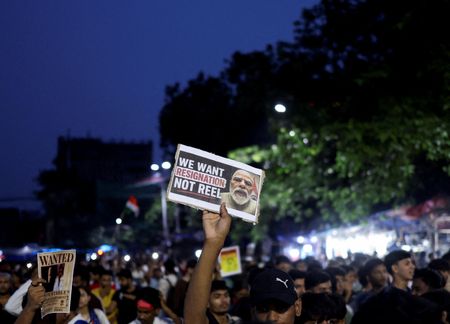
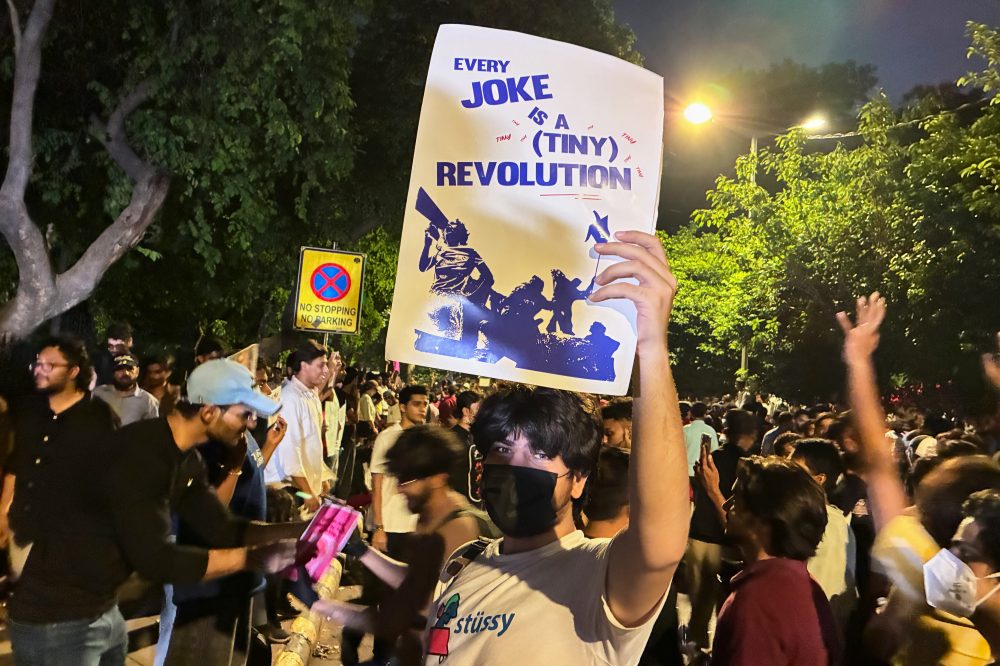
Some demonstrators march in Spider-Man masks and Batman costumes, carrying tongue-in-cheek signs. Other placards reflect the irreverent spirit of social media, blending memes and pop culture references into the protests.
One sign featuring the education minister posed the question: “When will AI take his job?” Another captured the movement’s essence with the phrase: “Every joke is a (tiny) revolution.”
Some slogans and signs have also taken on a more explicitly profane and provocative tone.
A 23-year-old student said the protesters are simply communicating in the language of their generation.
“We find speeches boring, we are the summary generation. We have a habit of consuming things in a short span of time, so we are using the same ways to put our message across,” she said.
For Modi, now entering his 13th year in power, the protests pose an unusual dilemma. His political identity is built around strength and decisiveness, yet cracking down too hard risks driving away young people at a time when nearly half of India’s population is under 25 — making youth voters one of the country’s most powerful electoral forces.
The protests have also shattered a longstanding taboo: openly mocking Modi himself.
During earlier protests, when his government faced criticism for cracking down on dissent, jokes targeting Modi directly were rare. Now, he has become a target himself.
His gestures, speech patterns, and mannerisms have been spliced into viral video edits that twist his own words into political punchlines.
When Modi posted a late-night, selfie-style video on Thursday addressing the protesters, he vowed swift legal action against those responsible for leaking academic or job-related exams. Internet users quickly responded by remixing the clip with parody voiceovers and callbacks to past promises they said had never been fulfilled.
One video spread especially fast. Modi’s original address opened with him calling the protesters “friends.” A parody version kept that same opening line, then abruptly cut to three young girls staring directly into the camera and responding: “No, we are not.”
A 21-year-old student summed up the strategy simply: there is no better way to push back against Modi than by using the very social media tools that helped build his political image.
“We’re just answering him in his language,” he said.