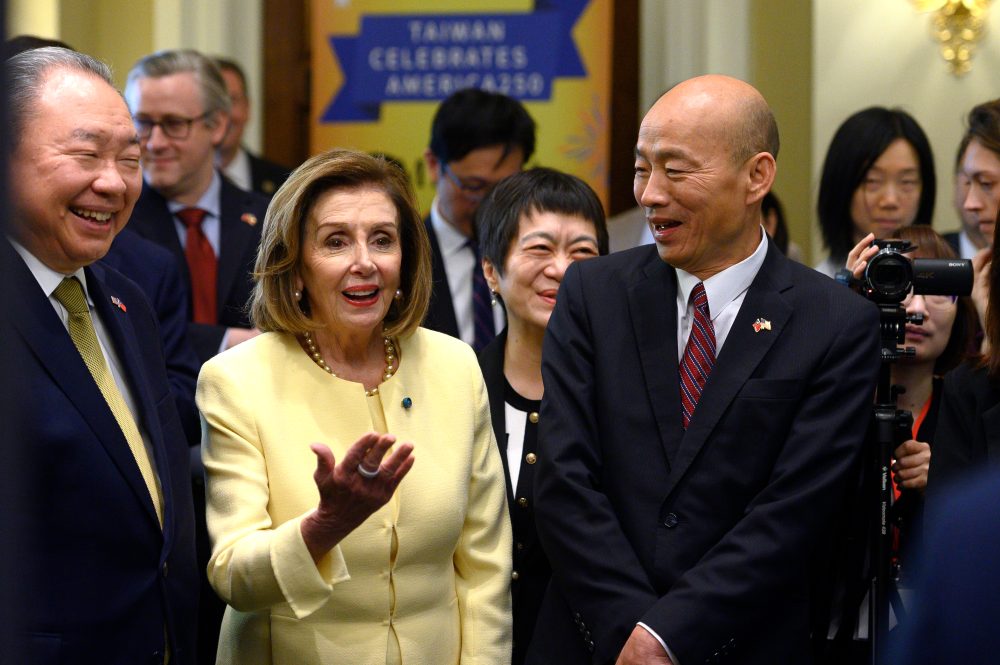

WASHINGTON — Lawmakers in the U.S. House of Representatives turned out in force Wednesday to express strong support for Taiwan, greeting Han Kuo-yu, the president of Taiwan’s Legislative Yuan, during a reception at the Longworth House Office Building. The visit comes at a sensitive moment, with the Trump administration currently reviewing a $14 billion arms sales package for Taiwan that had already received preliminary congressional approval.
More than 30 House members — from both sides of the aisle — attended the event to show solidarity with the island. Among those present were Speaker Emerita Nancy Pelosi of California, Rep. Michael McCaul of Texas, a Republican and former chair of the House Foreign Affairs Committee, and Ted Lieu, a California Democrat who serves as vice chair of the House Democratic Caucus.
McCaul wasted no time making his feelings known. “I love Taiwan,” he said while welcoming Han. “It’s very important to me to say that the United States supports you, Mr. Speaker.”
Pelosi echoed that sentiment, stressing that backing for Taiwan crosses party lines. “The support for Taiwan is bipartisan and bicameral — both houses, both parties,” she said. “It’s about peace. It’s also about commerce in terms of keeping the ships able to travel here.”
Han is leading an eight-member parliamentary delegation that flew into Washington on Tuesday evening after first stopping in Phoenix, Arizona, where the chipmaker Taiwan Semiconductor Manufacturing Co. is constructing new facilities and producing cutting-edge chips that are central to the artificial intelligence industry. TSMC has become a symbol of how deeply Taiwan’s economy is intertwined with that of the United States. Earlier Wednesday, Han met with U.S. senators, though his delegation declined to share specifics, noting only that the warm welcome from House members reflected how the senators had received them as well.
Taiwan sits at the heart of one of the most complicated issues in U.S.-China relations. Beijing considers the self-governed island part of Chinese territory and has not ruled out using military force to take control of it. Under U.S. law, Washington is required to supply Taiwan with enough military equipment to defend itself against any attack from the mainland. Following his May visit to Beijing, President Donald Trump announced he would be reviewing the $14 billion arms package — a deal China firmly opposes. Trump has also floated the idea that the package could serve as a negotiating tool. Secretary of State Marco Rubio, however, has stated that U.S. policy toward Taiwan has not changed.
Several lawmakers used Wednesday’s event to push back against any delay or cancellation of the arms deal.
“I’m here today … to affirm in the strongest terms that Taiwan is not a bargaining chip. It is an island of freedom. And we need to do all we can to preserve it,” said Rep. Lloyd Doggett, a Texas Democrat. “I believe we need to make available every weapon that Taiwan needs in its defense as quickly as it becomes possible.”
Rep. Lieu was sharply critical of the administration’s decision to hold the package. “I urge the administration to reverse that and to allow their arms sale to proceed,” he said.
Han, a member of Taiwan’s opposition KMT party, used his remarks to praise the United States on the occasion of its 250th anniversary and to draw a connection between the two sides’ shared commitment to freedom and democracy. He said both Taiwan and the U.S. carry the responsibility of protecting democratic values and maintaining stability and peace across the region.
Han also highlighted the strength of trade between Taiwan and the United States. The island of 23 million people has now surpassed Germany to become the fourth-largest trading partner of the U.S., a rise driven largely by global demand for Taiwan’s advanced semiconductor chips and other technology products.
Additionally, Han called on Congress to advocate for Taiwan’s broader participation in international affairs. Because of China’s territorial claim over the island, no country can maintain formal diplomatic ties with both Beijing and Taipei simultaneously. Only 12 governments — including the Holy See — still officially recognize Taiwan as a sovereign state. China has also worked to keep Taiwan out of international bodies such as the World Health Organization.
“On the international stage, Taiwan feels very lonely in its heart,” Han said. “I am here asking Taiwan’s good friends in Congress … to help us participate in global activities.”
Han is set to depart Washington on Friday aboard the inaugural nonstop flight operated by Taiwanese carrier EVA Air between Washington Dulles International Airport and Taiwan Taoyuan International Airport — a milestone that has been highlighted as further evidence of growing ties between the two sides.