
WASHINGTON — When the United States and Iran reached a tentative agreement to end the war, President Donald Trump managed to simultaneously praise the deal and cast doubt on it — sometimes within the same breath.
“It’s a very strong deal,” Trump said. “Nobody knows what it is. But it’s very strong.”
That kind of contradiction has become a hallmark of Trump’s presidency. He’ll appear to firmly take one side of a major issue, then pivot to the opposite position — and then suggest he hasn’t really made up his mind at all.
Just as Ronald Reagan earned the nickname “Great Communicator” and George W. Bush called himself “The Decider,” Trump appears increasingly comfortable occupying the role of what some are now calling the “Great Equivocator” — bouncing between contradictions within a single topic or even within a single social media post.
By staking out multiple positions, the president is rarely completely wrong, and different audiences can latch onto whichever statement aligns with their own views. Analysts note this is distinct from Trump’s tendency to make false claims, which can serve a deliberate political purpose.
“Trump is, generally, all over the map,” said Daniel Immerwahr, a historian at Northwestern University and author of “How to Hide an Empire: A History of the Greater United States.” “His friends forgive him, and his enemies hate it.”
White House spokesperson Kush Desai pushed back on questions about the president’s shifting stances, calling it an “asinine obsession with splitting hairs.”
“President Trump’s results speak for themselves,” Desai said, pointing to the ceasefire agreement, falling energy prices, and efforts to reduce prescription drug costs as “many other victories for the American people.”
Former aides from Trump’s first term say he leans on a business concept called “optionality” — keeping himself flexible enough to always have multiple paths forward. That allows him to change course quickly as political circumstances or personal priorities shift.
Deepak Malhotra, a Harvard Business School professor and author of “Negotiating the Impossible,” finds that explanation unconvincing.
“Business leaders and politicians have always sought to create option value whenever possible. But they wouldn’t go about it by taking incoherent, or mutually inconsistent, positions on major issues,” he said. “That erodes credibility.”
Even so, Trump’s unpredictability can make him a formidable negotiator, since no one can anticipate his next move. Some observers compare it to President Richard Nixon’s so-called “madman” theory of foreign policy, in which Nixon tried to gain leverage by keeping adversaries guessing about his volatility.
Trump has largely stepped away from the traditional U.S. role as the anchor of a rules-based international order. While that could hurt America’s global standing, it also gives Trump more freedom to maneuver, Immerwahr said.
Most presidents “are interested in systemic power, the whole chessboard,” Immerwahr said. Trump, by contrast, is “interested in what’s in front of his face.”
“That’s not just a pathology of his, that’s his worldview,” Immerwahr added. “That is a strategy.”
While most politicians work hard to avoid being labeled a flip-flopper, Trump has long been unbothered by contradicting himself — even when it rattles financial markets or frustrates fellow Republicans heading into November’s midterm elections.
On Iran, Trump had previously insisted that stripping Tehran of its enriched uranium stockpile and eliminating its ballistic missile capability were top priorities. More recently, he has suggested Iran should be allowed to keep both, citing the need for fairness among countries in the region.
“You’re not letting them have it for purposes of electricity and things like that,” he said in June about the enriched uranium. “You have to use a little common sense.”
On Iran’s missiles, Trump now says, “They have to have some because other people have some.”
Malhotra said Trump “has become accustomed to people not holding him accountable for outcomes because he is typically able to change the subject or declare victory regardless.”
“We are now witnessing what happens when someone like that realizes there are limits to how much you can spin reality,” he said. “You start to promise everything and nothing, and you get fixated on making excuses for yesterday rather than strategizing for tomorrow.”
Desai countered that the ceasefire deal was “the Art of the Deal in practice.”
Trump also repeatedly offered conflicting accounts of the war itself — claiming it was already won even as fighting intensified, dismissing it as “a little excursion” and “not a big thing,” while also citing it as the reason he couldn’t attend his son’s wedding in the Bahamas.
“I think there’s a point where he goes into default sales mode for whatever he’s trying to sell,” said Thomas Wright, a former special assistant to President Joe Biden and senior director for strategic planning at his administration’s National Security Council. “And he’ll say, with great conviction, points that will sometimes be in contradiction to each other.”
On Cuba, Trump has said the country is “ready to fall” without U.S. military action, while also suggesting the quick-strike operation that removed Venezuelan President Nicolás Maduro could serve as a blueprint for dealing with Cuba’s communist government.
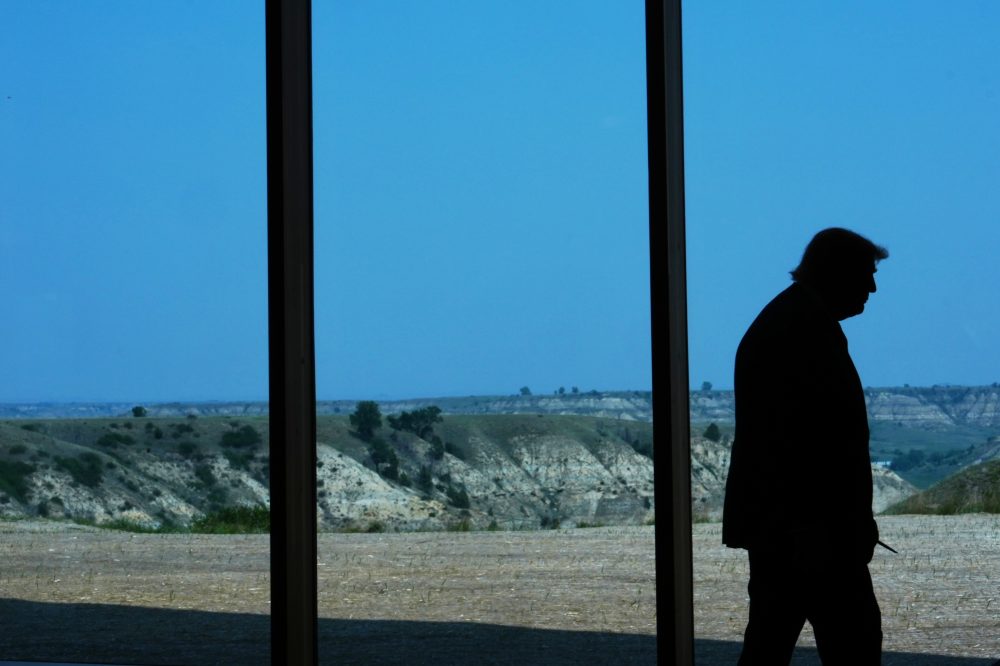
“Sometimes you have to use it,” Trump said of the military during a March investment forum. “And Cuba is next, by the way.” In a more recent speech in North Dakota, he went further, saying of Cuba: “After many, many decades, it’s coming our way.”
After years of attacking his predecessor for rising prices, Trump recently declared, “I love the inflation,” as costs climbed under his own watch during the Iran war.
Even on the question of seeking a third presidential term, Trump has gone back and forth — teasing another run one moment and suggesting he’s only joking the next, or maybe not.
Reagan earned his nickname through a background in radio, film, and television that gave him a natural gift for storytelling and connecting with audiences. Bush claimed the title of ultimate decision-maker during a difficult stretch of the Iraq War when asked whether he would fire his Defense Secretary.
Trump has never had trouble communicating. As a real estate developer in 1980s New York, he was so focused on controlling his public image that he reportedly used fake names to call reporters and pose as his own spokesperson.
Today, he speaks constantly to the press and is unquestionably the decision-maker in the White House, where aides often scramble to align their own statements with whatever position the president has most recently taken.
Trump still routinely talks in circles. After a sometimes tense lunch with Senate Republicans, he told reporters: “We like everybody really in the room. I don’t like a few people, but that’s OK.”
Daniel Ames, a professor at Columbia Business School who studies social judgment and behavior, suggested Trump may be motivated by a desire for showmanship.
“We could look at President Trump’s behavior through the lens of content production and managing for viewership,” Ames said. “Constant twists and cliffhangers may seem like attractive levers for engagement, leaving viewers wondering and having to tune back in to find out ‘What will I do?’”
Wright, now a senior fellow at the Brookings Institution, said Trump’s constantly shifting positions also mean he can fully back something one day and abandon it the next without warning — leaving even close allies in a difficult spot. He noted that Israeli Prime Minister Benjamin Netanyahu has been politically weakened as the Iran war’s major goals went unmet.
“It’s a little bit like riding the tiger,” Wright said. “You might sometimes get him to move in your direction. But, when all is said and done, one might wonder if it was better just to leave the tiger alone.”