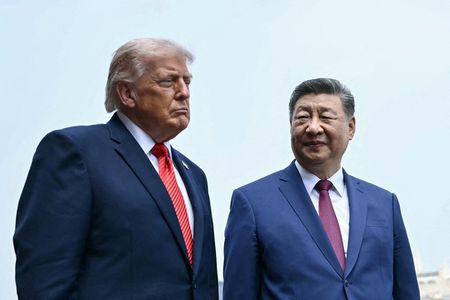

President Trump’s diplomatic trip to China has resulted in a managed improvement in relations between the two nations, with both countries announcing intentions for enhanced trade cooperation, potential significant Chinese acquisitions of Boeing planes, and an invitation for Chinese President Xi Jinping to visit the White House, though major disagreements concerning Taiwan, trade duties, cutting-edge technology, rare earth materials, and Iran remain unaddressed.
The American president and Xi conducted meetings Thursday at Beijing’s Great Hall of the People during President Trump’s initial China visit since 2017. These discussions occurred after President Trump’s Wednesday arrival in Beijing and took place as both administrations attempted to steady their relationship following extended periods of commercial tensions and strategic competition.
Chinese leadership characterized the session as an attempt to establish a more steady partnership in the coming years. According to official summaries of the discussions, Xi informed President Trump that China and the US ought to function as ‘partners, rather than rivals.’ Simultaneously, the Chinese leader cautioned Washington to approach Taiwan with ‘utmost caution,’ stating the matter could create an ‘extremely dangerous situation’ if handled improperly.
Taiwan continues to represent the most delicate political disagreement between both nations. Beijing considers the independently governed island territory as Chinese property and has not eliminated the possibility of military action to bring it under Chinese authority. Taiwan’s leadership disputes China’s assertion and maintains that only the island’s residents can determine their destiny. Washington keeps informal ties with Taipei and provides Taiwan with military equipment, while officially acknowledging Beijing as China’s legitimate government.
The commercial aspects of the trip seemed to generate the most apparent progress. Treasury Secretary Scott Bessent indicated he anticipated a substantial Chinese purchase order for Boeing aircraft to be revealed during the journey. He additionally mentioned that both nations were exploring Chinese acquisitions of US energy and farming goods, along with potential Chinese investments in non-critical areas of the American economy.
According to Bessent, Washington and Beijing were considering establishing a joint ‘Board of Trade’ and ‘Board of Investment’ to coordinate future economic cooperation. He also dismissed reports suggesting the administration was pursuing $1 trillion in Chinese investment, clarifying that such figures were not part of the negotiations.
Technology continued to be among the most scrutinized topics. The US has allegedly authorized sales of Nvidia H200 artificial intelligence processors to multiple prominent Chinese corporations, including Alibaba, Tencent, ByteDance, and JD.com, although shipments have not yet commenced. Nvidia Chief Executive Jensen Huang accompanied President Trump’s group in Beijing, demonstrating the crucial role of semiconductors and artificial intelligence in bilateral relations.
For Washington, semiconductor exports present concerns regarding profits, technological supremacy, and national security. For Beijing, this matter connects to China’s attempts to decrease reliance on US technology while preserving access to advanced equipment required for artificial intelligence advancement.
The trip also conveyed a significant business signal. Top executives from leading American corporations, including Nvidia, Tesla, and Apple, attended the Beijing meetings as Xi attempted to convince international investors that China remained welcoming to foreign business. This message arrives when international companies are evaluating Chinese market opportunities against regulatory risks, sluggish domestic consumption, and increasing geopolitical tensions.
President Trump also extended an invitation to Xi and his spouse, Peng Liyuan, to visit the White House on Sept. 24. Officials have indicated the two leaders might convene multiple times this year, including during the Group of 20 summit in Miami and the Asia-Pacific Economic Cooperation gathering in Guangzhou.
Iran-related conflicts also featured in the discussions. Available public information suggests diplomatic positioning rather than significant Chinese commitments. Both sides addressed Middle East tensions, energy transportation through the Strait of Hormuz, China’s position in international oil markets, and US concerns regarding sanctions implementation. China continues as a principal purchaser of Iranian petroleum, while the US seeks Beijing’s cooperation in avoiding actions that undermine pressure on Tehran.
From a ceremonial perspective, the journey appears to have proceeded without incident, featuring an official reception, a Temple of Heaven tour, a state dinner, and high-level meetings intended to demonstrate stability. In terms of substance, the visit resembles a temporary halt in ongoing competition rather than a major breakthrough. Both administrations secured valuable public relations benefits and possible business agreements, but fundamental disagreements persist.
President Trump is scheduled to depart China on Friday, May 15.