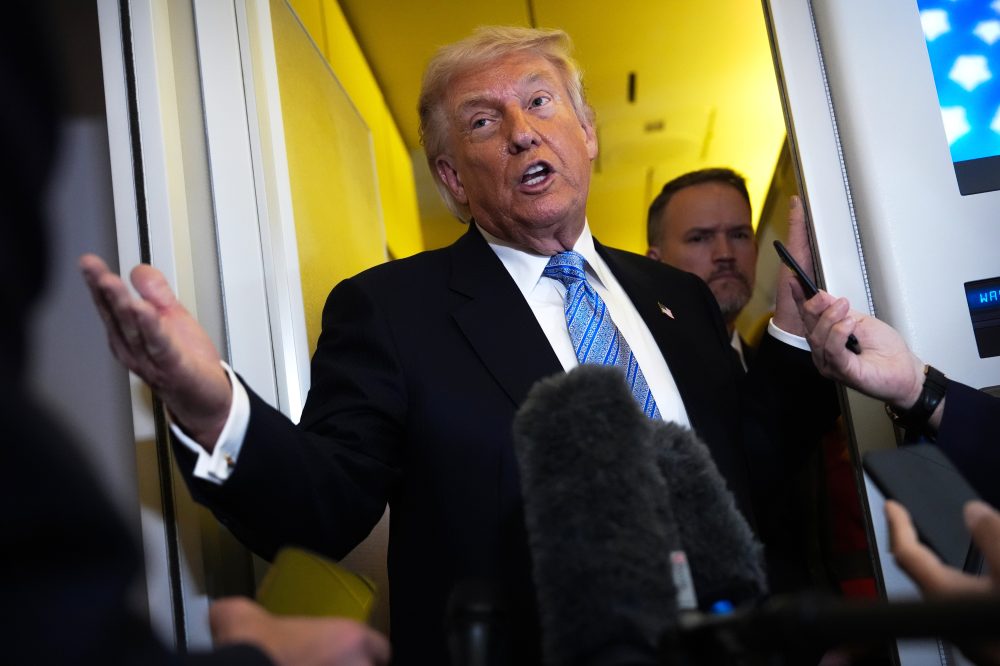

BEIJING (AP) — During a three-day visit to China, President Donald Trump remained unusually reserved, avoiding reporters and limiting his social media activity. However, once aboard his return flight, he opened up about the discussions.
The president’s visit was surprisingly focused on Taiwan tensions and the possibility of establishing a fresh approach to managing the complex U.S.-China relationship.
Chinese President Xi Jinping began the intensive visit with a stern message: mismanaging relations with the self-governing Taiwan could lead to confrontation or even open warfare between the U.S. and China.
While in Beijing, Trump avoided any public response and didn’t mention Taiwan. However, during his Air Force One flight home, he indicated that Xi’s strong opposition might influence his decision on a proposed U.S. weapons sale to Taipei.
Other discussion topics included trade and the U.S. and Israel’s conflict with Iran, which had been anticipated to dominate the agenda. Throughout the visit, Trump openly praised China’s leader, though Xi didn’t return the compliments.
The president also didn’t publicly challenge China’s claim that he and Xi had reached agreement on a “constructive” new approach to managing their relationship challenges.
Key highlights from Trump’s visit:
Prior to the trip, Trump had shown increased uncertainty about Taiwan during his second term, sparking questions about whether he might reduce support for the island democracy that Beijing considers a rebellious province.
Secretary of State Marco Rubio maintained that U.S. policy toward Taiwan remained unchanged. However, concerns existed that Trump — not recognized for diplomatic subtlety — might make spontaneous comments with significant consequences for Taiwan.
Ultimately, Trump made no public statements about Taiwan, despite his Chinese counterpart emphasizing the island as the most crucial element of U.S.-China relations.
When questioned by reporters after departing China, Trump revealed he hadn’t decided whether to proceed with a substantial arms package he had previously approved for Taiwan following Xi’s objections.
Trump’s Republican administration authorized an $11 billion weapons package for Taipei in December, though it hasn’t advanced. Lawmakers also approved a $14 billion arms sale to Taiwan in January, but it requires Trump’s formal submission to Congress to proceed.
“President Xi and I talked a lot about Taiwan,” Trump told reporters aboard the presidential aircraft. He explained that China’s leader “does not want to see a fight for independence because that would be a very strong confrontation.”
“I heard him out,” Trump stated. But “I didn’t make a comment.”
Trump seemed to have difficulty remembering Taiwanese President Lai Ching-te’s name and remarked about Washington’s island policy, “The last thing we need right now is a war that’s 9,500 miles away.”
When asked about potential military intervention if China attacked Taiwan, Trump declined to answer — a response aligned with longstanding U.S. policy known as strategic ambiguity.
This policy commits the U.S. to ensuring Taiwan can defend itself against forced unilateral changes by China, but doesn’t specify Washington’s military response level should conflict arise.
The leaders apparently held meaningful discussions about the U.S.-initiated Iran conflict that has driven up global oil prices and could potentially trigger worldwide recession if prolonged.
Trump reported that Xi agrees a nuclear-armed Iran is problematic and that the Strait of Hormuz needs reopening. He claimed Xi offered assistance in finding a war resolution.
Xi and Chinese officials haven’t confirmed such an offer. China has publicly stated that solutions should “take into account the concerns of all parties on the Iran nuclear issue.”
Trump believes China should play a larger role in resolving the conflict, given its reliance on Middle Eastern oil and liquefied natural gas.
Successfully convincing Xi to increase involvement could significantly benefit U.S. efforts to find a credible Iran war exit strategy.
China announced that both leaders agreed to a new vision for “a constructive China-U.S. relationship of strategic stability.”
The Chinese Foreign Ministry stated this framework would guide relations for at least three years — Trump’s remaining term — emphasizing cooperation, limited competition, and difference management.
The concept aims “to keep the relationship on an even keel,” explained Helena Legarda of the Mercator Institute for China Studies in Berlin.
George Chen, a partner at The Asia Group consultancy, viewed this approach as advancement from Trump’s Democratic predecessor Joe Biden’s era, when relations were characterized as strategic competition.
Trump brought numerous top CEOs to China, including the aircraft maker Boeing’s head, semiconductor giant Nvidia’s Jensen Huang, and SpaceX boss Elon Musk, who previously led Trump’s federal workforce reduction efforts.
Trump claimed major agreements were reached and that China might purchase approximately 200 Boeing aircraft, but he left Beijing without concrete announcements. Earlier suggestions that Xi would commit to large U.S. soybean and beef orders remained unresolved.
Speaking to Air Force One reporters, Trump suggested China could eventually purchase up to 750 Boeing planes if initial orders succeed, with 450 General Electric engines included in potential future purchases.
Additional trade agreement details may emerge later, but as with all major bilateral accords, specific terms matter most.
During his first term, Trump used an elaborate Beijing signing ceremony to finalize dozens of deals worth approximately $250 billion. However, not all pledged agreements materialized.
From his first Beijing remarks, Trump consistently praised Xi, sometimes excessively, while Xi offered no similar reciprocation.
Trump called Xi a “great leader” and predicted they would have a “fantastic future together.”
He described being with Xi as an “honor” and called him a friend, characterizing his counterpart as “warm.”
China’s president isn’t known for being effusive. Trump himself described Xi as “all business” in a Fox News interview.
Xi did acknowledge Trump’s “landmark visit” had strengthened mutual trust. However, he used subtler charm tactics, promising to send White House rose seeds like those in his residence garden where Trump had Friday tea.
Xi explained he hosted Trump there to reciprocate the hospitality Trump provided during Xi’s 2017 visit to Trump’s Mar-a-Lago Florida estate.