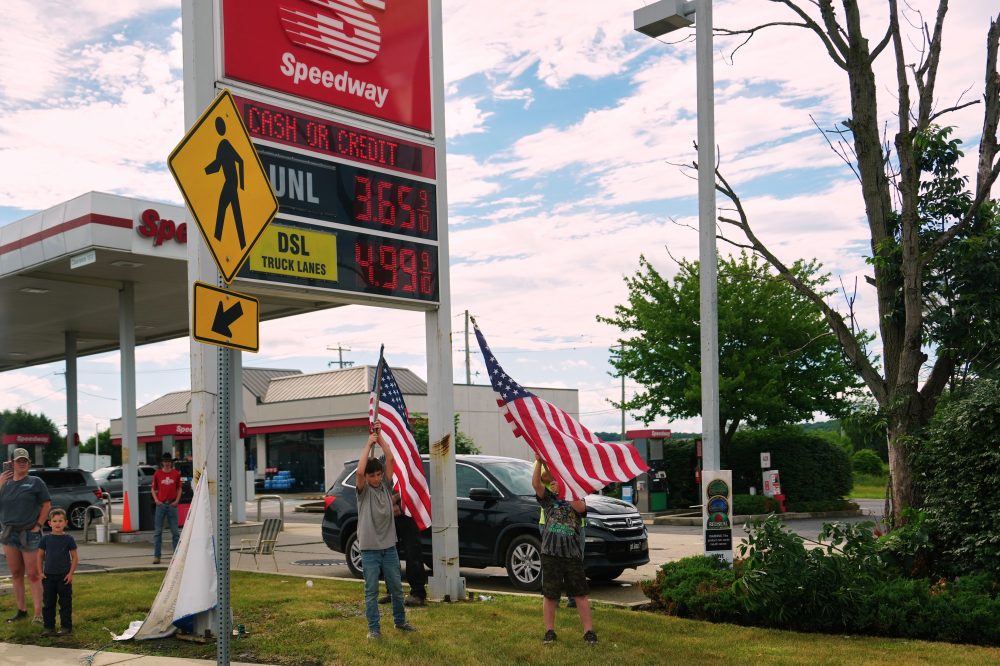

NEW YORK (AP) — The average price of gasoline across the United States has dropped 49 cents per gallon over the past month, driven largely by growing expectations that the conflict with Iran may be winding down. But that decline isn’t happening fast enough to satisfy President Donald Trump.
With midterm elections on the horizon and economic concerns mounting, Trump is now directing blame at oil companies. In an early-morning post on Truth Social just after midnight Wednesday, the president announced he had asked the Justice Department to look into whether consumers are being taken advantage of at the pump.
“The big Oil Companies are not dropping their price at the pump commensurate with the sharply lower prices they are paying for Oil,” Trump wrote. “Gasoline prices better start going down a lot faster than what I’m seeing!”
While crude oil is the primary ingredient in gasoline and accounts for the largest portion of what drivers pay, oil companies themselves don’t actually set gas prices — that’s up to the individual gas station owners. Those station operators often have little choice but to pass along price increases when oil costs spike, as happened during the Iran conflict.
Experts note that even after crude prices fall, it can take weeks or more for those changes to work their way through the system and ultimately reach consumers at the pump.
“It sounds a bit like political theater to me,” said Karen Young, a senior research scholar at Columbia University’s Center on Global Energy Policy, during a CNBC interview. “That’s not really how gasoline prices work in the U.S.”
WTI crude, the U.S. benchmark, has fallen 27% over the past month and was trading at $70.45 per barrel on Wednesday — still about 5% above where it stood before the war began. The average price for a gallon of regular unleaded gasoline was approximately $3.93, according to motor club federation AAA. That figure is roughly 13% lower than a month ago but still 32% higher than pre-war levels.
Several factors influence what gas station owners charge customers. According to the Energy Information Administration, crude oil made up about 51% of the cost of a gallon of gasoline last year. When oil becomes scarce and prices climb, gas prices typically follow suit.
The surge in oil prices earlier this year was tied in large part to Iran blocking ships from crossing the Strait of Hormuz — a critical waterway through which roughly one-fifth of the world’s oil and natural gas normally flows. That blockade was lifted after Iran reached an interim agreement with the Trump administration last week.
Beyond crude oil costs, federal and state taxes accounted for about 17% of gas prices in 2025, while refining costs and profits made up 14%, and distribution and marketing added another 17%, according to the EIA. States like California see prices well above the national average due to higher taxes and refining expenses.
Seasonal factors are also at play. Gasoline prices typically rise somewhat at this time of year as refineries switch to summer-blend fuels, which cost more to produce than winter formulations. Road travel also picks up in warmer months. AAA projects that 61.4 million Americans will travel at least 50 miles from home by car over the upcoming July Fourth holiday — just slightly more than the 61.3 million who did so last year.
Part of the delay in falling pump prices comes down to how the supply chain works. Refineries purchase crude oil in advance, and those deliveries can take considerable time. That means a refinery may still be processing oil bought at higher prices even weeks after market rates have dropped. From there, gasoline must travel through pipelines, ships, trucks, and storage terminals before finally arriving at filling stations — all of which adds time before lower costs reach drivers.
“We all felt how fast gasoline prices rose this spring,” said Rob Smith, director of global fuel retail at data and analytics provider S&P Global Energy. “The pace of their rise was actually less than the pace of the rise for crude oil.”
Smith calculated that Brent crude — the international oil benchmark — rose about $1.75 per gallon between the start of the war and early April, while average gasoline prices climbed $1.10 during that same stretch.
“It went up a lot,” Smith said of gasoline prices. “But it still wasn’t as much as the crude price went up.”
He explained that retailers absorbed some of the cost rather than passing the full increase along to customers. When oil prices began falling, those retailers were able to recoup some of what they had lost.
“Over the course of a year, there’s a certain operating margin that the retailers need to keep the lights on,” Smith said. “The vast majority of gas stations are owned by small corporations. A family that owns a dozen stations, or even one or two stations, they have little room for error.”
Oil prices have been declining for several weeks, spurred first by anticipation of a deal between the U.S. and Iran, and now by renewed optimism as more ships begin passing through the Strait of Hormuz following last week’s tentative agreement.
“Our industry shares the goal of delivering relief at the pump and restoring stability to global energy markets,” said Bethany Williams, a spokesperson for the American Petroleum Institute, in an email statement. “Gasoline prices don’t move in lockstep with crude oil, especially during a major global disruption that is still affecting supply, refining and inventories.”
Analysts caution that it could take months — or longer — for supply chains to return to pre-war levels. S&P Global Energy said earlier this week that it does not expect Persian Gulf oil production to fully recover until at least the first quarter of 2027. Conditions in the Strait of Hormuz have also shown the potential to shift rapidly.
Even with recent price drops, American drivers are still paying close to $1 more per gallon than they were before the war started, and gas is nearly 22% more expensive than it was at this point last year. Many households have responded by tightening their budgets and reconsidering spending habits more broadly.
Gasoline isn’t the only thing that has gotten more costly during the conflict. Groceries, airline tickets, and a range of consumer goods — including items like condoms and shoes — have all risen in price due to supply chain disruptions. Experts warn that even if a final peace agreement is reached and oil flows reliably from the Middle East again, prices are likely to stay elevated for some time.
Before joining Israel in launching strikes on Iran on Feb. 28, Trump had boasted about low gas prices. After Iran cut off Strait of Hormuz traffic and energy costs surged, the president shifted his tone. At one point in March, he attempted to reframe the situation positively, noting that since the U.S. is the world’s largest oil producer, rising oil prices could mean financial gains for the country.
An online tracker from Brown University’s Watson School of International and Public Affairs estimates that higher fuel prices for gas and diesel have cost American households an average of more than $474 since the war began — a combined consumer burden of approximately $62.1 billion nationwide.