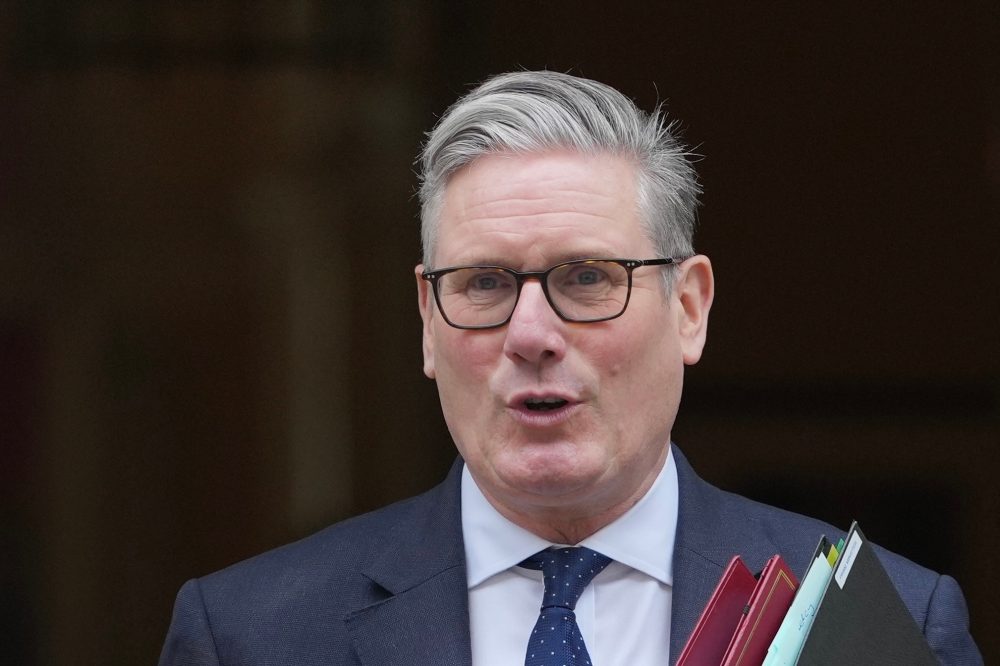

Political adversaries are blasting British Prime Minister Keir Starmer for damaging the historic alliance between the United States and United Kingdom following disagreements with President Donald Trump regarding Iran policy.
On Tuesday, Trump labeled Britain as “uncooperative” and criticized Starmer as “not Winston Churchill” following the prime minister’s initial refusal to allow American forces to utilize British military installations for operations against Iran. Starmer subsequently changed his position, permitting US aircraft to operate from English bases and the Diego Garcia facility in the Indian Ocean for strikes on Iranian missile installations threatening British allies across the Middle East.
Despite this reversal, Trump’s frustration persists, leaving Starmer to assess potential consequences for Atlantic partnerships and commercial relationships.
The foundation for post-World War II cooperation between the nations was established when Churchill proclaimed in a 1946 address at Westminster College in Missouri that there existed “a special relationship between the British Commonwealth and Empire and the United States.”
This partnership has endured through decades thanks to shared language, mutual interests, defense collaboration and cultural bonds. Personal connections have sometimes strengthened these ties, including the alliance between Prime Minister Margaret Thatcher and President Ronald Reagan during the 1980s, and the partnership between Tony Blair and Bill Clinton in the 1990s.
However, tensions have emerged periodically. During 1956, Israel, Britain and France launched an operation to control the Suez Canal following Egypt’s nationalization of the waterway. These forces ultimately retreated when President Dwight D. Eisenhower’s administration withheld support and threatened economic penalties, highlighting Britain’s declining influence and America’s growing global dominance.
Ten years later, diplomatic relations reached another low point when British Prime Minister Harold Wilson refused pressure from President Lyndon B. Johnson to participate in the Vietnam conflict.
Blair attempted to prevent similar discord by deploying British forces alongside the American-led Iraq invasion in 2003, based on subsequently discredited intelligence regarding Saddam Hussein’s purported weapons programs. This war resulted in 179 British military deaths, approximately 4,500 American casualties, and thousands of Iraqi fatalities. Blair’s choice remains among the most divisive decisions by a British leader in recent history.
The center-left Starmer had developed unexpectedly positive relations with Trump following the president’s 2025 return to office, though tensions between the leaders have been escalating for months. Trump’s statements about potentially acquiring Greenland drew condemnation from Starmer and fellow European officials earlier this year.
More recently, Trump has criticized Britain’s decision to transfer the Chagos Islands, which house the Diego Garcia installation, to Mauritius, despite his administration’s previous support for the arrangement.
Starmer has strongly suggested he views military action against Iran as unlawful and stated the British government opposes “regime change from the skies.”
Cabinet minister James Murray declared Wednesday that Starmer was proceeding with “a cool head, with a real clarity of purpose,” and maintained that Britain’s connection with America remains “historic, long-lasting and deep.”
However, political rivals and media critics argue that Starmer is marginalizing Britain during a critical period. The conservative Daily Mail announced: “Starmer takes the Great out of Britain.”
Conservative leader Kemi Badenoch argued that Starmer should have endorsed the American-Israeli military campaign.
On Monday, an Iranian-manufactured drone attacked a British air force installation in Cyprus, resulting in “minimal” damage without casualties. Badenoch claimed that Starmer “has the wrong priorities.”
“When our bases are attacked, they call the lawyers,” she stated Wednesday.
American presidential temperament can shift rapidly, and British authorities are optimistic this current disagreement will resolve quickly.
Trump’s warning this week to terminate trade with Spain after Prime Minister Pedro Sánchez condemned Iranian strikes as “unjustifiable” and “dangerous” demonstrates the potential consequences.
The British agreement with Mauritius regarding the Chagos Islands in the Indian Ocean, which Britain considers essential for maintaining the Diego Garcia base’s future, remains suspended pending American approval. A trade agreement signed by Trump and Starmer with considerable ceremony in May has yet to be completed and faces uncertainty following Trump’s recent tariff announcements.
Peter Ricketts, a former British national security adviser, observed that Trump appears to demand “completely blind loyalty” from allies and had launched an “unfair” attack against Starmer. However, he advised British officials against overreacting.
“I think the prime minister should keep calm and carry on,” he told the BBC.