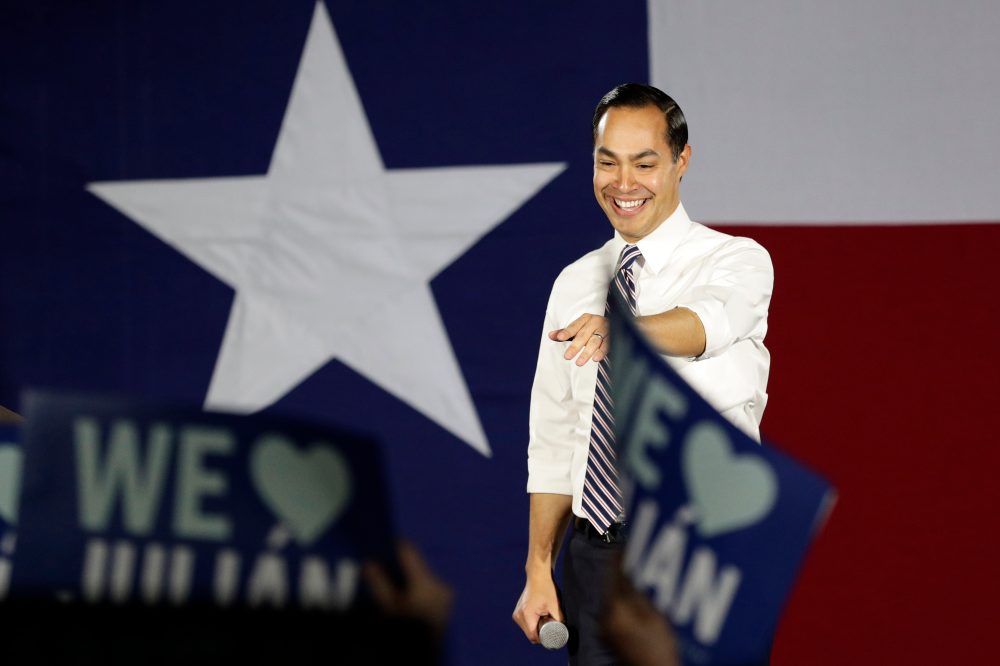

Former Housing and Urban Development Secretary Julián Castro is launching an ambitious initiative to address what he calls a “five-alarm fire” facing Latino communities nationwide.
Castro, who previously ran for president and now leads the Latino Community Foundation, announced Wednesday his organization’s commitment to establishing a $250 million endowment while expanding grant distribution throughout southwestern states.
“The destiny of the United States is intertwined with the destiny of the Latino community like never before,” Castro shared with The Associated Press. “We’re confident that by helping to ensure that the Latino community does well, we’re helping to ensure that the United States does well in the years to come.”
The initiative addresses a stark funding gap in charitable giving. Organizations serving people of Latin American heritage consistently receive less than 1% of all philanthropic funding, according to Hispanics in Philanthropy, despite Census data showing nearly 20% of Americans identify as Hispanic or Latino.
This disparity has grown more pronounced as community organizations assist immigrant families dealing with President Donald Trump’s expanded enforcement measures. The current administration is increasing detention facility capacity to potentially house around 100,000 immigrants, while enforcement actions in cities like Minneapolis and Chicago have created fear in predominantly Latino neighborhoods, where some residents avoid leaving their homes regardless of their legal status.
Responding to these challenges, the Latino Community Foundation launched its first nationwide funding program last month, distributing an initial $500,000 to five organizations in Minnesota, California and Nevada focused on holding federal immigration authorities accountable and safeguarding families.
The foundation has evolved significantly since starting as a San Francisco United Way affinity group in 1989. Castro hopes to distribute at least $10 million yearly, matching last year’s output when Los Angeles-area wildfire response pushed grantmaking beyond typical levels.
However, the organization’s current $35 million endowment — which Castro describes as “modest” compared to other philanthropies — cannot address expanding nationwide demand.
“Now is the moment, under these unique circumstances that we face, to go bigger and to seek to make a real, lasting impression on philanthropy,” he explained.
Castro, who previously served as San Antonio’s mayor before leading HUD during President Barack Obama’s second term, discussed his foundation vision exclusively with AP.
He emphasized the widespread need across America, noting Latino population growth over recent decades extends beyond traditional areas into smaller communities throughout the Southwest, Midwest, and every region.
During visits to Arizona and Nevada, Castro observed numerous excellent community-rooted nonprofits conducting voter registration, voter mobilization, small business capital access, and Latino empowerment work — all chronically underfunded.
“It feels like an imperative,” Castro said about the current moment. “The moment that we’re going through gives me and the LCF team an added sense of purpose and of urgency to serve our community.”
He noted that all team members share immigrant heritage and feel fortunate to have accessed American opportunities while pursuing their aspirations.
“And that’s what we want for everybody in the country — of course, including other Latinos, whether they’re recent immigrants or they’ve been here for five generations,” Castro continued. “And what I see happening in the country right now is the taking away of opportunity. Subtraction instead of addition.”
The endowment will provide funding for nonprofits typically excluded from mainstream philanthropy, Castro explained, since the Latino Community Foundation emerged partly because mainstream philanthropic dollars rarely reach Latino-led organizations.
“This endowment will help ensure that if somebody is doing excellent grassroots work to serve the Latino community, they always have a place to look,” he said.
Castro acknowledged that many organizations remain deeply connected to their local communities but face staffing shortages, lack grant writers, and need expertise in securing philanthropic resources. He also noted that major philanthropy still requires significant progress in reflecting national diversity and understanding comprehensive community needs.
“We know that there’s a very strong need. We know that that need is going to continue. And that the investments that we’re making to Latino-serving organizations are consistent with the current law,” Castro stated.
While some funders have reduced investments in organizations serving specific demographic groups, Castro called this development unfortunate given persistent generational inequities.
“The Latino Community Foundation is absolutely committed to our mission. And through thick and thin, we’re gonna have the community’s back,” he concluded.