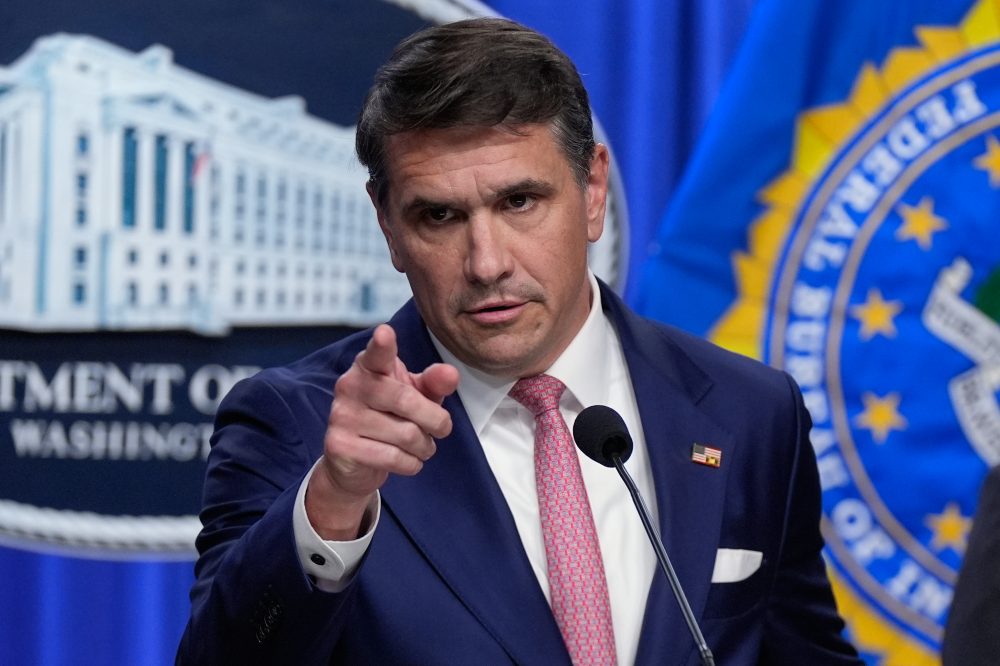

WASHINGTON — Todd Blanche is facing one of the biggest tests of his career this week as he seeks official confirmation as attorney general, with several key Republican senators still on the fence about whether to support him.
To move his nomination forward, Blanche needs every Republican on the Senate Judiciary Committee to vote in his favor. He has been leading the Justice Department in an acting role since April.
When he appears before the committee Wednesday, Blanche is expected to be questioned sharply on several fronts — including the department’s investigations into President Donald Trump’s political opponents, a disputed settlement tied to Trump’s IRS lawsuit, and the department’s controversial management of records related to Jeffrey Epstein.
Here is a breakdown of the major issues likely to take center stage at the hearing:
Political Prosecutions and Loyalty to Trump
Blanche first gained widespread public attention as the lead defense attorney for Trump during his hush money trial in New York. The close bond the two developed during that case — and the steadfast loyalty Blanche has demonstrated since joining the Justice Department — will likely be a focal point of Wednesday’s hearing.
Trump has made no secret of his wish to use the Justice Department to go after those he considers political enemies. Blanche has ramped up investigations into perceived opponents of the president, particularly after his predecessor was removed following a failure to produce criminal cases against Trump’s rivals.
Democrats have argued that Blanche is behaving more like Trump’s personal lawyer than the nation’s top law enforcement official.
Blanche has firmly pushed back on those accusations. In a February interview with ABC, he stated that “there’s not a whiff of political partisanship in what we’re doing.”
Traditionally, the Justice Department has maintained a careful separation from White House influence when it comes to deciding which cases to pursue. But Blanche has said he sees nothing wrong with the president taking an interest in departmental matters and has denied feeling any pressure to satisfy Trump.
“We have thousands of ongoing investigations and prosecutions going on in this country right now,” Blanche said during a May press conference. “And it is true that some of them involve men, women and entities that the president in the past has had issues with and believes should be investigated. That is his right, and indeed it is his duty to do that.”
When asked at that same event about his possible nomination for attorney general, Blanche said that if Trump chose someone else, his response would be: “Thank you very much. I love you, sir.”
January 6 and the Capitol Riot Pardons
Blanche’s past statements about the January 6, 2021, attack on the U.S. Capitol are also expected to come under fresh scrutiny.
Blanche has said he was not consulted before Trump issued sweeping pardons to roughly 1,500 people charged in connection with the riot, including individuals convicted of assaulting police officers. During his earlier confirmation hearing for deputy attorney general, Blanche said that anyone who commits violence against law enforcement “should be prosecuted to the fullest extent of the law.”
When senators asked whether he would counsel the president against pardoning violent offenders in the future, Blanche told lawmakers that “violence against law enforcement is never something that should be tolerated.”
However, at a May appearance before the Conservative Political Action Conference, Blanche celebrated the January 6 pardons as a victory for the administration. Speaking to a cheering crowd, he said, “by 5 p.m. on Jan. 20, every one of them was either pardoned or had their sentence commuted.”
“So when folks say we’ve done nothing, I say ‘you have a very short memory,’” Blanche added.
Republican Sen. Thom Tillis of North Carolina — whose vote is considered essential for Blanche’s nomination — has said he will not back any attorney general candidate who hedges on what happened on January 6. Tillis recently indicated, however, that he currently has no concerns about Blanche’s record on the matter.
With the death of South Carolina Sen. Lindsey Graham, who had been a member of the Senate Judiciary Committee, the panel now consists of 11 Republicans and 10 Democrats. A single Republican “no” vote could be enough to derail Blanche’s nomination entirely.
The $1.776 Billion Compensation Fund
Perhaps the most turbulent chapter of Blanche’s time running the Justice Department has been the controversy surrounding a $1.776 billion fund intended to compensate individuals who felt they were treated unfairly by the criminal justice system and who are allies of the president.
Blanche served as the public face of the initiative, which grew out of a settlement of Trump’s $10 billion lawsuit against the Internal Revenue Service over the leak of his tax returns. The fund immediately drew bipartisan opposition from Congress, including a heated closed-door meeting during which Republican lawmakers reportedly confronted Blanche loudly over the proposed payouts.
Weeks after that confrontation, Blanche announced the plan was being abandoned, telling a hearing, “We are not moving forward with the fund, period.”
Still, Democrats are expected to press Blanche on whether the fund is truly dead, particularly since Trump has continued to express support for compensating his supporters and since the Justice Department has resisted a judge’s demand that it put in writing that the fund will not be revived.
Sen. Tillis has also been outspoken in his criticism of a separate element of the IRS settlement — a provision that grants Trump and his family members protection from future audits. Blanche has repeatedly confirmed that this audit immunity agreement remains in place, an issue that is expected to generate pointed questions from both parties. A federal judge on Monday stopped short of voiding the audit immunity deal but raised serious doubts about its legal standing.
The Epstein Files Controversy
Blanche was serving as deputy attorney general during the summer of 2025 when the Justice Department found itself engulfed in a crisis over how it was handling records from the Jeffrey Epstein sex-trafficking investigation. Questions have persisted even after the department released what it described as more than 3 million pages of documents from the probe of the late financier.
Blanche is certain to face tough questioning on this topic, especially after his predecessor told lawmakers in a private meeting following her dismissal as attorney general that Blanche had been the department’s lead official overseeing the release of the Epstein documents.
The controversy began in February 2025, when the then-attorney general presented far-right influencers at the White House with white binders she claimed contained the Epstein files — materials that turned out to consist largely of documents already available to the public.
The situation deteriorated further last July when the department issued an unsigned statement declaring it would release no additional records, only to reverse course after a wave of criticism from across the political spectrum and after Congress passed legislation requiring the documents to be disclosed.
The release itself was plagued by serious errors, including redaction mistakes that left exposed nude photographs showing the faces of possible victims. Some names, email addresses, and other identifying details were either left unredacted or not adequately obscured.
Blanche has also drawn scrutiny for personally traveling to a Florida prison to interview Epstein’s former girlfriend, Ghislaine Maxwell, who is serving a 20-year sentence for recruiting teenage girls to be sexually abused by Epstein. Following that visit, Maxwell was transferred from a low-security federal prison in Florida to a minimum-security prison camp in Texas.