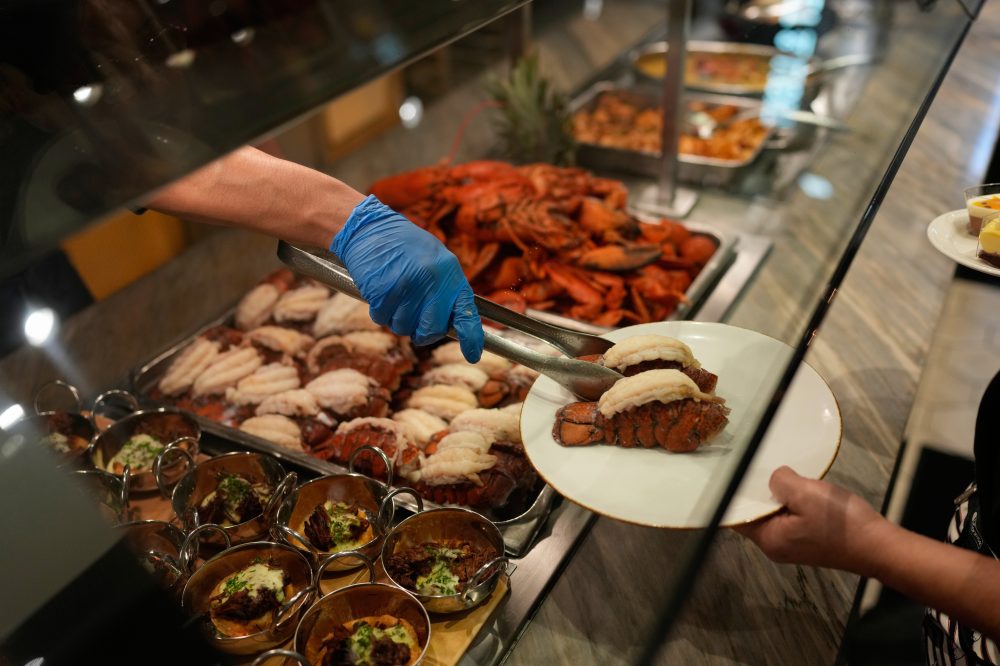

LAS VEGAS — It was a landmark evening in a small desert city with big ambitions. Shortly after the close of World War II, Las Vegas unveiled what a local newspaper described as America’s very first all-you-can-eat buffet, drawing out local dignitaries and the social elite for the occasion. Glazed ham and prime rib were on the menu at the El Rancho Vegas, and American dining would never quite be the same.
While the space race and arms race dominated Cold War-era news coverage, a quieter revolution was happening on American farms. Through advances in genetics, chemical treatments, and motorized machinery, U.S. agricultural output nearly tripled between 1948 and 2017 — and someone had to eat all that food.
The buffet concept offered one answer. At least three Las Vegas legends claimed credit for inventing it. The most widely told version centers on a promoter named Herb McDonald, who one night reportedly set out cheese and cold cuts along a bar. According to his 2002 obituary, “Gamblers walking by said they were hungry, and the buffet was born.”
Michael Green, a history professor at the University of Nevada, Las Vegas, explains that other casinos soon followed suit, offering buffets as a way to keep gamblers fed and on the floor. For a single flat price, diners could pile their plates with salads, meats, pasta, and seafood — and, crucially, go back for seconds.
But the origin story has long been contested. Las Vegas historian Jeffrey Carlson dismisses the El Rancho tale outright. “It couldn’t have been that simple,” he says, pointing to a rival account that ties the buffet’s creation to organized crime figures who helped shape early Las Vegas.
In his book “Neon Metropolis: How Las Vegas Started the Twenty-First Century,” author Hal K. Rothman credits mobster Davie Berman with the invention. Berman relocated from Iowa in 1944 as Jewish gangsters were acquiring local hotels and casinos. He reportedly hired a chef who laid out lox, whitefish, herring, and other traditional Jewish brunch items on a long table. “A Las Vegas tradition, the buffet, was born,” Rothman wrote.
Regardless of its true origins, the all-you-can-eat buffet eventually spread far beyond Nevada, taking root in restaurant chains like Golden Corral and Ponderosa across the country. Over time, however, food industry expert Darren Tristano notes that the format began losing customers to casual dining establishments like Olive Garden and Chili’s.
Then came 2020. The COVID-19 pandemic struck a serious blow to the buffet business — one that has yet to fully heal. The idea of communal food stations where everyone reaches for the same serving spoons suddenly lost much of its appeal.
Still, longtime Las Vegas food journalist Al Mancini believes the buffet will always hold a special place in that city’s culture. “There’s a visceral reaction to just loading up that tray,” he says. “People still love that, and I think they always will.”
This story is part of a recurring series called “American Objects,” produced in recognition of the 250th anniversary of the United States.