
KNOXVILLE, Tenn. — Dr. John Gordon spent three decades helping couples struggling with infertility, but his faith eventually led him to question the very methods he used to help them.
The reproductive endocrinologist found himself increasingly uncomfortable with standard fertility treatment practices that created excess embryos destined for storage or disposal. Modern genetic screening allowed parents to select their baby’s gender or eliminate certain conditions, raising ethical questions that troubled the Christian physician.
“It’s too morally problematic,” Gordon reflected. “I don’t know where you draw the line.”
His wife Allison pushed for change in 2018, viewing their comfortable lifestyle as potentially built on what she called “ill-gotten gains.” Both believed their Christian faith required viewing embryos as sacred life.
Gordon purchased a Knoxville practice and transformed it into Rejoice Fertility, implementing strict policies against discarding viable embryos, genetic testing, or donating embryos to research. The clinic also minimizes the number of embryos created during treatment.
This transformation occurred amid growing national controversy over in vitro fertilization. Recent court decisions, including the Alabama Supreme Court ruling that designated embryos as children, have intensified debates about IVF practices. While polling shows continued public support for fertility treatments, President Trump’s conservative Christian supporters remain divided on the issue.
The Southern Baptist Convention, America’s largest Protestant denomination, called for IVF restrictions in 2024 when procedures destroy what they term “embryonic human life.” The Catholic Church has long opposed IVF entirely.
Gordon acknowledged the difficulty of his career change at age 55, saying “I don’t like changing toothpaste brands.”
However, he explained, “I need to practice in a way that I can I live with the decisions I’m making.”
Rejoice attracts patients from across the country seeking faith-based fertility care. The waiting room displays evangelical literature and a wooden cross, while a Bible verse near the recovery area reads: “Do not be afraid or discouraged, for the Lord your God will be with you wherever you go.”
Knoxville residents Maggie and Cade Lichfield, members of the Latter-day Saints church, recently celebrated a successful pregnancy after three failed embryo transfers. They appreciate Rejoice’s approach to embryo handling.
“You’re still letting God be God,” Maggie Lichfield observed. “He is in control.”
Tennessee couple Domenic and Olivia D’Agostino drive nearly two hours to reach Rejoice, having initially planned to avoid IVF for religious reasons until discovering Gordon’s practice.
“That was the biggest one for me because in my eyes there’s not much difference between discarding an embryo and abortion,” Domenic D’Agostino explained. “We just weren’t really willing to do that.”
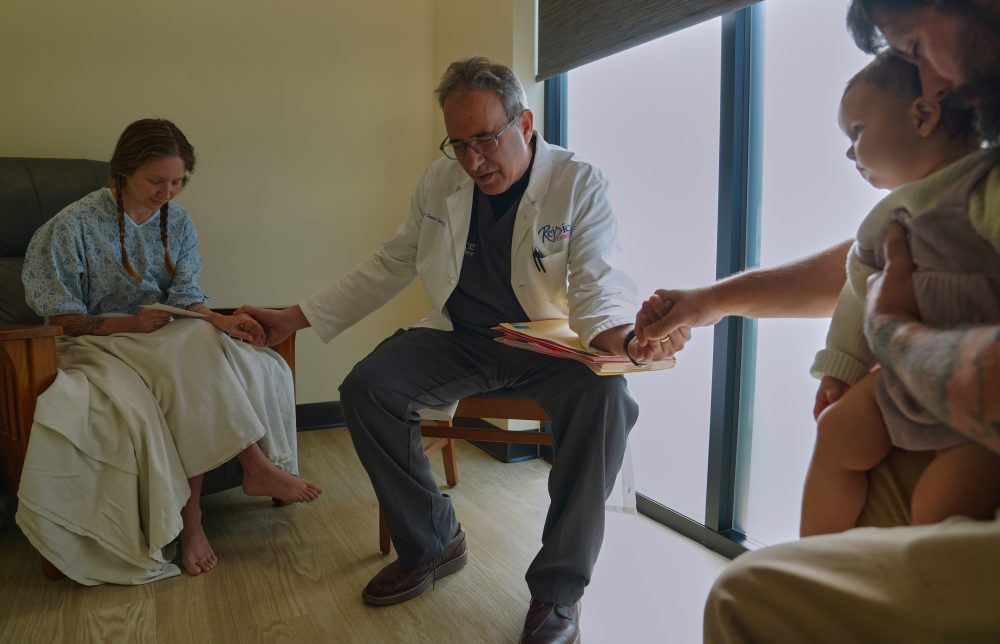
He particularly values Gordon’s practice of praying with patients before transfers, saying the doctor “focused in on the sovereignty of God in it and submitting to God’s will in this process.”
Gordon’s path to this practice began with his Jewish upbringing outside Boston in a family of physicians. After attending Princeton and Duke medical school, he completed his residency at Stanford.
He married Allison, a Duke engineering doctorate recipient from a small North Carolina Christian community. Their interfaith marriage continued for years until their oldest son’s life-threatening illness prompted Gordon’s conversion experience.
“I got down on my knees, and I said, ‘OK, you’ve got my attention, Lord,’” Gordon recalled.
Following their son’s recovery, the family joined a Presbyterian church where Gordon was baptized in 2000. They now belong to the conservative Presbyterian Church in America, with church elders supporting Rejoice’s mission.
The clinic welcomes employees and patients regardless of religious beliefs. Senior embryologist Sarah Coe Atkinson said, “I don’t necessarily believe in everything he believes in, but I believe in what we’re doing in terms of helping these embryos become lives.”
Atkinson oversees a laboratory that accepts embryos regardless of condition, often saying “Sometimes the ugliest embryos make the prettiest babies.”
Rejoice recently handled care for a couple using an embryo frozen for nearly 31 years, resulting in a 2025 birth that broke records for the longest-frozen embryo to produce a baby.
Atkinson has created a reference library of outdated embryo storage devices, complete with opening instructions. One entry for glass ampules warns to wear face shields because they “Might explode.”
Medical experts estimate 1.5 million frozen embryos exist in U.S. storage, though advocates suggest the number could be higher.
Gordon works to avoid adding to that total by customizing treatments based on patients’ desired family size. He specializes in lower-medication IVF cycles that cost less and typically produce fewer eggs, allowing patients to fertilize fewer eggs overall.
While other clinics offer similar options, Rejoice uniquely prioritizes these approaches. The downside involves potentially needing additional $8,000 to $10,000 cycles if initial embryos don’t succeed, though Gordon notes his patients generally prefer creating fewer embryos due to their beliefs.
Knoxville resident Emily Martin struggles with embryos she has in storage from treatment at another clinic, saying “I would wake up in the middle of the night just like, ‘Oh, what have we done?’ And just this heaviness.”
As an anti-abortion Christian, she wishes she had discovered Rejoice before creating more embryos than she planned to use. “That portion is something that’s not being talked about enough,” she noted.
When Rejoice patients have unused embryos, Gordon encourages embryo adoption. Conservative Christian communities call these donations “embryo adoptions,” viewing embryos as children rather than property.
The clinic recently launched Rejoice Embryo Rescue, which Gordon describes as an “orphanage” for donated embryos. The program works with primarily Christian agencies specializing in embryo adoption coordination.
Augusta, Georgia couple Adrienne and Colby McKnight learned about embryo adoption through their homeschooling community before traditional adoption. They adopted an 11-year-frozen embryo they named Gloria.
Though the transfer didn’t result in pregnancy, they found peace in their decision.
“Really it’s just giving her a chance at life and just freeing her from being frozen,” Adrienne McKnight explained. “Either way she gets to continue on. She gets to be with the Lord.”
The couple has since adopted two additional embryos through Rejoice.
“It’s hard to be torn between your faith and your work,” Gordon reflected, referencing biblical teachings about showing “faith through our works.”
While Rejoice has allowed him to reconcile these conflicts, the journey has presented challenges. His relationship with the physician who sold him the practice deteriorated into legal disputes.
Gordon also faces criticism from Christians and anti-abortion activists who consider all IVF forms unethical.
“He’s moving in the right trajectory,” said Matthew Lee Anderson, a Christian ethicist at Baylor who opposes IVF. “It’s impressive that he’s taken the steps that he has to change how he is doing business, and I hope for more.”
Gordon expresses no regret about his career restart and plans to hire additional physicians.
During a recent Sunday clinic visit, Atkinson prepared a North Carolina couple’s frozen embryo for afternoon transfer. As the embryo thawed and expanded in its culture dish, its cells rehydrated and plumped with renewed potential.
The laboratory scene represented hope combined with prayer—hallmarks of Rejoice’s approach.
Four weeks later, welcome news arrived: the patient was pregnant.