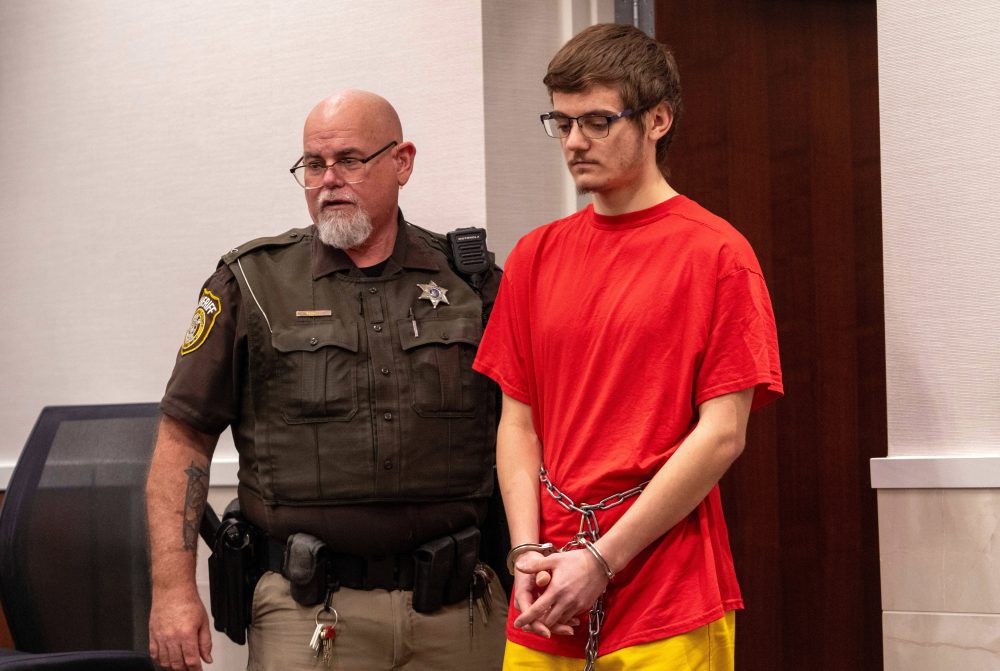

WAUKESHA, Wis. — An 18-year-old Wisconsin man received a life sentence without possibility of parole Thursday after admitting he murdered his parents to finance an elaborate scheme to assassinate President Donald Trump using an explosive-laden drone.
Nikita Casap entered guilty pleas in January to two first-degree intentional homicide charges in Waukesha County Circuit Court for the fatal shootings of his mother, Tatiana Casap, and stepfather, Donald Mayer, in February 2025. As part of a plea agreement, prosecutors dismissed seven additional charges including concealing corpses and theft.
Judge Ralph Ramirez imposed two consecutive life terms without the possibility of extended supervision during Thursday’s sentencing hearing, describing Casap’s crimes as both “horrific” and “inexplicable.” The judge explained he couldn’t predict if or when the defendant might change.
“I choose to find he’s not eligible for extended release because I do not know … when and if and whether a profound and significant change can occur,” Ramirez stated.
Court documents indicate Casap fatally shot both victims at their Waukesha village residence on or around February 11, 2025. He then cohabitated with the decomposing remains for two weeks before taking his stepfather’s SUV and fleeing westward with $14,000 in cash, jewelry, identification documents, a firearm, and the family pet.
Law enforcement apprehended Casap during a traffic stop in Kansas on February 28 following a four-day manhunt.
Federal investigators allege Casap orchestrated his parents’ deaths to secure funding and freedom to execute his assassination plan, which involved purchasing drone equipment and explosives. A federal search warrant reveals he authored a manifesto demanding Trump’s death and communicated with co-conspirators, including a Russian-speaking contact, about overthrowing the government.
“The killing of his parents appeared to be an effort to obtain the financial means and autonomy necessary to carrying out his plan,” the warrant stated.
Investigators discovered cell phone messages from January 2025 showing Casap inquiring about hiding periods before potential relocation to Ukraine. One message asked: “So while in Ukraine, I’ll be able to live a normal life? Even if it’s found out I did it?”
District Attorney Lesli Boese argued Thursday that Casap posed too great a public safety risk for eventual release. Drawing from FBI interrogation transcripts, Boese revealed that Casap immigrated from Moldova as an elementary student but became increasingly consumed by what she termed “disturbing websites,” including content about serial killers and mass school violence.
According to Boese, Casap initially planned to attack Trump using an AK-47 rifle mounted on a drone in late 2024. He later modified the scheme to involve dropping explosives from above before escaping by sea to Ukraine, where he intended to remain hidden for ten years. Casap admitted to federal agents he was indifferent to collateral casualties during the attempted assassination.
The teenager contacted two online sellers offering drone equipment and explosives, transferring $8,700 in bitcoin from his stepfather’s account to one of them. However, both contacts were operating fraudulent schemes, and no actual weapons or equipment existed.
“He walked right into it,” Boese commented.
Defense attorney Paul Rifelj requested parole eligibility after 20 years, explaining that news coverage of a December 2024 vehicle attack at a German Christmas market triggered Casap’s violent ideation. The attorney said his client believed he could impact world events by targeting a political figure.
Rifelj argued that the online contacts manipulated Casap by convincing him he was participating in a larger military operation, providing direction and purpose during a period of social isolation at school.
“Children are more than their worst deeds,” he told the court.
During his emotional statement to the court, a visibly shaking Casap expressed love for his mother, saying he constantly worried about her safety, even during mundane activities like reaching for items on high shelves. While acknowledging a more distant relationship with his stepfather, he credited Mayer with treating him as family.
However, Casap admitted becoming consumed by violent thoughts.
“I thought I was part of a revolution,” he said. “I thought I was part of a war. I told myself bad things had to happen.”