
WASHINGTON — Technology journalist Kara Swisher has become nearly impossible to avoid these days.
She has been filling in for Joy Behar on ABC’s “The View,” appearing alongside Meryl Streep in “The Devil Wears Prada 2,” starring in a CNN documentary, preparing for a national tour, and producing four podcasts most weeks that feature lengthy interviews and commentary.
That level of visibility stems from more than 30 years spent covering the technology industry with a self-described disregard for power — a stance that elevated her into a rare category of journalistic celebrity.
She used that standing to convince rivals Steve Jobs and Bill Gates to share a stage, and her pointed questioning once made Mark Zuckerberg visibly uncomfortable enough to break into a sweat. She once had Elon Musk’s personal cell number — the two are currently not in contact — and regularly communicates with tech and business leaders by text.
Now, Swisher is betting that the clout she built in Silicon Valley will carry over into the political arena, particularly as podcasts increasingly replace traditional media as the go-to platform for candidates seeking a public audience.
During President Donald Trump’s second Republican term, potential Democratic presidential hopefuls have lined up to appear on Swisher’s programs — including California Gov. Gavin Newsom, former Vice President Kamala Harris, former Transportation Secretary Pete Buttigieg, and former White House chief of staff Rahm Emanuel. Swisher expects that list to keep growing.
“We get called by all the presidential candidates,” said the 63-year-old Swisher during an interview at her Washington home. “We’re going to get to all of them.”
Swisher is far from the only podcast host diving into political commentary. Conservative voices like Megyn Kelly and Tucker Carlson, along with liberal programs such as “Pod Save America” — hosted by former aides to Barack Obama — draw larger audiences. All of them are overshadowed by Joe Rogan’s massive following.
But few podcasters can match Swisher’s deep knowledge of the technology sector and her ability to connect that expertise to broader political discussions.
“When I first went on her podcast when I just got into Congress in 2017, she was very well respected in tech circles,” said Rep. Ro Khanna, a California Democrat whose district includes Silicon Valley. “But now she’s emerged as a larger cultural force, especially at a time where there’s such anger at the tech billionaires and tech arrogance.”
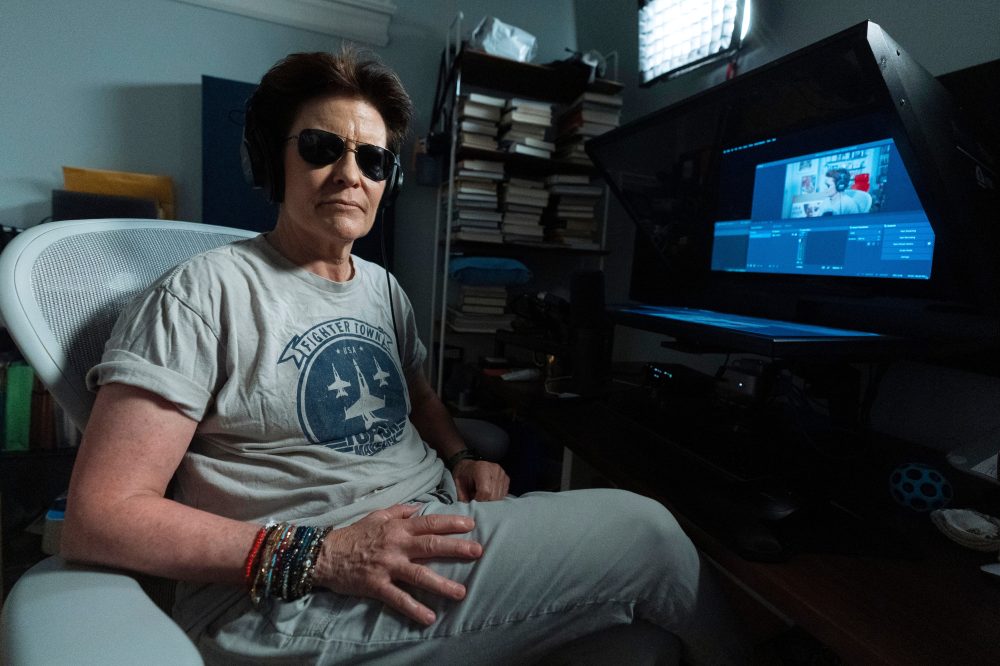
When she is not traveling, Swisher typically records from a basement studio in her Washington home, where she lives with her wife, children, and a cat named Lovely. Her interview podcast, “On with Kara Swisher,” often feeds into discussions on “Pivot,” which she co-hosts with entrepreneur Scott Galloway.
Those conversations have produced memorable moments. When Newsom filled in for Galloway on “Pivot,” Swisher criticized him for going too easy on longtime Trump aide Steve Bannon during an appearance on Newsom’s own podcast.
“You had an opportunity to engage,” Swisher pressed. “Why not engage?”
The typically composed Newsom acknowledged, “I’m not the pro that some of these others are, but I appreciate the insight.”
Swisher also challenged Buttigieg over why he waited so long to publicly say that President Joe Biden, a fellow Democrat, should not have sought reelection. Buttigieg responded that he had not been consulted.
“Sure, but you have eyes,” Swisher shot back.
Her interview with Harris caught the former vice president in a candid moment, as she described policies from Trump’s Health and Human Services secretary, Robert F. Kennedy Jr., as “f—— up.” Harris said solemnly that she “can’t laugh” about such issues, though Swisher later noted on a subsequent podcast that the two had actually joked about Kennedy before the cameras rolled.
“Be the person backstage because that’s the person who gave a great answer,” Swisher said in that follow-up episode.
In a separate interview, Newsom said Swisher “calls out my bulls—-.”
“She’ll send me missives unsolicited,” he added. “She’s usually right, and it drives me crazy.”
Sen. Mark Warner, a Virginia Democrat who has known Swisher for years, agreed that sitting down with her is “not a layup.”
Even Sen. Thom Tillis of North Carolina — a rare Republican guest on her show — said the experience was valuable, even though Swisher pressed him on whether he only began speaking out against the Trump White House after deciding not to seek reelection.
“If you’re a politician, you should be able to walk up anywhere and hold your own,” Tillis said. “Do the prep, get on the show. You may end up having an opportunity, like in my experience, to give a completely different perspective.”
Influencing political debate was never the original goal when “Pivot” launched in 2018. Galloway recalled that the show was conceived as a look at the overlap between technology and business. That remains a core focus, but major stories in those fields — such as the anticipated initial public offering for Musk’s SpaceX or the rapid rise of artificial intelligence — now carry unavoidable political dimensions.
“Show me a big business or tech story, and I’m going to show you a political overlay,” Galloway said.
This shift aligns with a growing urgency among Democrats to be more assertive on digital platforms, where audiences are increasingly concentrated.
“The single most important quality that every candidate needs to have is the ability to talk and the ability to talk anywhere,” said Teddy Goff, co-founder of Precision Strategies and digital director for Obama’s 2012 presidential campaign. “That might mean a two-hour podcast interview. It might mean a 15-second digital video.”
Democrats are still feeling the sting of Rogan’s nearly three-hour interview with Trump during the final stretch of the 2024 campaign. Rogan, who does not consider himself a journalist, has said Harris’ campaign declined to meet his conditions. Harris has described being turned away by Rogan.
Swisher agreed that Democrats should lean into podcasts but pushed back on the idea that she is simply a left-leaning answer to Rogan.
“You can’t manufacture this stuff,” she said. “It just doesn’t work, right? The kids like what the kids like.”
Still, the podcasts have translated into both influence and financial reward. Galloway said “Pivot” — effectively a joint venture between himself, Swisher, and Vox Media — is on track to be a $15 million to $20 million business this year. With a staff of just five people, that makes it a highly profitable operation at a time when traditional media is being reshaped by mergers and acquisitions.
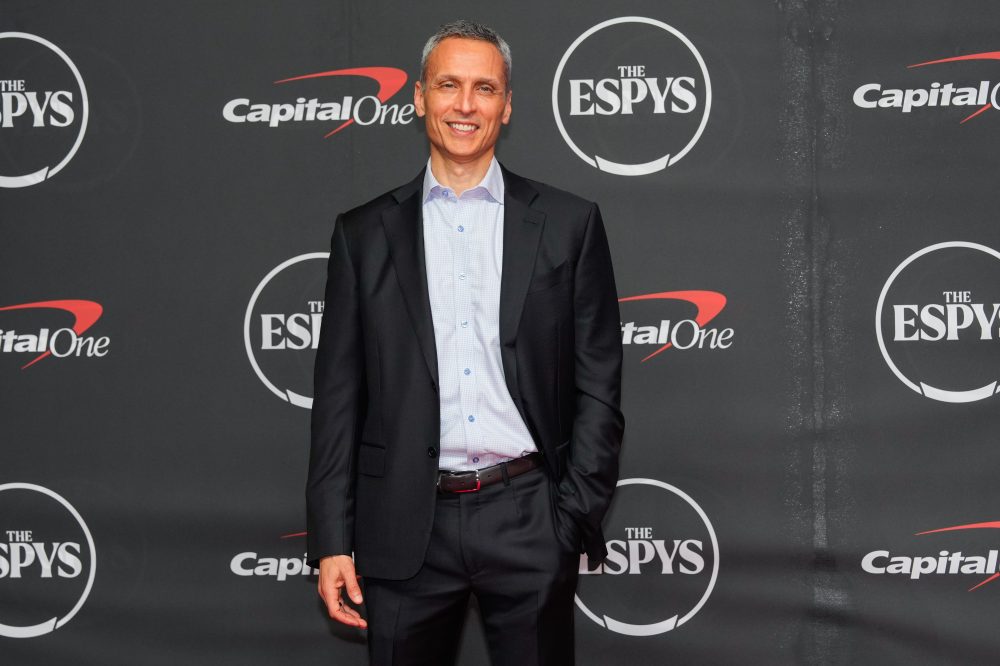
Vox Media itself has been revitalized following a recent acquisition by James Murdoch, who brought together New York magazine, the Vox Media Podcast Network, and the Vox editorial brand under one umbrella, with podcasts serving as the fastest-growing segment of the business.
“Podcasts are the NBA,” Galloway said. “There’s a small amount of people making a lot of money.”
While Swisher’s guest list leans heavily Democratic, she has recently hosted Tillis and conservative CNN commentator Scott Jennings. She hopes to bring on more Republicans soon and said she reached out to Steve Hilton’s wife — a former Google executive — hoping to book him shortly after he advanced in California’s governor’s race.
“What we’re going for is to be popular among the entire populace,” she said. “So that people who don’t feel they want to be in a constant state of anger, whether it’s on the left or the right, can have a place to go.”
Her pointed remarks about Trump and other Republicans could make that goal harder to achieve. Kelly McBride, an ethics expert at the Poynter Institute, a journalism think tank, said programs like Swisher’s can sometimes “butt right up against the type of podcasts that I would not consider journalism.”
“The way you separate them out is that the intention and the system surrounding the podcast is engineered in a way to create fact-based information,” McBride said.
Swisher describes her own work as “reported analysis,” citing tech writer Om Malik, who died last week, as a source of inspiration.
As for the tone of her podcasts, Swisher views it as part of the authenticity that defines her brand. She and Galloway have built a distinctive chemistry — his tendency toward colorful language often makes her come across as comparatively refined.
“We don’t shy away from our faults,” she said. “We don’t shy away from our biases. We don’t shy away from things that most people try to.”