
AMANA, Iowa — When President Trump launched his sweeping trade tariffs, few American companies seemed better positioned to benefit than Whirlpool, the appliance giant whose workers hand-assemble refrigerators at a sprawling Iowa facility. But the reality on the ground tells a very different story.
At the facility known as “Big Blue” — a nickname drawn from the robin’s-egg-colored exterior of the building — the company has eliminated more than half of its workforce of nearly 2,000 people over the past year. This has happened even as the administration pushed tariffs as a way to protect and grow American manufacturing jobs.
“Jobs and factories will come roaring back into our country,” Trump declared in April 2025 during his self-described “Liberation Day” tariff announcement.
Whirlpool was widely seen as one of the companies that stood to gain the most. The Michigan-based company produces roughly 80% of the products it sells in the United States across 10 domestic factories — with an 11th on the way — making it far less vulnerable to import duties than many of its competitors. In theory, that should have given it an edge as foreign-made appliances became pricier for American consumers.
Instead, the plant that once ran five assembly lines and turned out close to one million refrigerators per year now operates just a single line. An additional 288 workers are scheduled to be let go in July.
CEO Called Company a ‘Net Winner’
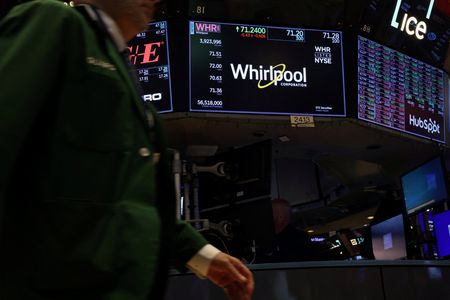
Whirlpool’s CEO Marc Bitzer had been optimistic about the tariffs, telling investors last year that the company was a “net winner” from the trade policies. But that confidence has not translated into job security at the Iowa plant, nor has it reversed a dramatic slide in the company’s stock price, which has now fallen to its lowest level since the financial crisis of 2007 to 2009.
The tariffs have cut two ways for Whirlpool. While they have narrowed the cost gap between Whirlpool and lower-priced foreign competitors, they have also pushed up the company’s expenses for steel and imported parts. A sluggish housing market has further dampened demand for appliances. At the same time, Whirlpool has shifted some production to its facilities in Mexico and China and relocated certain specialty models to a newly updated Ohio plant.
The situation highlights the complicated and still-unfolding impact of the tariff strategy. Some businesses report that the measures have encouraged domestic investment, while others are grappling with higher costs and disrupted supply chains — with very different outcomes for workers depending on where they are.
Political Stakes in a Competitive Iowa District
The job losses are drawing political attention, particularly in Iowa’s 1st U.S. Congressional District, where the Whirlpool plant is located. The seat is considered one of just 18 true toss-up races in the country, according to the Cook Political Report. Republican incumbent Mariannette Miller-Meeks defeated Democrat Christina Bohannan by fewer than 1,000 votes in the 2024 election, making the November midterm contest extremely competitive.
Manufacturing job losses have become a flashpoint in the district. Beyond Whirlpool, tractor maker CNH shut down its Burlington, Iowa plant in May, and John Deere has trimmed its workforce at multiple Iowa locations.
Miller-Meeks and fellow Iowa Republican U.S. Representative Ashley Hinson both sent a letter to Whirlpool CEO Bitzer following a layoff announcement in March. “These layoffs would hollow out a community and undermine the very domestic manufacturing base that American workers have spent decades building,” the letter stated.
Democratic challenger Bohannan also sent her own letter to Bitzer. The two candidates have sparred over who has been more forceful in pushing back on the company. “She didn’t say anything about it until after I put out my statement,” Bohannan told Reuters. She added that many voters backed Trump in 2024 because of his promises to restore jobs. “But reckless, chaotic tariffs are not the way to do it.”
Miller-Meeks responded with her own statement: “I remain deeply disappointed by Whirlpool’s decision. From the moment we learned of the layoffs, I engaged directly with Whirlpool leadership and followed immediately with a formal letter.”
White House Defends the Strategy
The Trump administration maintains that tariffs will ultimately revive domestic production by making imported goods more expensive and less attractive.
White House spokesman Kush Desai said, “The Trump administration is implementing a nimble and multi-faceted strategy for America’s long-term reindustrialization,” and noted that industry leaders including Whirlpool have pledged to invest “trillions into American manufacturing.”
Whirlpool does say it is expanding its U.S. footprint — just not yet in Iowa. In October, the company announced a $300 million investment in its washer and dryer plants in Marion and Clyde, Ohio. In April, it committed another $60 million to build a new Ohio facility that will produce plastic parts for its laundry products.
Company officials say the Iowa plant overhaul is part of a long-term commitment to domestic refrigerator production. “We are one of the last who think we can be competitive making refrigerators in the U.S.,” said Jason Ebert, Whirlpool’s vice president of North American manufacturing. He explained that the workforce and assembly line reductions were necessary to make room for new technology and updated production layouts, which are currently in the design phase. The company is also working to bring more component manufacturing in-house at the Iowa location.
Luke Harms, Whirlpool’s director of government relations, said trade policies have helped level the playing field against low-cost foreign competitors, particularly Chinese manufacturers. He pointed to the administration’s decision to extend steel tariffs to include finished products like appliances and to apply those tariffs to the full value of the goods. “That’s made us more confident in our modernization plan,” he said. Even so, tariffs on steel and imported parts have added to the company’s overall costs.
Workers Feel Left Behind
For many of the workers still on the job in Amana, the mood is bleak. The plant was producing more than 900,000 refrigerators per year just a few years ago, according to the International Association of Machinists and Aerospace Workers, the union that represents the employees. That figure has now dropped to fewer than 250,000 units annually.
Kerry Waddell, a 36-year veteran of the plant who now serves as business agent for the union, said he has watched the facility shrink as Whirlpool poured investment into its refrigerator operations in Mexico. The sense of defeat was evident at the most recent monthly union meeting, held at a local community center, where only a handful of members showed up. One item on the agenda was arranging to clear out furniture from the union’s old hall — a space the shrunken workforce can no longer afford to maintain.
Greg Cousins, a 63-year-old forklift driver who attended the meeting, was blunt about where he thinks the work is going. “It’s all going to Mexico. I’ve thought that for the last three years,” he said. Cousins said he plans to retire next year and will be relieved to leave. When asked about Whirlpool’s modernization plans, he said he sees no evidence of them. “Just stuff going out.”
Aaron Southard, a 44-year-old auto press operator who describes himself as a Republican and voted for Trump in the last election, said he is now considering supporting Democrats in the midterms. “We thought we’d be getting our jobs back,” he said. “I feel betrayed — they’re out there stomping and saying Make America Great and bring jobs back.”
Many workers, including Southard, have begun searching for other employment. One company drawing interest from displaced Whirlpool employees is Sub-Zero, a high-end refrigerator manufacturer that is building a new, non-union plant in nearby Cedar Rapids.
Building refrigerators in the United States presents unique challenges. The appliances are labor-intensive, often containing hundreds of parts and complex features such as through-door ice and water dispensers and multiple compartment doors. That makes them harder to automate compared to products like washing machines or stoves, which can be assembled more quickly on automated production lines.
The pressure isn’t limited to Whirlpool. Sweden-based Electrolux announced in April that it would end refrigerator production at its 1,255-employee plant in South Carolina, moving that work to Ciudad Juárez, Mexico. The company said it plans to retool the South Carolina facility to manufacture laundry equipment instead.
Across the U.S. appliance industry, conditions remain difficult. The tariff rollout triggered a rush of imports as companies tried to stockpile goods before the taxes took effect, which drove down prices and squeezed profit margins for domestic producers — all against the backdrop of a housing market that has been slow to recover.
Investors have also grown frustrated. Whirlpool’s share price has tumbled roughly 70% since Trump returned to office 17 months ago and began issuing a rapid succession of tariff orders. The company recently suspended its dividend, ending a streak of consecutive payouts that had lasted seven decades.
That last move hit Southard personally. Over his decade at the plant, he had accumulated Whirlpool stock as part of his retirement savings. “I used to make $600 a year from it,” he said, referring to the dividend income. “Now, that’s gone.”