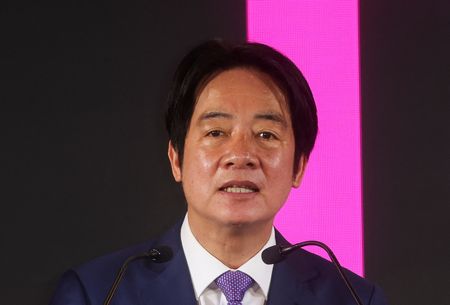

Taiwan’s President Lai Ching-te delivered a strong warning to graduating military officers Tuesday, telling them to stay vigilant against China’s efforts to spy on and undermine the island’s armed forces.
Lai spoke at a graduation ceremony held at Fu Hsing Kang College, located on the outskirts of Taipei. The college, now part of the National Defence University, was established in 1951 — just two years after the Republic of China government retreated to Taiwan following its defeat in a civil war against Mao Zedong’s communist forces.
The institution was originally created to train military officers in political warfare and to foster a strong anti-communist identity within the ranks. That Cold War-era spirit remains very much present at the school today.
Addressing the graduates, Lai said a soldier’s honor is rooted in loyalty. He called on the new officers to be clear-eyed about who their adversaries are.
“In the face of various threats and challenges, as well as China’s infiltration, division, sabotage, and espionage activities targeting our armed forces, I ask all of you to establish a clear awareness of friend and foe,” Lai said.
“Only by resisting all forms of threat and temptation can we defend our nation’s sovereignty and security,” he added.
The president also urged graduates to oppose communism, protect against infiltration, and firmly uphold democratic values and freedom. He insisted that the Republic of China and the People’s Republic of China are not subordinate to one another — using Taiwan’s formal official name in making that point.
Taiwan and China have long engaged in mutual espionage, but Taiwan has recently reported a rising number of Chinese spying cases, particularly within its military. China, which considers Taiwan part of its own territory, has never ruled out using military force to bring the island under its control, and Chinese military activity around Taiwan occurs on a daily basis.
Inside the hall where Lai delivered his address, large Chinese characters flank both sides of the room. The inscription — “I regard the nation’s rise or fall as my own personal responsibility” — was written by former Taiwan leader Chiang Kai-shek shortly before his death in 1975. Chiang remains a divisive figure in Taiwan, condemned by some for his authoritarian rule while admired by others for his fierce opposition to communism.
During the Cold War, the college also trained military officers from other anti-communist nations around the world, and it continues to host international students today.
Among those attending Tuesday’s ceremony were the ambassadors of Belize, Guatemala, and Paraguay — three countries that maintain formal diplomatic relations with Taiwan — as well as the de facto ambassador from Jordan, which does not officially recognize Taiwan despite having maintained close military ties during the Cold War.