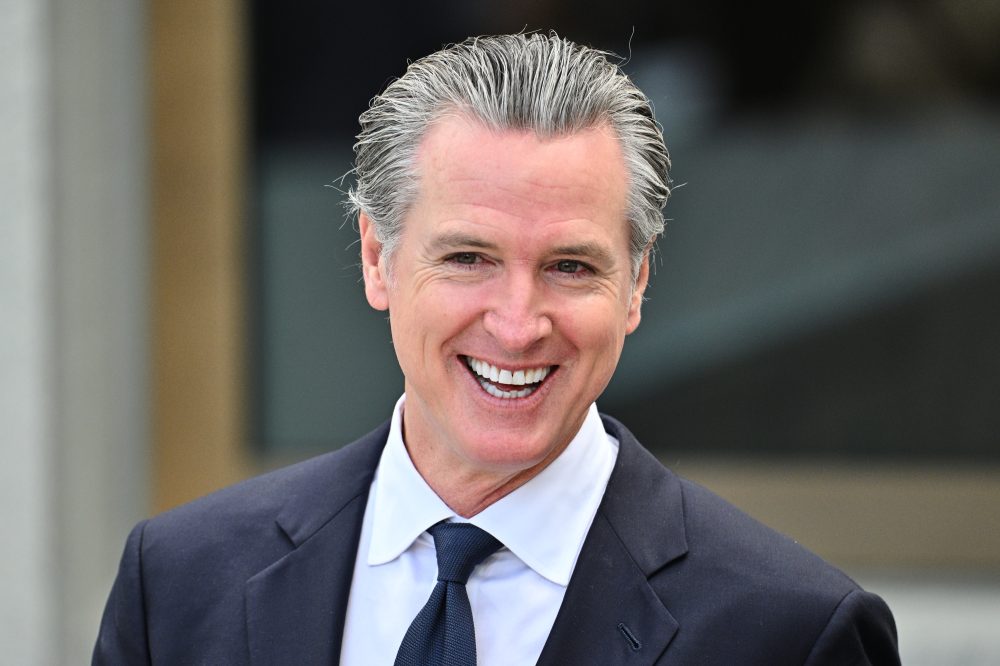

California’s Democratic Gov. Gavin Newsom put his signature on a nearly $352 billion state spending plan Monday — his final budget before leaving office in January — as he continues to weigh a run for the presidency.
The budget avoids sweeping cuts or major new spending, instead taking a more measured approach. Newsom used the occasion to look back on his nearly eight years as governor, releasing a video that highlighted state policies such as free school meals, expanded internet access, increased renewable energy production, and higher minimum wages for fast food and healthcare workers.
He also pointed to the budget’s increased contributions to state reserve funds as evidence that California manages taxpayer money responsibly — pushing back against critics who say the state spends without restraint.
Taking aim at Republican-led states and the federal administration, Newsom issued a challenge: “To every other state across our country — to Washington, D.C. — to anyone who’s been told that responsibility and ambition can’t share the same balance sheet: Come to California.”
The spending plan seeks to raise additional state revenue through a reformed tax on healthcare providers, a sales tax applied to certain software products, and limits on tax breaks for large corporations. While Newsom has generally resisted broad tax increases during his tenure, he has backed more targeted measures. He opposes a one-time tax on billionaires — pushed by a healthcare union — that will appear on the November ballot.
Newsom and Democratic legislative leaders say the plan carries no deficit for the coming fiscal year and positions the state to respond to federal cuts to healthcare programs for low-income residents.
“We have done a lot of work to mitigate harm, to protect vulnerable communities,” said Assembly Budget Committee Chair Jesse Gabriel, though he acknowledged the state was not “in a position to fully backfill those federal cuts.”
Republicans were not convinced. “The governor can claim he has a ‘balanced’ budget on his way out the door, but really, he’s just leaving us with his tab,” said Republican Sen. Roger Niello in a statement, arguing the plan delays spending problems rather than solving them.
California has struggled in recent years with tens of billions of dollars in budget deficits, leading to painful decisions — including scaling back a commitment to provide free healthcare to low-income immigrants without legal status. Nonpartisan budget analysts had projected shortfalls of more than $20 billion annually over the next several years, though their estimates sometimes differ from Newsom’s projections.
Higher-than-expected tax revenues — driven largely by a surging stock market fueled by excitement over the artificial intelligence industry — helped lawmakers avoid some of last year’s planned cuts. Those included reductions to dental benefits for low-income immigrants without legal status and premium increases for adults enrolled in the state’s Medicaid program, known as Medi-Cal. Lawmakers had previously agreed to charge those recipients $30 per month starting next year. Newsom had proposed raising that to $50, but the final budget leaves that decision to whoever succeeds him.
Expanding childcare access has been a consistent priority for Newsom, and the new budget funds nearly 23,000 additional childcare spots for the upcoming fiscal year.
With November’s election approaching, the budget directs $29 million to the Secretary of State’s office to help accelerate the state’s lengthy vote-counting process through added staffing and technology upgrades. Another $10 million is set aside to educate voters about the election process — split between counties and the state. The budget also includes close to $1 million to combat misinformation about state elections, a response to repeated — and unsubstantiated — claims by President Donald Trump and other Republicans that California’s slow vote count enables widespread fraud.
November’s election is expected to draw significant attention, as California has several U.S. House seats that could help determine which party controls the chamber, along with more than a dozen ballot measures and the race to choose Newsom’s successor. Democrat Xavier Becerra, a former state attorney general, and Republican Steve Hilton, a former Fox News host and adviser to conservative British politicians, are vying to replace him.
Some major spending decisions were deliberately left for the next governor. Among them is how the state will handle revenue from its cap-and-trade program, which requires large polluters to reduce emissions, purchase allowances, or fund offsetting projects. State air regulators recently approved changes that could cut in half the pot of money California receives from allowance sales for climate, transportation, and other programs.
Lawmakers also indicated they want to explore penalizing large companies whose employees rely on Medi-Cal rather than employer-provided health coverage. The Department of Finance has been directed to bring options to the Legislature — though any such penalties would not be approved until next year at the earliest, disappointing some Democrats.
“This is a budget that bought time: Medi-Cal delayed, not resolved, not restored,” said Democratic state Sen. María Elena Durazo at a budget hearing Monday.
The budget deal would also shift oversight of the state’s Department of Education to the governor’s office, a move Newsom says is aimed at improving student outcomes.