
TAIPEI – A high-ranking Taiwanese security official declared Monday that Taiwan’s administration should take the lead in discussions with China regarding newly proposed trade and tourism relaxations, instead of allowing private political party negotiations to handle such matters.
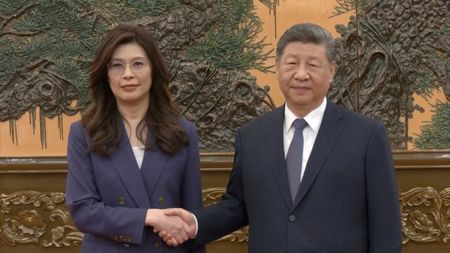
Beijing announced 10 fresh incentive proposals on Sunday aimed at reducing restrictions on tourism, permitting “healthy” television programming, and streamlining food commerce between the nations. The announcement followed a recent visit by Taiwan’s opposition leadership.
However, Chinese officials maintain their refusal to engage directly with Taiwan President Lai Ching-te’s government, labeling him a “separatist” and consistently rejecting multiple diplomatic overtures.
Tsai Ming-yen, who heads Taiwan’s National Security Bureau, emphasized that direct government-to-government communication should remain the preferred method.
“Only then can the government conduct proper assessments and planning and drive relevant exchanges – rather than conducting private dealings through inter-party exchanges,” he told reporters at parliament.
“Having the government take charge of the relevant planning can therefore also better help avoid unnecessary risks and long-term consequences.”
Chinese officials from the Taiwan Affairs Office have not yet provided comment on these statements.
Tsai noted that such “goodwill measures” from Beijing have historically emerged before electoral periods, targeting particular regions, municipalities, businesses, sectors, or individuals.
“However, this has already become a tool the Chinese communists use to interfere in Taiwan’s elections,” he added.
The island nation faces important municipal elections this November.
Prior to Taiwan’s presidential contest in early 2024, officials accused China of attempting to influence voters through various economic policies, including reassessing preferential tariffs on agricultural products, seafood, industrial machinery, automotive components, and fabric goods.
Taiwan’s leadership continues to reject Beijing’s sovereignty assertions, maintaining that only Taiwan’s citizens can determine the island’s destiny.