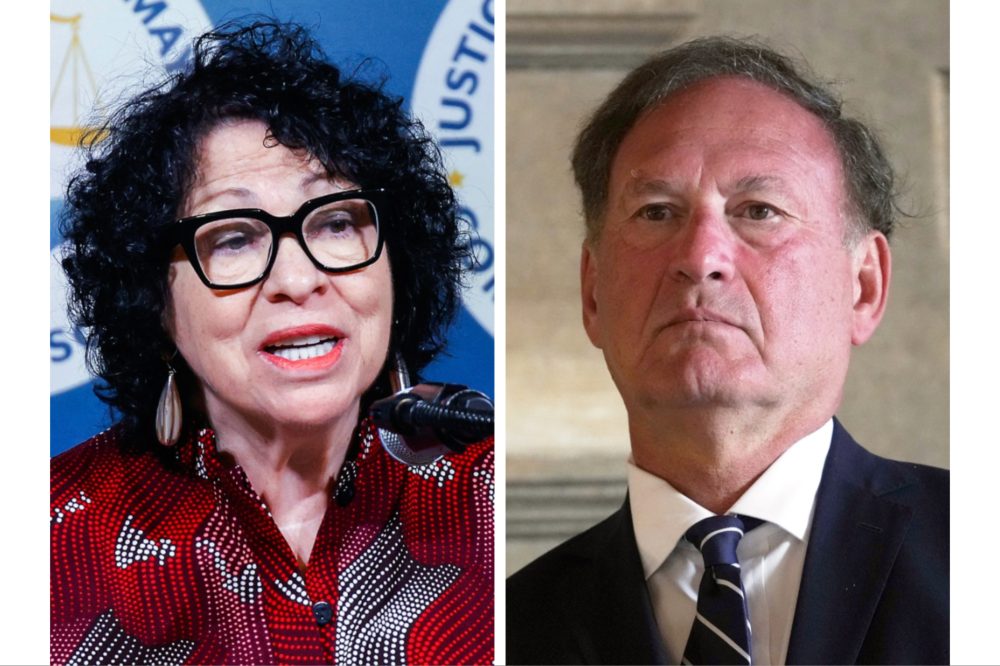

WASHINGTON — The U.S. Supreme Court has been issuing significant rulings at a fast pace, but even with some of its most consequential decisions still ahead, visible friction among the justices is becoming hard to ignore.
A particularly unusual moment unfolded Thursday as the justices took their seats to deliver brief summaries of their latest decisions — among them two major immigration victories for President Donald Trump.
After conservative Justice Samuel Alito finished presenting the majority’s ruling that limits how individuals can seek asylum at the southern border, liberal Justice Sonia Sotomayor rose to read aloud from her strongly worded dissent.
Sotomayor recounted the hardships many asylum seekers endure and invoked a painful episode from history: the 1939 turning away of a ship carrying Jewish refugees fleeing Nazi Germany by the United States and other nations. Roughly 250 of those passengers would later perish in the Holocaust.
In her dissent, Sotomayor argued the majority’s ruling would enable the Trump administration to prevent people from applying for asylum at the border, leading to more deaths. She said the decision “regrettably and tragically extinguishes the light of the torch of the Statue of Liberty.”
Justice Brett Kavanaugh watched Sotomayor closely as she spoke, while Justice Ketanji Brown Jackson kept her gaze fixed straight ahead.
While majority opinions are always delivered from the bench, dissenting justices may also speak up to emphasize their objections — though this typically occurs in only a handful of cases each term. Additional rulings are expected Monday.
Sotomayor’s decision to speak appeared to catch Alito off guard. In a highly unusual move, he responded off the cuff, sounding visibly irritated. He said he had no idea she planned to speak and would have elaborated more in his own summary had he known.
From the conservative majority’s perspective, the case centered on whether border officials have the authority to delay asylum seekers’ entry into the country “until they can be processed in a safe and orderly way.”
Alito defended the ruling by pointing out that the policy in question had been used under both the Obama and Trump administrations. “I won’t add anything more to that,” he said.
The public dispute comes as the court prepares to issue rulings next week on some of the most significant questions of the term, including Trump’s effort to limit birthright citizenship and his push to expand presidential authority to remove members of independent federal agencies.
This is not the first sign of unusual tension this term. In April, Sotomayor issued a rare public apology to Justice Kavanaugh for what she described as “hurtful comments” made during a law school appearance, where she suggested a colleague “probably doesn’t really know any person who works by the hour.”
Earlier, in March, Kavanaugh and Justice Ketanji Brown Jackson publicly clashed over the numerous emergency orders the court had issued allowing the Trump administration to move forward with key elements of its agenda.