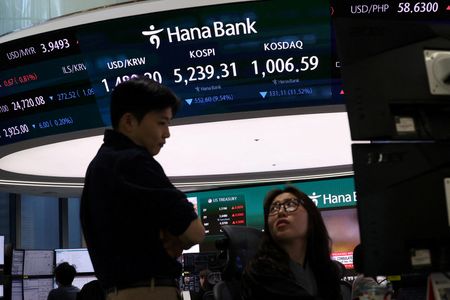

Stock markets across Asia experienced dramatic gains Thursday as investors appeared to regain confidence following signals that escalating Middle East tensions might be cooling down.
South Korea’s main stock index bounced back from heavy losses in the previous trading session, climbing more than 10% after Wall Street posted strong gains on speculation that the United States and Iran could be looking for ways to reduce hostilities. Meanwhile, oil and precious metals continued their upward trajectory.
In economic policy news, China announced its growth projections at a marginally slower rate compared to last year as part of an extensive economic blueprint that drew significant attention from global markets. However, the U.S. Senate endorsed President Donald Trump’s military operations against Iran, indicating the conflict that has disrupted financial markets, shipping routes, and energy supplies may not end quickly.
“Political tensions in volatile regions can resurface rapidly, meaning the early positive momentum we’re witnessing across Asia-Pacific stock exchanges today might not hold,” warned Paco Chow, dealing manager at Moomoo Australia and New Zealand. “Market sentiment will stay guarded until we observe energy shipments returning to standard levels.”
The broad Asia-Pacific stock measurement excluding Japan climbed 2.9% according to MSCI data. South Korea’s benchmark index dominated regional performance with its 10.4% jump, while Japan’s primary index also gained 2.9%.
U.S. Treasury bond yields moved higher, with the 10-year note yield increasing 2.7 basis points to reach 4.109%, and the 30-year bond yield climbing 3.1 basis points to 4.7479%.
The conflict between the U.S.-Israel alliance and Iran intensified significantly Wednesday following an American submarine’s attack on an Iranian naval vessel and NATO defense systems intercepting an Iranian missile aimed at Turkey.
However, stock markets in Europe and America found encouragement in Trump’s commitment to safeguard shipping operations and a New York Times article suggesting Iranian intelligence had contacted the CIA early in the conflict regarding potential resolution pathways.
Iran subsequently denied the newspaper’s account, while the Republican-controlled Senate voted against a bipartisan measure seeking to halt aerial combat operations.
Energy supply worries kept pushing petroleum prices upward. American crude oil increased 3.01% to reach $76.91 per barrel, with Brent crude climbing to $83.43 per barrel, representing a 2.49% daily gain. Gold prices in spot markets rose 0.84% to $5,178.42 per ounce.
“Headlines continue driving market behavior, and additional price swings appear likely moving forward,” explained Henry Russell, a London-based economist with ANZ, during a podcast appearance. “Energy availability remains under pressure as production sites shut down, with more closures probable if this confrontation extends further.”
Chinese officials established their economic expansion goal for 2026 between 4.5% and 5%, representing a modest reduction from last year’s 5% achievement, creating space for initiatives addressing industrial excess capacity and economic restructuring. Beijing simultaneously unveiled its 15th five-year strategy, committing to investments in innovation, advanced technology sectors, and a “significant” boost in consumer spending.
China’s premier stock index gained nearly 1% during early trading hours, while the Shanghai benchmark added 0.4%.
The U.S. dollar paused after recent increases driven by safe-haven buying. The dollar measurement against major currencies remained unchanged at 98.81.
Japan’s currency strengthened 0.2% to 156.75 against the dollar.
Digital currency markets saw declines, with bitcoin dropping 0.78% to $72,774.53 and ethereum falling 0.94% to $2,130.43.