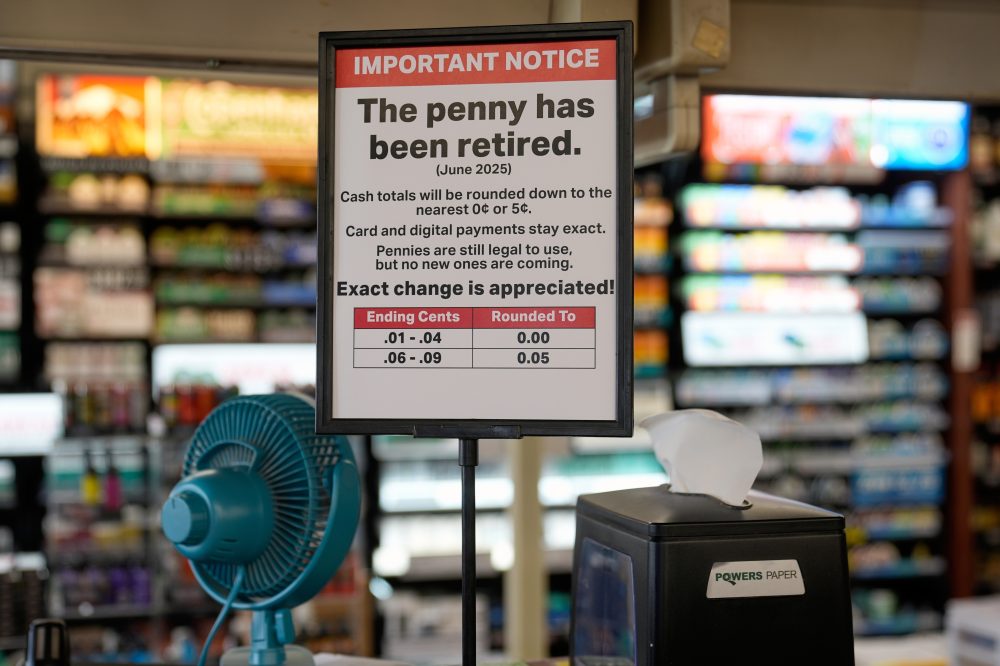

Following the cessation of penny manufacturing several months ago, state governments nationwide are establishing regulations for how cash transactions should be handled when exact change isn’t possible.
Former President Donald Trump declared an end to penny manufacturing last year, citing the wasteful expense of producing coins that cost 3.7 cents each to manufacture, according to U.S. Mint data from 2024. This decision created penny shortages at retail locations during the summer months, compelling both merchants and customers to adapt to transactions without the ability to make precise change.
The Treasury Department has indicated it will keep the approximately 114 billion existing pennies in circulation for as long as feasible, and businesses must continue accepting pennies as valid payment.
The primary approach being considered involves rounding cash payments to the nearest five-cent increment through a method known as symmetrical rounding. Under this system, final prices ending in one, two, six, or seven cents would round downward for cash payments. For instance, totals of $1.91 or $1.92 would become $1.90. Conversely, prices concluding with three, four, eight, or nine cents would round upward, meaning $1.98 or $1.99 purchases would cost $2 in cash.
Congressional legislation introduced previously and approved by the House financial services committee would implement symmetrical rounding nationwide. Representative Lisa McClain, a Michigan Republican, stated via email that federal legislation is necessary to avoid creating a “confusing patchwork of state policies.”
The legislation remains pending a full House vote and would require Senate approval before reaching Trump’s desk.
Meanwhile, six states—Arizona, Florida, Oregon, Tennessee, Virginia, and Washington—have enacted bills addressing cash transactions without pennies, awaiting gubernatorial approval. State approaches vary between permitting businesses to round purchases versus mandating the practice.
Indiana’s Republican Governor Mike Braun signed legislation this month requiring businesses to round all cash transactions not ending in zero or five. However, lawmakers created a second bill making rounding voluntary, which would become effective Sunday pending Braun’s signature.
Both Indiana measures allow businesses to choose their rounding method: consistently rounding up to the nearest nickel, always rounding down, or using the symmetrical approach.
Tennessee’s Republican-controlled legislature passed measures exempting symmetrical rounding from state consumer protection lawsuits without requiring the practice.
“It is to provide safe harbor for private businesses,” explained Republican Representative Charlie Baum, the Tennessee bill’s sponsor, during legislative debate.
An Associated Press review using Plural bill-tracking services found approximately two dozen states have introduced rounding legislation since late last year.
Beyond legislative action, various state agencies have issued guidance recommending rounding occur after tax calculations, ensuring full taxed amounts reach state coffers.
While electronic payments have reduced cash usage, Federal Reserve survey data from 2024 shows roughly 80% of American adults recently used cash, with higher usage among seniors and lower-income households.
The Treasury Department has stated online that prices would be “rounded down just as often as they will be rounded up, so there should be no overall effect on consumer prices.”
However, Federal Reserve Bank of Richmond researchers analyzed 2023 survey data revealing prices not ending in zero or five frequently concluded with eight or nine. Though payment amounts vary based on multiple item purchases and tax rates, the prevalence of upward rounding could collectively transfer millions from consumers to businesses, though individual losses would amount to mere pennies per person.
Social media posts from Americans experiencing rounding have expressed feelings of being cheated, even over small amounts.
Nikki Capozzo-Hennessy, a 50-year-old Trumbull, Connecticut resident, prefers cash payments to monitor her spending habits. She shared her grocery receipt online after noticing a rounding adjustment on her $8.73 after-tax purchase, where the store rounded down, giving her three cents back.
Capozzo-Hennessy acknowledged potential frustration from consistently paying extra pennies but recognizes the practicality of uniform rules. As a food truck operator, she anticipates using symmetrical rounding for consistency.
“At the end of the day it’s three cents, but I can imagine with all the purchases that you make, it can add up,” Capozzo-Hennessy noted.
Washington State Representative April Berg, who sponsored rounding legislation there, understands consumer frustration over losing pennies but emphasizes that eliminating the physical currency leaves few alternatives.
“We did make sure that everyone is allowed to pay exactly what they owe,” Berg said regarding her legislation.
The Treasury estimates ending penny production will generate $56 million in annual savings, though rounding may increase nickel demand. Five-cent coins are also expensive to produce, costing nearly 14 cents each in 2024, according to Mint data.
Current federal legislation includes potential cost-reduction measures, permitting the Treasury to modify coin composition using less expensive zinc and nickel rather than copper and nickel.