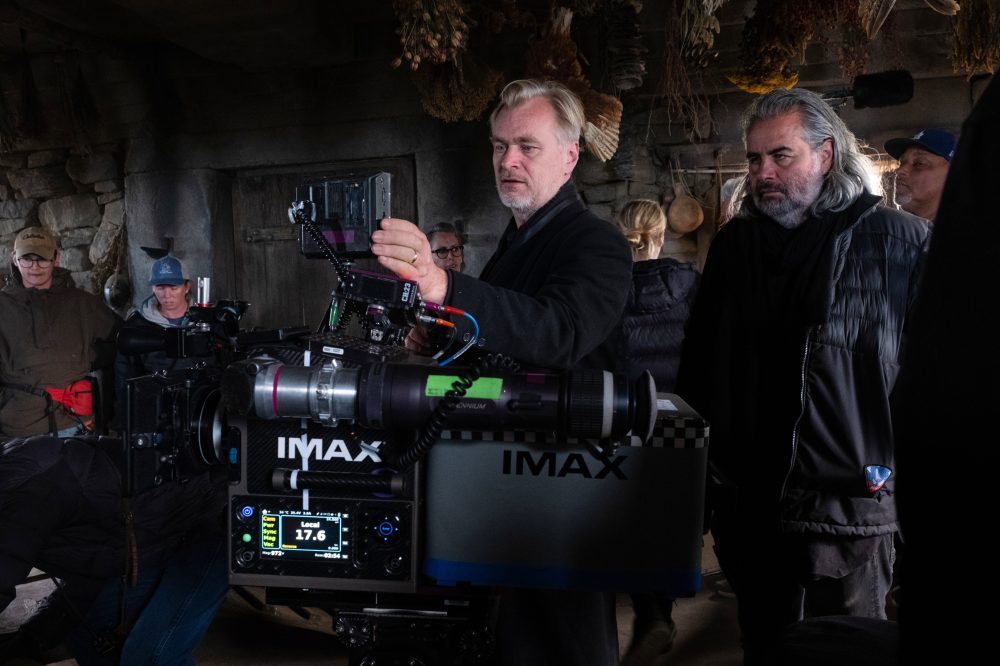

Long before he became one of Hollywood’s most celebrated directors, Christopher Nolan was a kid staring up at massive screens at the Museum of Science and Industry in Chicago, watching nature documentaries in IMAX and imagining what it would be like to make a major movie that way.
With his new film “The Odyssey,” that childhood dream has become reality. The film is the first feature ever to be shot entirely on IMAX film — a landmark achievement in cinema history.
The road to that milestone wasn’t simple. For years, Nolan had been incorporating IMAX cameras into his films, but the cameras were far too loud to use during scenes with dialogue. After completing “Oppenheimer,” the time was finally right to push for the development of a camera silencing device, which the team calls “the blimp.” The newly developed IMAX camera was named The Keighley, in honor of longtime IMAX executives Patricia and David Keighley. Tragically, the film is dedicated to David, who passed away just three weeks after completing his work on “The Odyssey.”
The new setup came with significant technical hurdles. With the blimp attached, the camera tipped the scales at 300 pounds. The film also had to be reloaded every two-and-a-half to three minutes. A special mirror system was also required so that actors could see each other around the massive camera while filming. All of it was done in pursuit of one goal — giving audiences something they can’t get anywhere else.
“They’re looking for something new and exciting, and that’s what we’re trying to offer,” Nolan said.
When “The Odyssey” hits theaters this Friday, audiences will face a dizzying array of viewing options: IMAX 70mm, standard 70mm, IMAX digital, 35mm, Dolby Cinema, and more. In a 2023 interview with The Associated Press, Nolan took the time to walk moviegoers through his favorite formats so they wouldn’t need a film school education just to pick a theater.
“You rarely get the chance to really talk to moviegoers directly about why you love a particular format and why if they can find an IMAX screen to see the film on, that’s great,” Nolan said. “It really is just a great way of giving people an experience that they can’t possibly get in the home.”
Nolan’s three most recent films — “Dunkirk,” “Tenet,” and “Oppenheimer” — were all shot on large-format film stock, combining IMAX 65mm and Panavision 65mm, the same approach used for epic films like “Lawrence of Arabia,” and then projected in 70mm.
“The sharpness and the clarity and the depth of the image is unparalleled,” Nolan said. “The headline, for me, is by shooting on IMAX 70mm film, you’re really letting the screen disappear. You’re getting a feeling of 3D without the glasses. You’ve got a huge screen and you’re filling the peripheral vision of the audience. You’re immersing them in the world of the film.”
Nolan first began using IMAX cameras with “The Dark Knight,” which opened with a shot filmed in IMAX 70mm.
“Every time we screened that, we would get a gasp,” he recalled. “It’s just a helicopter shot. But the format is truly stunning. And it was truly something no one had seen before.”
To put the technical difference in perspective: IMAX film resolution is nearly 10 times greater than a standard 35mm projector. Each frame contains roughly 18,000 pixels of resolution, compared to just 1,920 pixels on a home HD television screen.
The slight size difference between 65mm and 70mm film comes from an era when the extra space was needed for a soundtrack. With digital sound now standard, that space is used purely to improve the visual experience, Nolan explained.
Beginning with “The Dark Knight,” Nolan’s team developed what they call “center punching the action” — a careful framing approach that ensures nothing important is lost when the film is shown in different theater formats.
“We have to plan very carefully because by shooting an IMAX film, you capture a lot of information,” Nolan said. “Your movie is going to translate very well to all the formats because you’re getting the ultimate amount of visual information. But there are different shapes to the screen — what we call aspect ratios. What you have to plan is how you then frame your imagery so that it can be presented in different theaters with equal success.”
Cinematographer Hoyte van Hoytema also keeps a close eye on the frame lines for different theater types while looking through the camera during production.
On the largest IMAX screens — those with a 1.43:1 aspect ratio — the screen essentially vanishes and the image fills your entire field of vision. On smaller formats like 35mm, digital, and CinemaScope, portions of the top and bottom of the image are cropped.
“From a creative point of view, what we’ve found over the years is that there’s no compromise to composition,” Nolan said.
His top recommendation for the best possible viewing experience is IMAX 70mm film. However, these screenings are rare — only 32 theaters across the United States and Canada are showing the format. High-demand locations like the AMC Universal CityWalk in Los Angeles and the AMC Lincoln Square in New York are nearly sold out for weeks. Other venues offering the format include the Cinemark 17 in Dallas, the Regal King of Prussia near Philadelphia, and the Esquire IMAX in Sacramento.
“The fascination of IMAX for me was always that it was the best that celluloid film ever got. The real reason for its high quality is it’s a massive film negative. It’s a huge roll of film that runs through the projector at hundreds of miles an hour,” Nolan said.
Standard 70mm prints — which Nolan called “a fabulous presentation” — are also being distributed to theaters around the world. “The two formats are sort of different and I love them both,” he said.
For most North American moviegoers, digital presentations will be the most accessible option. These range from IMAX digital — which may feature laser projection or a retro-formatted screen — to large-format systems developed by individual theater chains, such as Regal RPX, Cinemark XD, and Cineplex UltraAVX. A quick tip: if you see an “X” in the format name, it’s likely a premium large-format option.
Even so, Nolan reassured audiences that digital presentations will still deliver an impressive experience. His team spends months converting the original film for digital formats to ensure quality across every screen type.
“This is the exciting thing about shooting an IMAX film: When you scan it for the digital format, you’re working with the absolute best possible image that you could acquire, and that translates wonderfully to the new projector formats like the laser projectors in a lot of IMAX locations, the Dolby Cinema locations, which have a wonderful, high-contrast laser projector,” Nolan said.
He also noted that the widespread influence of IMAX over the past two to three decades has pushed theaters across the board to invest more in quality projection and sound — something he called “great for filmmakers.”
As for where to sit, Nolan has a clear preference depending on the theater type. “When I’m in a theater that’s CinemaScope ratio, I like to be right near the front, middle of the third row,” he said. “When I’m in a stadium, IMAX 1.43:1, then I actually like to be a little behind the center line right up at the middle. So, a little further back.”