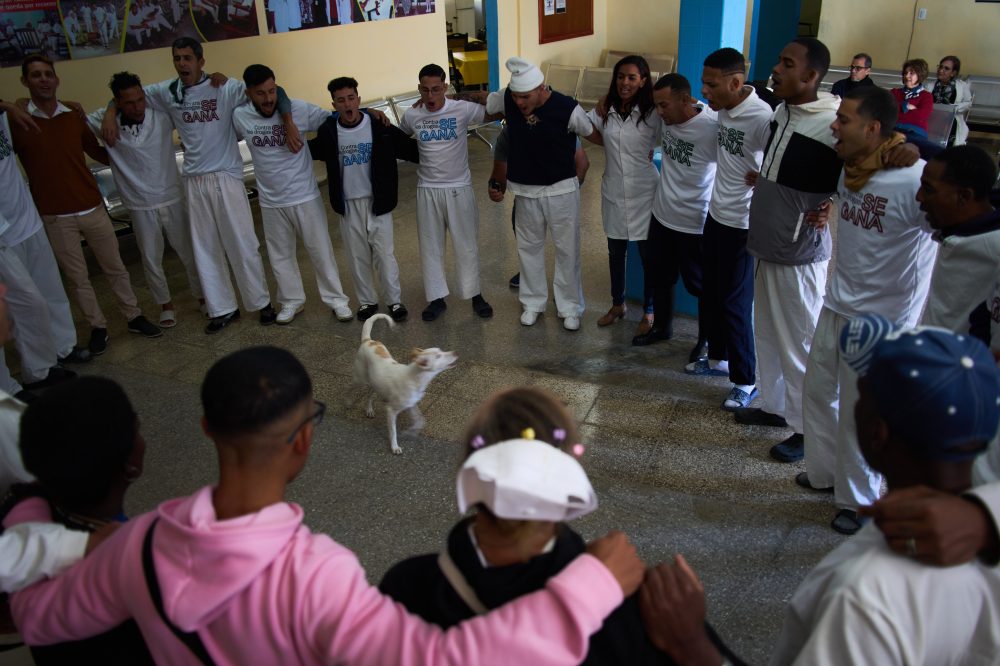

At a psychiatric facility in Havana, dozens of individuals joined hands in a circle, reciting promises together to eliminate “the toxins that enslave” their bodies. This collective commitment to stay clean for the next 24 hours marked the beginning of their three-month detox program before entering rehabilitation.
Until this decade began, substance abuse was virtually nonexistent in Cuba. But a worsening economic situation, scarcity of essential items, and the arrival of affordable synthetic narcotics have dramatically altered the situation.
Throughout Havana and other Cuban cities, witnessing young individuals collapsed in public spaces, struggling to walk, or found unconscious has become commonplace.
Officials identify the main danger as “químico” (chemical) — a dangerous mixture of synthetic cannabinoids combined with toxic substances. Street dealers also call it “papelitos” or “little papers,” since the substance soaks into paper sheets that get cut into small portions for smoking. Each dose sells for approximately 250 Cuban pesos (50 cents), making it cheaper than basic bread or soft drinks.
“It’s very cheap…and it’s everywhere,” said David Morales, 25, who is in recovery after receiving help at government-funded health centers and is now in rehabilitation therapy at the Alcance Victoria Cuba evangelical Baptist church.
Recognizing the growing consumption problem, Cuba’s Ministry of Health and multiple government departments created a National Drug Observatory in July, designed to study, track, and reduce illegal drug effects across the nation.
While officials don’t maintain user statistics, Dr. Tania Adriana Peón, who leads mental health and addiction services at the General Directorate of Health, referenced emergency department records as an indicator of the growing problem. During 2024, 467 individuals requested assistance or were documented in Havana emergency facilities. In 2025, this number almost doubled to 886.
The island maintains strict anti-drug laws, with trafficking penalties reaching life sentences. Though Cuba doesn’t manufacture or store drugs domestically, officials recognize the country faces addiction challenges.
Occasionally, authorities report finding cocaine packages discarded by smugglers during pursuits that wash onto beaches, called “recalos” or washups. Narcotics also enter through imported merchandise, and authorities have discovered small-scale domestic marijuana growing operations.
“The primary challenge Cuba faces today is related to new psychoactive drugs or synthetic cannabinoids, which originate mainly from the United States,” said Col. Juan Carlos Poey Guerra of Cuba’s Interior Ministry.
Police laboratories identified 46 different synthetic compounds during the past year, he noted. Substances combined with cannabinoids included the seizure medication carbamazepine, formaldehyde, and fentanyl, among other chemicals. During 2024 and 2025, authorities prevented 72 drug smuggling attempts from 11 different countries.
According to Poey Guerra, the United States supplies the primary chemical components used in químico production.
Cuba operates free, government-controlled healthcare, making local family medical centers the initial detection points for substance abuse signs. Medical officials refer patients with serious or complicated cases for extended hospital treatment programs.
The Associated Press recently visited a 40-bed male unit at Havana Psychiatric Hospital, housing patients between 20 and 30 years old completing 90-day detoxification before starting rehabilitation.
The facility contained two-person rooms decorated with family photographs, plus a small library area, meal space, and recreational zone. Daily, patients wearing white shirts displaying “We win against drugs” messages take charge of maintaining their living areas.
“I was incredibly depressed…living on the streets; I just couldn’t take it anymore,” said 23-year-old Daniel Fulleda, who was admitted in January. His tone was enthusiastic as he shared his plans of getting married before the year end and start a family. “Next year, I’ll start my own business.”
For many years, the centralized government handled drug and alcohol treatment — particularly alcohol cases — but the current crisis magnitude has allowed other organizations to participate.
“There are neighborhoods that are infested… I’ve seen young people using drugs right in front of me,” said Pastor Abel Pérez of the Alcance Victoria Cuba church. “As a pastor, I’m not called to sit idly by.”
During the previous year, the congregation offered counseling to roughly 50 youth and their families, with more than twelve people currently attending regular sessions.
“In my youth, talking about drugs was extraordinary… The problem has grown so rapidly and in such a short time that, to some extent, it has overwhelmed the country’s capacity to address it,” said Alejandro Morales, a 57-year-old oceanographic engineer who accompanies his son David to meetings at the Alcance Victoria Cuba church.
In the same space, 64-year-old Vilma Arias sought assistance alongside her 36-year-old daughter. Her other son, 26, also battles substance abuse but won’t accept treatment.
“We have to pray a lot,” she said. “My daughter is a wonderful teacher and my son is a graduate in automotive mechanics. I don’t even know how they fell into this,” she added.