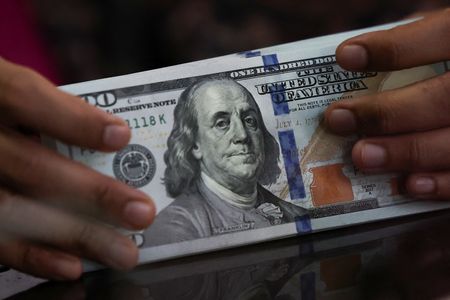

The U.S. dollar extended its slide Wednesday, retreating further after falling from a two-week high, as a cooler-than-anticipated inflation report led traders to scale back their expectations for a Federal Reserve interest rate hike in the coming weeks.
The greenback dropped 0.1% against the Japanese yen, trading at 162.08. Meanwhile, both the euro and the British pound each climbed 0.1%, reaching $1.1433 and $1.3401, respectively.
The New Zealand dollar held firm at $0.5819, hovering near its best level in a month, while the Australian dollar remained steady at $0.6983.
The U.S. dollar index, which tracks the dollar against a group of six major currencies, dipped slightly to 100.81. The index had dropped 0.35% in the prior session — its steepest single-day decline in nearly two weeks — pulling it back from its highest point since July 2.
June consumer inflation came in at 3.5% on a year-over-year basis, slower than markets had anticipated. The headline consumer price index fell 0.4% for the month, marking the first monthly drop since April 2020, driven largely by a retreat in energy costs.
Bond yields also fell following the unexpectedly mild inflation data, with two-year U.S. Treasury yields retreating nine basis points from a 16-month peak, as investors dialed back bets on an imminent rate increase from the Fed.
“The sizeable downside surprise gives the Fed greater scope to remain on hold for longer,” said Sim Moh Siong, FX strategist at OCBC, pointing out that central bank officials had indicated their July decision would depend heavily on the June inflation figures. “While we continue to expect modest USD appreciation by year-end, near-term upside momentum may remain constrained in the absence of fresh catalysts,” he added.
Traders now widely anticipate the Fed will hold off on a July rate hike as inflation cools. According to Fed funds futures prices tracked by CME Group, the probability of a July rate increase was cut in half, falling to just 16% following the inflation reports.
Still, some of that optimism was tempered by remarks from Fed Chair Kevin Warsh, who testified before the House Financial Services Committee that the central bank has “no tolerance” for persistently high inflation and pledged to “do my job” if challenged by U.S. President Donald Trump.
Adding to inflation concerns, escalating hostilities involving Iran in the Gulf pushed oil prices back to one-month highs. Trump reimposed a naval blockade of all Iranian ports on Tuesday, and the U.S. military announced a new round of strikes aimed at “continuing to degrade Iranian capabilities used to attack commercial shipping in the Strait of Hormuz.”
“One month of softer-than-expected CPI data will not close the door to interest rate hikes,” CBA economist Samara Hammoud wrote in a note, adding that markets are closely watching producer prices data due later in the day.