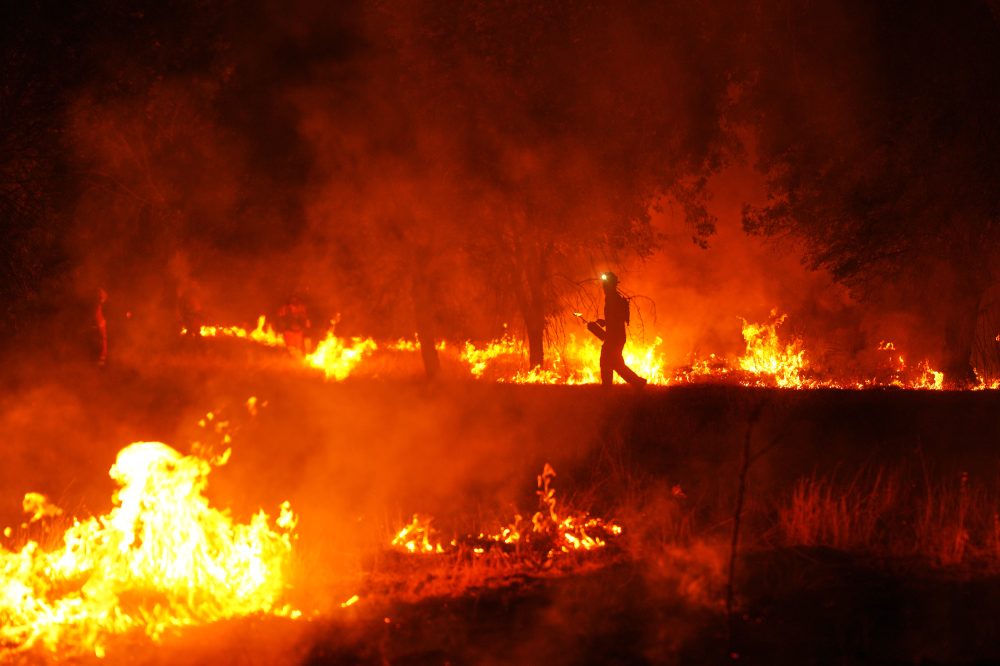

BARCELONA, Spain (AP) — Veteran Spanish firefighter Javier García has spent 20 years defending forests and rural communities, but nothing in his career has prepared him for the massive wildfire currently burning near Madrid.
“This doesn’t have a precedent,” García told the Associated Press by phone before heading into another grueling day on the front lines.
The out-of-control blaze has devoured 500 square kilometers — roughly 193 square miles — an area five times larger than the city of Barcelona. It has driven 25,000 residents from their villages in the smoke-filled hills of Ávila, located west of the Spanish capital.
The sheer power of what is now Spain’s largest wildfire on record is forcing emergency crews to completely rethink how they operate. Rather than directly attacking the flames, firefighters are now focused on evacuations and protecting structures, as fast-moving walls of fire make direct confrontation too dangerous.
“The evolution is alarming,” García said.
Where his crew once battled fires deep in the wilderness, they are now the last line of defense for people and their homes. Fortunately, no fatalities have been reported. Across the Ávila fire and two other blazes — one in the Madrid region and another in eastern Castellón — a total of 79,000 people have been displaced.
“That gives us more work and more stress,” García said. “Now it is lives first, then homes, and after, the forest.”
García is part of one of Spain’s dedicated emergency wildfire brigades, which are sent in to support regional firefighting teams when situations escalate. Crews work 12-hour shifts, spraying down burning trees and cutting away brush before it can feed the advancing fire.
His 40-person unit, stationed in Ávila, has already been working the Ávila fire for three days. Prior to that, they battled blazes in Guadalajara and near Zaragoza in recent weeks. The Guadalajara fire alone burned through 320 square kilometers — about 123 square miles — ranking it as Spain’s third largest wildfire ever recorded.
“Until last year, I had never experienced fighting one big fire after another,” said García, who is 43 years old.
Spain has long dealt with wildfires due to its hot summers and dry climate, but experts and government officials point to climate change as a driving force behind more frequent heat waves and extended drought periods, pushing the window of high wildfire danger longer each year.
Once a fire breaks out, it now spreads with a speed and intensity rarely witnessed before.
García noted that extreme fire risk days used to number around 15 per year. Today, firefighters remain on high alert for 30 to 40 days annually.
Spain’s ecology minister has stated that fires have burned through 1,530 square kilometers — about 590 square miles — so far this year. That figure is six times the area that burned during the same period in 2025.
The crisis extends beyond Spain’s borders. A massive fire in neighboring France has forced more than 200,000 people to evacuate their homes.
Raúl Guerrero, 29, has fought fires in the Castilla y León region — which includes Ávila — for the past ten years. He said this fire is unlike anything he has ever faced.
Guerrero told the AP that his 40-person crew has been forced to pull back to safer positions multiple times when the threat of being surrounded by flames became too great.
At certain points, he described the fire as “beyond the capacity of extinction” — meaning, in his words, “the fire is so virulent and has such power that no matter what you do, you can’t put it out.”
When asked how that reality feels, Guerrero answered with one word: “above all, impotent.”
While wildfires are frequently sparked by lightning or equipment used in farming, another major factor making them harder to control is the gradual disappearance of farms, orchards, and local forestry operations that once created natural firebreaks around towns and villages.
Guerrero said vegetation now grows directly up to people’s homes. He urged both property owners and local governments to make year-round brush clearing and forest maintenance a priority.
Without that effort, Guerrero warned, the overgrown vegetation will remain “pure gunpowder” waiting to fuel the next catastrophic fire.