
HONG KONG — China fired back Tuesday against growing international criticism that its economy is producing far more goods than the world needs, as the United States prepares to release the results of a major trade investigation that could lead to new tariffs.
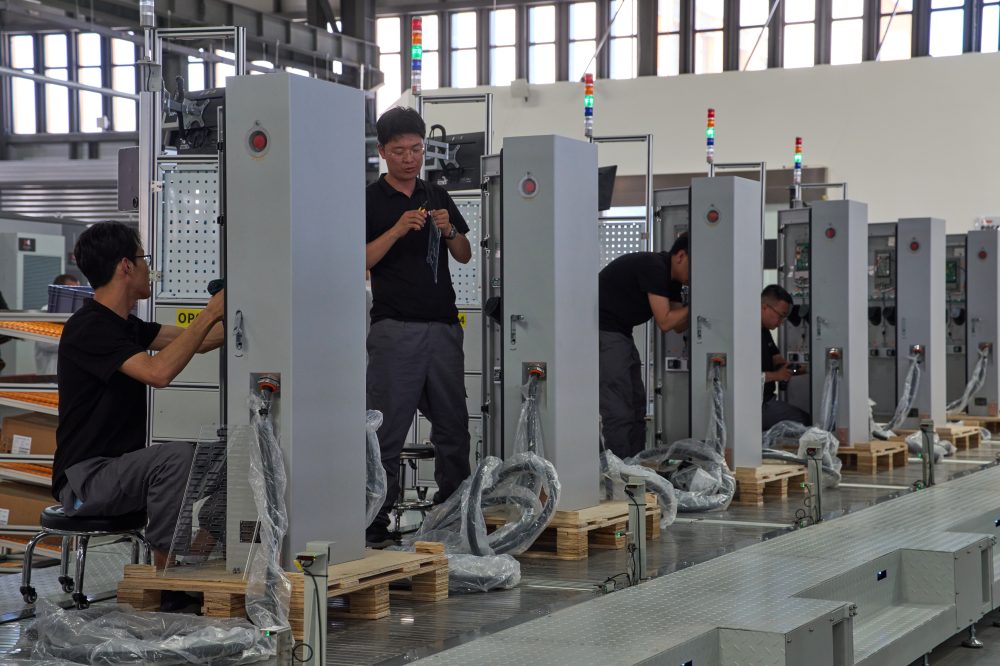
Chinese industries ranging from automobile manufacturing to solar panels, cement, and steel have come under increasing scrutiny from the country’s trading partners in recent years. While China’s own government has made restructuring its economy a stated priority, a slowdown in domestic spending has pushed Chinese companies to sell more goods abroad. Those surging exports drove China’s trade surplus to a record high of nearly $1.2 trillion last year.
China’s Ministry of Commerce released a report titled “China’s Position on the So-called Excess Capacity Issue,” declaring that the country has never deliberately sought a large trade surplus. The report specifically challenged recent talk of a so-called “China shock 2.0” — a reference to the economic disruption China’s rise as a manufacturing giant caused for other countries.
“The U.S. and other western countries have come up with the so-called ‘China shock 2.0,’ falsely accusing China’s industrial development of posing threats to western countries’ monopoly,” the report stated, adding that such claims are “not supported by facts and totally untenable.”
The report echoed comments made by China’s second-highest official, Premier Li Qiang, at the World Economic Forum’s “Summer Davos” gathering in the northeastern Chinese city of Dalian. Li argued that instead of a “China Shock 2.0,” the current situation should be seen as a “China Opportunity 2.0.”
The U.S. is expected to soon release the findings of an investigation into manufacturing and production levels across 16 economies, including China. That probe is widely anticipated to result in higher tariffs on certain countries.
Just last Friday, the U.S. already moved to impose higher tariffs of 10% to 12.5% on 60 economies, including China, citing their failure to adequately enforce a ban on goods made using forced labor. China and many other affected nations objected to that action.
At a press conference Tuesday in Beijing, Lin Weilong, director of the Commerce Ministry’s policy research office, argued that the U.S. has no right to unilaterally judge whether other countries are overproducing and then impose trade penalties as a result.
“The U.S. cannot narrowly define production capacity that exceeds domestic demand as excess capacity, and slap it with a surplus label,” Lin told reporters.
Earlier this month, the European Union also moved to protect its own industries from Chinese competition, putting in place measures to shield its steel sector and limiting imports of small packages from e-commerce platforms.
One analyst said China’s arguments are unlikely to gain much traction. Alfredo Montufar-Helu, a China expert at the consultancy Ankura, said Western governments are under too much political pressure to simply stand by.
“Economic conditions in Western markets have made it politically untenable to do nothing in the face of rising Chinese imports, especially in high value added sectors that Western firms used to dominate,” he said, suggesting China’s position will likely “fall on deaf ears.”