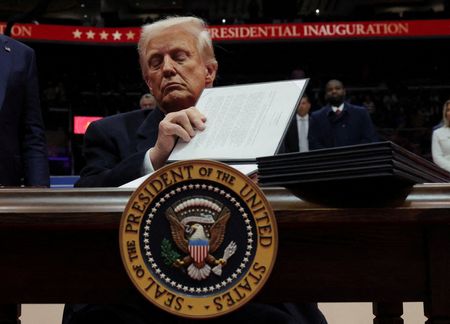

The push by President Donald Trump against corporate diversity programs is making a measurable impact in America’s boardrooms, with new data showing that appointments of women and racial minorities to S&P 500 company boards have dropped to their lowest point in more than a decade.
Research from global executive search firm Spencer Stuart, released Tuesday, shows that board diversity in new appointments has been steadily falling since it peaked at 72% in 2021 and 2022. Of the 364 new independent directors added to S&P 500 boards during the year ending April 30, only 40% were women or racial minorities — the lowest share since 2014, when that figure stood at 39%.
Overall board diversity across S&P 500 companies currently stands at 49.3% — just slightly below the record high of 49.6% reached in 2024 and 2025, according to Spencer Stuart. But recruiters and analysts caution that this overall figure reflects years of past appointments made in the wake of the #MeToo and Black Lives Matter movements, and may not hold if current hiring patterns persist.
George Anderson, co-leader of Spencer Stuart’s North American Board Advisory Practice, said boards are reacting to shifting legal, regulatory, and political pressures. He noted that one contributing factor is an increased preference for recruiting current and former CEOs, who made up 37% of new directors this year — the highest proportion in 15 years. While companies view these executives as capable of handling complex business environments, the pool of CEOs is itself less diverse, he said.
The drop in diverse appointments has been accompanied by a sharp decline in companies publicly stating that diversity plays a role in how they select board members. Currently, about 12% of S&P 500 companies disclose using some form of diversity criteria in board decisions, compared to 23% at the start of Trump’s second term in 2025 and 48% in 2024 under the previous administration, according to data provided to Reuters by PeopleReturn, a human resources analytics firm.
Supporters of diversity initiatives argue they open doors for historically disadvantaged groups and lead to better governance and decision-making. Trump and critics of such programs contend they discriminate against white people and men and undermine advancement based on merit.
Kristin Hull, chief investment officer of Nia Impact Capital — a firm that frequently lobbies technology companies on social issues — said the declining numbers signal a return to male-dominated corporate leadership. “We were making such progress,” she said. “Now the bro culture is alive and well.”
Conservative activist Robby Starbuck, who has led high-profile social media campaigns pushing companies including Tractor Supply and John Deere to roll back DEI programs, welcomed the change. “They were focused on all the wrong things, and it shows in their earnings,” he said. Neither company responded to requests for comment.
When asked about the rollback of corporate diversity efforts, White House spokeswoman Allison Schuster said Trump “was resoundingly elected with a mandate to end divisive, racist policies and restore merit and efficiency.”
Under Trump, the Equal Employment Opportunity Commission — established under the Civil Rights Act of 1964 — has been directed to identify and act against what the administration characterizes as illegal DEI practices that it says gave preferential treatment to women and minorities in hiring and promotions.
Many companies had already begun scaling back or reconsidering their diversity programs before Trump’s second term, following a 2023 Supreme Court ruling that made it illegal to consider race in college admissions. Although that ruling did not directly apply to corporate hiring, it triggered a wave of legal challenges against companies over various diversity-related practices.
Trump issued executive orders last year restricting DEI programs among federal contractors and within the federal government itself, declaring at the time that “our country will be woke no longer.” His administration has also threatened significant financial penalties for companies that fail to comply.
In April, IBM agreed to pay $17 million to settle allegations that it discriminated against certain employees and did not comply with Trump’s orders designating DEI initiatives as illegal for federal contractors. The U.S. Justice Department alleged that IBM prioritized diverse candidates in hiring and tied employee bonuses to hitting specific demographic targets. IBM was the first U.S. company to face enforcement action under Trump’s anti-DEI directive regarding employment practices. The company did not respond to requests for comment but denied wrongdoing in the settlement agreement.
Despite the administration’s pressure, shareholders have shown little interest in proposals aimed at weakening diversity programs. Three conservative-backed shareholder proposals targeting corporate DEI efforts received an average of just 1.5% support at recent annual meetings — a typical rate for such measures.
The shift in board recruitment is visible at several major companies that had championed diversity following the #MeToo movement and the 2020 protests over the police killing of George Floyd, including Johnson & Johnson, Goldman Sachs, and American Express.
Goldman Sachs dropped its requirement early last year that companies it helped take public have at least two diverse board members, citing “legal developments” shortly after Trump signed his first executive order targeting diversity efforts. A Goldman spokesperson said the firm still believes diversity strengthens its performance and is essential to its financial success. Johnson & Johnson and American Express did not respond to requests for comment.
PeopleReturn CEO Josh Ramer said that when major asset managers such as BlackRock, Vanguard, and State Street stepped back from their DEI stances, it removed significant pressure on companies to diversify their boards. “All the big investors that were pushing for this have completely stopped mentioning it. Large-cap executives feel a lot less pressure to be talking about this,” he said.
BlackRock had called in late 2021 for boards to be at least 30% diverse, while Vanguard in 2022 called for diversity of gender, race, and ethnicity “at a minimum.” Both firms removed that language last year. State Street dropped its expectation in February 2025 that women make up at least 30% of major company boards. All three asset managers declined to comment for this story.
In the executive suite, diversity is also carrying less weight in leadership searches. Women and racial minorities made up roughly 22% of all S&P 500 CEOs last year, down from 23% the year before, according to Spencer Stuart.
Jeff Christian, CEO of executive headhunting firm Christian & Timbers, summed up the changed environment this way: “Today we hear more about ‘the best person.’ There’s less currency for being a person of color than there once was.”