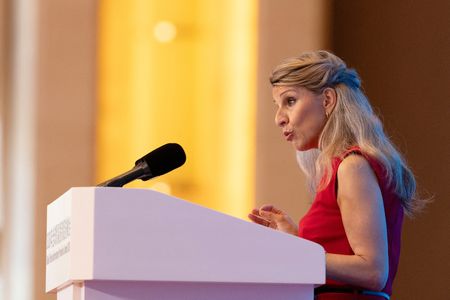

Spain has put forward its Labour Minister, Yolanda Diaz, as a candidate to lead the United Nations’ International Labour Organization, a move that could make her the first woman ever to hold the position. The nomination came on Thursday amid growing financial uncertainty at the Geneva-based agency caused by the United States withholding its payments.
The Spanish government said Diaz’s bid for the leadership role reflects her track record on workplace reform, pointing to policies that helped cut down on temporary employment contracts and pushed Spain’s employment numbers to record highs.
In an official statement, the government said, “Yolanda Díaz has driven some of the most significant labour and social reforms of recent years, all of them achieved through social dialogue and resulting in 30 agreements.”
Diaz founded the multi-party left-wing coalition Sumar in 2023 and is widely recognized for significantly increasing the minimum wage in Spain. However, her relationship with the country’s business community has grown increasingly strained over time, and she has yet to follow through on a pledge to shorten the standard workweek.
She is expected to go up against the ILO’s current Director-General, Gilbert Houngbo of Togo, whose term runs through 2027. The election to determine the agency’s next leader is scheduled for November. The ILO has 187 member states and is responsible for setting international workplace standards and championing workers’ rights around the world.
A senior diplomat told Reuters that Diaz’s candidacy is expected to draw backing from many European nations.
The ILO is currently under significant financial pressure. As of July 17, the United States — long the agency’s biggest financial contributor — owes 257 million Swiss francs, roughly $315 million, in assessed contributions and unpaid arrears. Earlier this month, the White House expressed support for a House spending bill that would eliminate U.S. funding for the ILO and several other international organizations, including UNESCO, the World Health Organization, and the Organisation for Economic Co-operation and Development.
Houngbo has drawn criticism from both staff and member nations over his plans to restructure the organization and address its cash shortfall. Reuters previously reported in June that the ILO reversed the appointment of a U.S. official to a senior leadership position because of delays in American payments. The financial crunch has already forced the agency to eliminate 120 jobs, halt new hiring, and put other cost-saving measures in place.
The ILO was established in 1919 and holds a distinctive place within the United Nations system. Unlike most UN bodies, it operates through a tripartite structure that brings together governments, employers, and workers to shape global labor standards.