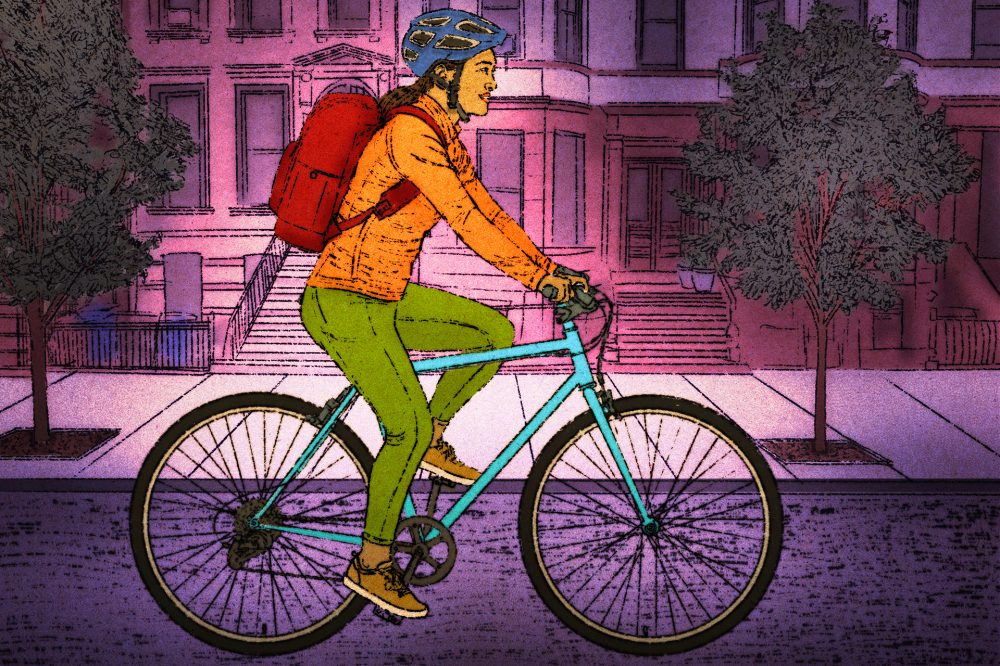

When 72-year-old Michael Roper rides his bicycle to and from the Chicago pub he owns, he says he can’t picture a better way to get to work. Along the way, he gets exercise, breathes fresh air, and notices things about his neighborhood — a newly opened coffee shop or an owl swooping overhead at night — that he’s certain he’d never catch from behind a car windshield.
If you’ve thought about riding a bike to work but talked yourself out of it because of the cost, your fitness level, or fears about showing up sweaty and disheveled, experts say those obstacles are easier to overcome than you might think. With gas prices remaining high, cycling offers a practical, budget-friendly alternative for getting to the job.
“It’s such a great, practical invention that I became enamored with as a little kid, and I find it just as valuable as a 72-year-old,” said Roper, who owns the Hopleaf Bar and restaurant.
Seasoned cyclists and bicycle safety advocates have shared their best advice for beginners who want to start commuting by bike — and make it to their destination safely and looking reasonably put-together.
You don’t need to spend a lot of money
While some cyclists invest in foldable bikes, padded shorts, and waterproof bags, none of that is required. If buying a bike isn’t in your budget, bike-sharing programs that rent two-wheelers for short trips are another option worth exploring.
When 22-year-old Natalie Frank graduated from college and started a job as a software engineer at a technology company’s Boston office, she didn’t have money to spare. She reached out to friends to see if anyone had an unwanted bicycle, and within a few weeks she had a free road bike. She fills the tires using free air pumps available in city parks.
“My commute costs zero dollars. That’s crazy,” Frank said.
Plan ahead for your appearance
Many bike commuters arrive a few minutes early to freshen up and change into work clothes. Some leave a spare outfit at their desk. Frank carries her work clothes and laptop in a backpack.
Ellie Dannenberg, 37, a math professor at the University of Denver, rides in gym clothes and brings her work outfit in panniers — storage bags and baskets that fasten onto a bicycle. She keeps a pair of work shoes in her office.
“Investing in pannier bags is a really great thing to do, especially for the commute to work when you probably don’t want to show up super sweaty,” Dannenberg said. “Backpacks are heavy, they’re more uncomfortable, and then you end up with a sweaty back when you get there.”
On rainy days, Dannenberg wears rain pants and a waterproof jacket that fits over her helmet. For offices without shower facilities, keeping body wipes, rinse-free cleanser, or deodorant at your desk can help you feel refreshed when you arrive.
Make yourself visible and ride defensively
Safety advocates strongly urge cyclists to wear a helmet. Bright or reflective clothing, along with lights and reflectors mounted on the bike, make riders much easier for drivers to see.
Roper wears a yellow-green helmet and uses front and rear flashing lights. “You really can’t fail to see me,” he said.
On smaller roads without dedicated bike lanes, Dannenberg recommends riding in the middle of the lane and moving to the front of traffic at red lights. She also warns riders to watch for black ice in colder months. “If you’re running late and there’s ice on the road, it’s worth it to slow down around the corners,” she said.
The League of American Bicyclists offers videos on its website covering traffic safety and hand signals that cyclists use to indicate turns or stops.
Find a riding buddy and learn the safer routes
New cyclists may benefit from pairing up with a more experienced rider who knows which routes are calmer and less congested.
“It’s nice to have a buddy if you know someone who’s commuting by bike in the vicinity that you’re going,” said Alison Dewey, education director at the League of American Bicyclists. “Maybe the most enjoyable route is just going another half-mile in this direction and getting on a trail instead of a more direct way. Someone who’s more experienced might know that.”
Some riders prefer electric bikes with a pedal-assist feature that gives them a boost when they need to keep up with traffic, particularly when starting up again after stopping at intersections, Dewey noted.
Watch out for car doors
When riding alongside parked vehicles, give yourself plenty of space to avoid being “doored” — a collision that happens when a car occupant swings open a door directly into a passing cyclist’s path.
The League of American Bicyclists recommends staying at least four feet away from parked cars, even if that means riding outside of a marked bike lane. “It’s more important to be out of the ‘door zone’ than to be in the bike lane,” Dewey said. She also advises scanning parked cars for anyone sitting inside and moving over if you spot a driver or passenger.
Know what to do if you’re in a crash
If you’re involved in a collision with a vehicle, call the police, collect information to identify the driver, and don’t delay seeking medical attention, advised Daniel Flanzig, a lawyer who serves as board president of the New York Bicycling Coalition, a nonprofit advocating for bicycle-friendly policies.
“Be vigilant when you’re riding,” Flanzig said. “Things can come at you as a cyclist. Whether it’s a car or a pothole or a road defect, there’s a lot of hazards out there that we have to keep our head on the swivel for.”
The unexpected bonus: a better start to your day
Beyond the practical benefits, many cyclists say the morning ride itself improves their mood and energy before they even step through the office door.
“Biking is genuinely probably one of the best parts of my day. I get to listen to music. I get to be by myself. I get to think,” Frank said. “Biking feels like it’s reclaiming some of the autonomy of my day, like the joy and whimsy of moving around, especially in the city.”
Dewey, 52, enjoys views of the Potomac River during her 16-mile ride to work. “It brings me a lot of happiness to just ride,” she said. “Being outside is just always good for my emotional health. And honestly, I like being under my own power.”