
CAIRO — Yemen’s Houthi rebels are threatening to blockade a critical global shipping lane, a move that experts warn could escalate the ongoing Iran war and send further shockwaves through international oil markets and trade.
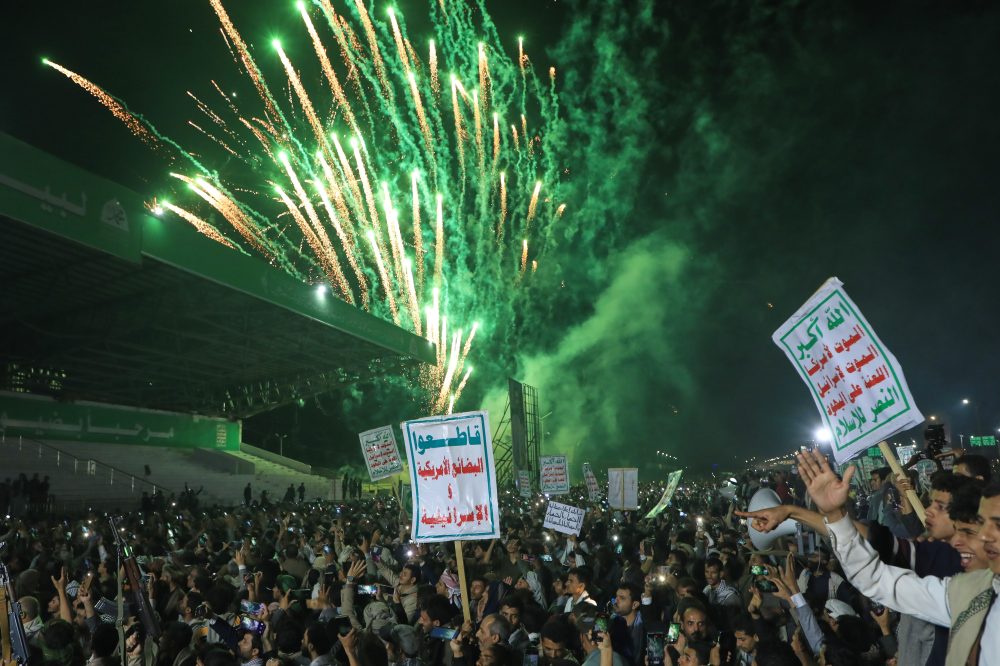
The Iran-backed rebel group says it has shut the Bab el-Mandeb Strait to vessels connected to Saudi Arabia, citing the kingdom’s blockade on Yemen and a recent strike on the international airport in Sanaa, the rebel-held Yemeni capital. On Thursday, the Houthis announced they had struck two Saudi oil tankers in the Red Sea, igniting fires aboard both ships.
Saudi Arabia’s state-run news agency confirmed a fire on a tanker following an attack in the Red Sea, a report echoed by the United Kingdom Maritime Trade Operations Center. No injuries or deaths were reported.
Located at the southern end of the Arabian Peninsula, Bab el-Mandeb is one of the most strategically important waterways on the planet. It links the Red Sea to the Gulf of Aden, and roughly 12% of all global trade passes through it — including about a quarter of worldwide container shipping.
The strait has grown even more critical for Saudi oil exports since the Iran war disrupted shipping through the Strait of Hormuz, drastically cutting the flow of vessels out of the Persian Gulf.
While the Houthis say they are only targeting ships tied to Saudi Arabia or its Red Sea ports, their track record tells a different story. During a similar blockade they imposed against Israel during the Gaza war, the rebels attacked numerous vessels with little or no connection to that conflict.
Even the threat of a blockade, analysts note, may be enough to push international shipping companies away from the route entirely.
Although the Houthis do not control the stretch of Yemen’s coastline that runs along Bab el-Mandeb — that territory is held by their civil war opponents — they do hold ground less than 100 kilometers, or about 60 miles, away.
Three Houthi officials, speaking anonymously with The Associated Press because they were not authorized to speak to the media, said on Tuesday that the group has spent months preparing to disrupt shipping in the strait. Their plans reportedly involve naval mines, boats packed with explosives, drones, and helicopters used to deploy fighters onto ships.
The officials said ships would first receive warnings to stay out of designated zones. If those warnings are ignored, military force would follow.
The situation echoes what has unfolded in the Strait of Hormuz, where Iran has demonstrated that even occasional attacks on vessels can effectively close off a vital waterway by driving up risk assessments and insurance costs.
Clionadh Raleigh, founder of ACLED, a conflict monitoring organization, put it plainly: “If Bab el-Mandeb comes under pressure at the same time as shipping in the Gulf, you have disruption around two of the world’s most important maritime routes at once.”
According to an analysis published this week by Allison Minor, director of the Atlantic Council’s Project for Middle East Integration, more than 7 million barrels of petroleum per day moved through Bab el-Mandeb in June — up sharply from around 4 million barrels before the Iran war began.
Saudi Arabia has been moving roughly 4 million barrels of oil daily through its Red Sea port of Yanbu, partially offsetting the damage caused by the Strait of Hormuz closure, which has nonetheless rattled economies around the globe.
Even if Bab el-Mandeb becomes impassable, Saudi Arabia has some alternatives. It could send up to 2.5 million barrels per day across the Red Sea to Egypt, where the SUMED pipeline can carry crude to the Mediterranean. Another option is routing up to 1 million barrels per day through the Suez Canal.
International shippers could also divert around Africa’s Cape of Good Hope, as they did during the height of the Gaza conflict — but that path adds one to two weeks to voyage times and significantly increases shipping costs.
At the peak of the Gaza war, the Houthis attacked more than 100 vessels before a sustained U.S. and Israeli air campaign brought those attacks to an end in early 2025.
When asked about Thursday’s tanker attack, U.S. Secretary of State Marco Rubio offered a measured response: “I hope they’ll stop. They shouldn’t really do that.” Speaking at a regional summit in the Philippines, Rubio added, “I think the Houthis, frankly, got snookered into this thing by the Iranians. And they were smart to stay out of it, and they should stay out of it and they should stop.”
The Houthis also face the risk of reigniting their war with Saudi Arabia and its allies inside Yemen, where major fighting had wound down following a 2022 truce. Saudi Arabia’s military has vowed to keep the strait open.
“All Houthi threats against transiting vessels will be dealt with swiftly and firmly, as such threats are a blatant violation of international law and fall under acts of maritime piracy,” said Maj. Gen. Turki al-Malki, a Saudi military spokesperson.
Yemen’s civil war dates back to 2014, when the Houthis seized Sanaa and large portions of northern Yemen, driving the internationally recognized government into exile. Saudi Arabia then led a coalition to fight the rebels and imposed an air and sea blockade on Houthi-controlled areas, though that blockade has eased in recent years.
According to the Houthis, Saudi Arabia struck Sanaa’s airport earlier this month in an effort to prevent a flight from landing that was carrying Houthi leaders returning from Iran, where they had attended the funeral of Supreme Leader Ayatollah Ali Khamenei. The plane ultimately landed safely at a different airport. In response, the Houthis launched missiles and drones at Saudi Arabia’s Abha International Airport, marking the most significant confrontation between the two sides in years.
The Houthis frame their push to close Bab el-Mandeb to Saudi traffic as an effort to break the coalition’s blockade on Yemen.
Ahmed Nagi, a senior Yemen analyst at the International Crisis Group, said the threat also serves the interests of the Houthis’ Iranian backers at a moment when the U.S. has resumed daily airstrikes. “From Iran’s perspective, opening additional pressure points across the region gives it more leverage,” Nagi said. “The Houthis provide Tehran with influence over one of the world’s most important maritime chokepoints.”