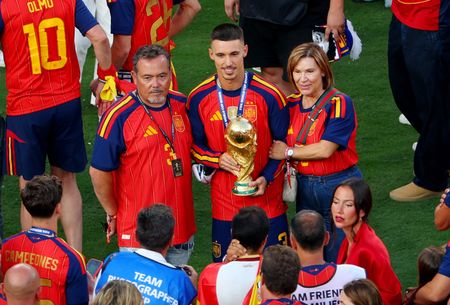

EAST RUTHERFORD, New Jersey — Spain navigated every twist and turn the beautiful game could throw at them Sunday, blending elegance with grit, and emerged as World Cup champions with the ball firmly in their control and confidence running through their veins.
The Spanish side defeated Argentina 1-0 in a result that was less a break from their style of play and more a reaffirmation of it. Spain passed relentlessly, probed for openings, and treated possession like something precious — never wavering even as Argentina held firm and the match pushed deep into extra time.
In a moment that perfectly captured the team’s philosophy, the decisive goal came from players who had entered from the bench. Substitutes Nico Williams and Ferran Torres combined for the winner — marking the third time in the knockout stage that a replacement player delivered the game-winning blow for Spain.
That detail speaks volumes about the squad built by manager Luis de la Fuente. This is not a team driven by individual stars seeking the spotlight, but rather a collective unit where even those coming off the bench are fully prepared to deliver when called upon.
Spain finished the match controlling more than 65% of possession, registering 12 shots on target, and completing more than twice as many passes as Argentina. The Argentine side managed their first attempt on goal — which missed — only near the closing minutes of extra time.
Spain dominated without delivering a knockout blow. Their well-known vulnerability — the lack of a traditional center forward — showed in the number of chances they created but could not convert.
Still, that shortcoming remains perhaps the only real crack in an otherwise tightly bound team built on collective strength.
Spain swept several major individual awards from the tournament. Pau Cubarsi was named Best Young Player, Unai Simon took home the Best Goalkeeper honor, and Rodri was recognized as the tournament’s Most Valuable Player. The only individual prize that slipped away from them was the Golden Boot, which went to France’s Kylian Mbappe.
Even that felt fitting. Spain’s success was never built around a single scorer. Their 14 goals across eight matches were distributed among eight different players — echoing their European Championship run in 2024, when 10 different players shared a tournament-record 16 goals.
The victory over Argentina also pushed Spain’s unbeaten streak to 38 consecutive matches, surpassing Italy’s previous mark and cementing three years of dominance on the international stage.
The championship also served as a personal vindication for De la Fuente, who was once mocked by Spanish media with the nickname Luis de la “Who” — a nod to his long years working quietly within Spain’s youth football system. He has now converted that patient, behind-the-scenes career into the sport’s greatest prize.
This Spanish squad also mirrors the diversity of the country itself, bringing together players from various regions, backgrounds, and cultures. Players from the Basque Country such as Mikel Oyarzabal, Simon, and Mikel Merino share the field with Borja Iglesias from Galicia, Torres from Valencia, Rodri from Madrid, Fabian Ruiz and Gavi from Andalucia, and Pedri from the Canary Islands. Cubarsi and Marc Cucurella are among nine players born in Catalonia, while Lamine Yamal and Williams represent the country’s immigrant communities and a changing Spain.
Spain has long drawn strength from the distinct regions and peoples that make up the nation. On Sunday, those differences were not erased — they simply ceased to be divisions.
For one night at least, football accomplished something that politics rarely manages: it made Spain feel united.