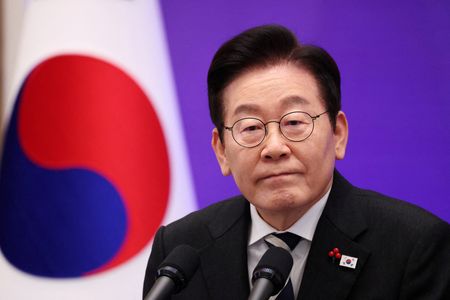

South Korean President Lee Jae Myung is meeting with Indian Prime Minister Narendra Modi in New Delhi on Monday, with plans to significantly strengthen economic partnerships between the two nations, particularly in the shipbuilding sector.
This marks the first time a South Korean president has made a state visit to India in eight years.
Speaking at a dinner with Korean community members in New Delhi on Sunday, Lee acknowledged current limitations in their economic relationship. “The level of economic cooperation between South Korea and India is still very low,” the president stated. “Going forward, we will expand that space and make the relationship between South Korea and India completely different from what it is now.”
Both nations are working to enhance their Comprehensive Economic Partnership Agreement, with goals to nearly double trade volume to $50 billion by 2030, up from last year’s $25.7 billion, according to presidential adviser Wi Sung-lac.
Lee’s visit will include business meetings with corporate executives, exploring collaboration opportunities in finance, artificial intelligence, and defense sectors, Wi noted.
The South Korean leader emphasized the strategic importance of this partnership on Sunday, stating that supply chain disruptions and global economic pressures from the Iran conflict will make the countries “the most important strategic partners” for each other. He characterized India not merely as a consumer market, but as a crucial player in worldwide production and supply networks.
Last month, South Korea made urgent requests for India to increase naphtha supplies to help mitigate potential disruptions from Middle Eastern tensions.
India supplied approximately 8% of South Korea’s naphtha imports in the previous year. South Korean Trade Minister Yeo Han-koo suggested that increased imports could help address trade imbalances between the nations.
Trade data from the Korea International Trade Association shows South Korea maintained a $12.8 billion trade surplus last year, with $19.2 billion in exports compared to $6.4 billion in imports.
During a policy discussion at South Korea’s parliament last week, Seoul National University Asia Center research fellow Maeng Hyun-chul highlighted India’s ongoing concerns about its growing trade deficit with South Korea. He noted that political relationships have lagged behind commercial connections.
Maeng suggested shipbuilding could become a major area for enhanced cooperation, aligning with India’s employment creation goals while leveraging South Korea’s industrial expertise. He also identified food and consumer products tied to Korean cultural popularity as potential growth sectors.
Following his India visit, Lee is scheduled to travel to Vietnam.