
Business confidence among Japanese manufacturers held firm in July, driven by robust demand for semiconductors and components tied to artificial intelligence, even as service sector companies grew more pessimistic due to rising costs, according to the latest Reuters Tankan survey.
The monthly poll, which serves as an early indicator of the Bank of Japan’s official quarterly Tankan business survey, showed the manufacturers’ sentiment index remaining steady at plus-13 in July — unchanged from the previous month.
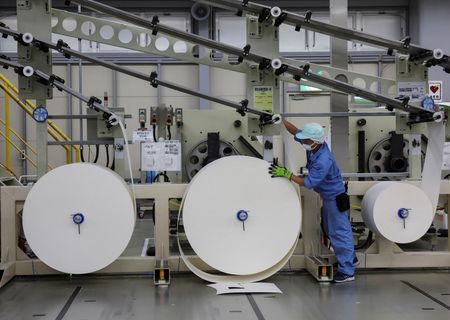
Factory sector respondents pointed to a rebound in the semiconductor market, including stronger demand for memory-related products, along with a rapid surge in orders for components used in chip manufacturing and AI server systems. Orders for electronic components were also climbing across the board.
“Order volumes and values are at levels we’ve never seen before, and we’re concerned about production capacity,” said a manager at a precision machinery manufacturer.
The survey was conducted between July 1 and July 10 and gathered responses from 218 of the 511 companies contacted. The sentiment indexes are calculated by taking the share of optimistic respondents and subtracting the share of pessimistic ones, so a positive number reflects an overall upbeat outlook.
In contrast, non-manufacturers saw their sentiment index slide to plus-25 from plus-32, pulled down by cost pressures and ongoing uncertainty surrounding the U.S.-Israeli war with Iran.
“Although signs of a resolution to the Middle East issue are beginning to emerge, the situation has not yet recovered,” said a manager working in the service sector.
Earlier this month, the Bank of Japan’s official Tankan survey revealed that the overall business mood had climbed to an eight-year high, with corporate expectations for inflation reaching record levels.
Still, the central bank struck a cautious tone on inflation last week, warning that the Iran conflict would likely push more companies to raise their prices later in the year.
While the United States and Iran reached a preliminary agreement to end hostilities in June, the ceasefire remained fragile, with both sides continuing to exchange missile strikes. Japan’s wholesale inflation jumped to a three-year peak of 6.3% in May, signaling that businesses were already passing along higher costs stemming from the energy shock.
Looking ahead, manufacturers anticipate their sentiment will hold relatively stable, with the index projected to tick up slightly to plus-14 by October. The non-manufacturers’ index is also expected to remain at plus-25 as business leaders continue to weigh the effects of geopolitical risks and supply chain disruptions.