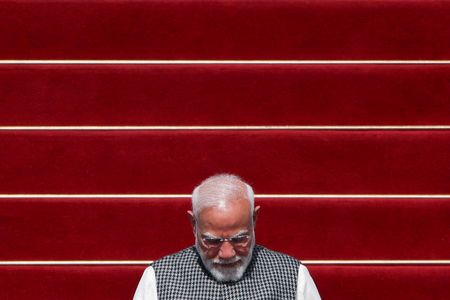

NEW DELHI – Prime Minister Narendra Modi’s ruling party has bolstered its strength in India’s parliament after seven opposition legislators switched allegiances on Monday, according to official parliamentary records. The move could help the government advance its legislative agenda more smoothly.
The seven lawmakers who changed parties all belonged to the Aam Aadmi Party (AAP), which is headed by Arvind Kejriwal, one of Modi’s most vocal political opponents. AAP currently controls Punjab state and previously held power in Delhi, the nation’s capital territory.
Following these defections, AAP now holds only three seats in the Rajya Sabha, India’s upper legislative chamber. Meanwhile, Modi’s Bharatiya Janata Party has increased its membership to 113, putting it just 10 seats away from controlling a simple majority in the 245-seat body. The broader National Democratic Alliance, led by Modi, now commands approximately 140 seats in what is also called the Council of States.
Members of the Rajya Sabha serve six-year terms and are chosen by elected officials from state and territorial legislatures through a proportional representation voting system. Modi’s coalition currently governs 19 of India’s 28 states plus two of the three federal territories that have their own legislatures.
Among those who switched parties are former cricket star Harbhajan Singh and Raghav Chadha, who effectively led the group of defectors. Chadha had gained public recognition by advocating for middle-class issues, including challenging expensive food prices at airports.
Chadha criticized his former party, claiming it was controlled by “corrupt and compromised” individuals. In response, AAP officials accused the defectors of acting purely out of political opportunism.
Six of the seven former AAP legislators were originally elected from Punjab, where state elections are scheduled for next year and where Modi’s party has never secured an outright majority independently. Multiple AAP leaders, including Kejriwal himself, are currently facing legal proceedings related to corruption charges.
In February, a New Delhi court chose not to move forward with prosecution against Kejriwal and other party members in one corruption case, which AAP maintains is politically driven. The case has since been appealed to a higher court.