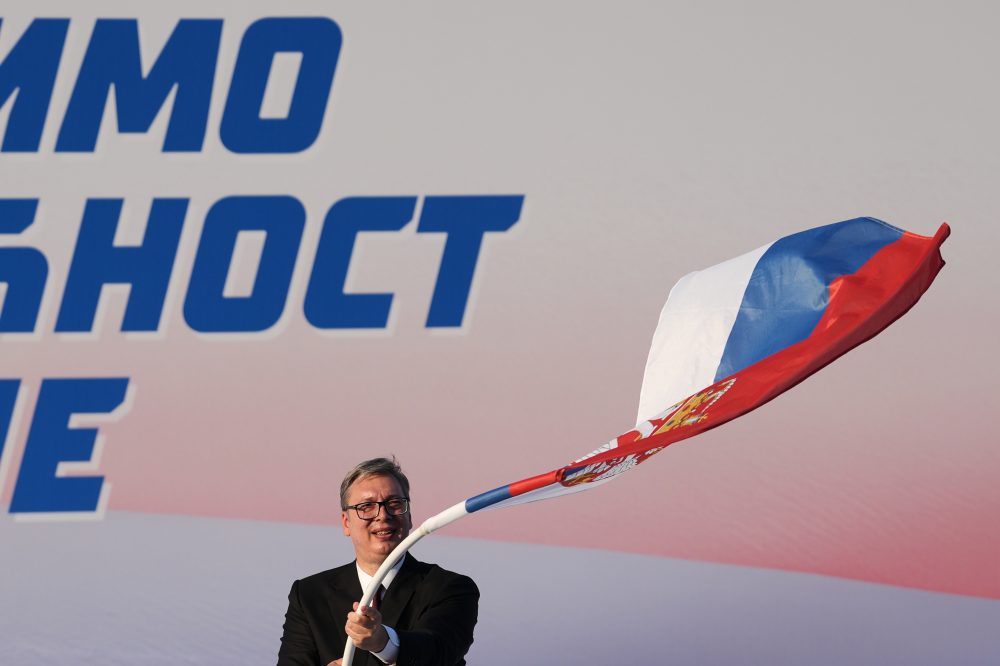

BELGRADE, Serbia — Serbian President Aleksandar Vucic announced Monday that early general elections in the Balkan nation are expected within the next three to four months. He also repeated his intention to step down from the presidency before that vote takes place.
Vucic did not provide specific dates for either his resignation or the elections. Speaking to supporters at a rally on Saturday, he indicated it was likely the final time he would address them as president and said he plans to leave office within weeks.
Political observers widely view the move as a strategic maneuver that would position Vucic to take over as prime minister — a role that is formally the most powerful in the Serbian government. Vucic is currently serving his second presidential term and is prohibited by law from running for president again.
“Yes, it is logical that we will have elections soon, and when I say soon I mean the next three-four months,” Vucic stated. He added that he has not yet decided whether to pursue the prime minister’s position if his Serbian Progressive Party, known as SNS, wins the upcoming parliamentary election.
“Whatever I decide and whatever decision I make, it will be transparent, just like I have done by announcing my resignation,” he said. He noted he could step down at any point in July, August, or September, adding, “It will be no surprise.”
Under Serbian law, once Vucic formally submits his resignation, a presidential election must be held within 90 days. Regularly scheduled presidential and parliamentary elections in Serbia are not due until next year.
Vucic has been facing more than a year of widespread street demonstrations that originally erupted following a deadly train station tragedy in northern Serbia, which claimed the lives of 16 people. A youth-led movement demanding accountability for the collapse of a station canopy has rattled Vucic’s hold on power more significantly than any previous challenge.
Anti-government demonstrators have attributed the canopy collapse at the Novi Sad railway station to corruption-driven negligence in large government infrastructure projects.
Before assuming the presidency in 2017, Vucic had previously held the position of prime minister. His right-wing SNS party came to power in 2012, and since then he has steadily consolidated his authority. He has pushed back forcefully against protesters and has drawn criticism from the European Union over concerns about democratic backsliding in Serbia, including a crackdown on media freedom.
Hundreds of individuals have been detained during the protests, with demonstrators and international human rights organizations accusing Serbian police of using excessive force and conducting arbitrary arrests.